
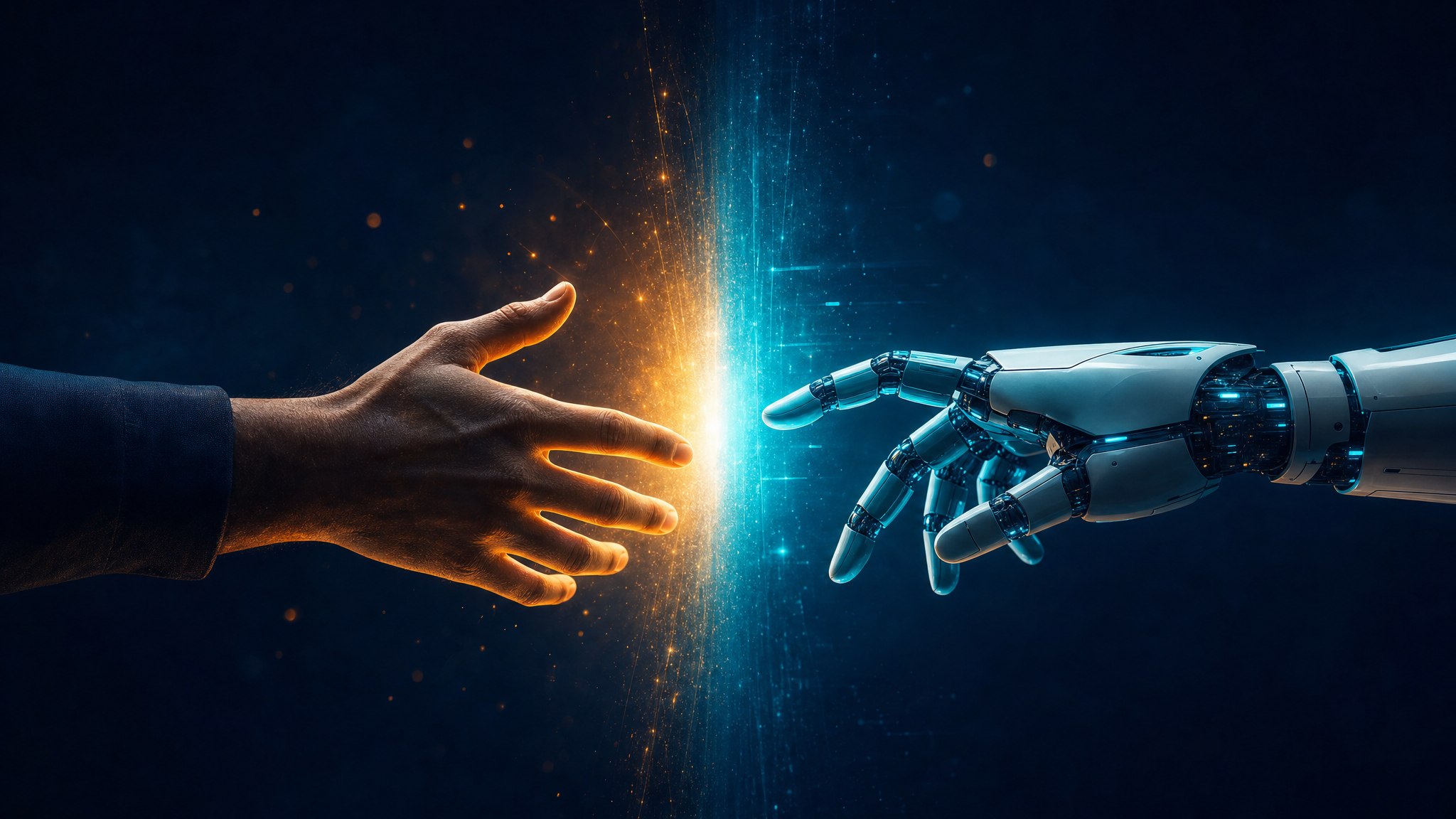
The pessimist case is stated with confidence: artificial intelligence will automate the cognitive work that gives modern life much of its meaning, leaving a vast population of economically redundant humans without purpose, structure, or dignity. The outcome, on this view, is social disintegration — a purposeless society of idle consumers sustained by universal basic income, numbed by entertainment, and stripped of the work-derived identity that has organized human existence for millennia. History has heard this prediction before, in different technological idioms. It has been wrong every time — not by accident, but by mechanism.
The Pattern That Repeats
| Transition | Labor Displaced | Where the Energy Went | Outcome |
|---|---|---|---|
| Agricultural Revolution (10,000 BCE) | ~80% of time freed from food production | Specialization, art, philosophy, religion, architecture | Civilization itself |
| Industrial Revolution (1800–1900) | 60% → 2% in agriculture | Science, education, medicine, culture, civic life | Modern world |
| Post-WWII automation | Manufacturing productivity surge | Service economy: health, education, creative work | GDP and well-being both rose |
The agricultural revolution did not eliminate human purpose. It created it at scale. When the domestication of crops and animals freed the majority of human energy from the daily requirement of food production, that energy did not dissipate into purposelessness. It flowed into specialization — into the potter, the priest, the architect, the philosopher, the soldier, the merchant. The surplus generated by agricultural productivity is the precondition for every subsequent human achievement. Without it, there is no ancient Greece, no Rome, no Renaissance, no scientific revolution.
The industrial revolution repeated the pattern at greater velocity and scale. In 1800, 60 percent of the American workforce was employed in agriculture. Today that figure is under 2 percent. Rutger Bregman’s Utopia for Realists documents what happened to the displaced labor: it did not disappear into purposeless idleness. It created the modern service economy — the hospitals, schools, universities, research institutions, cultural organizations, and civic infrastructure that define twentieth-century civilization. The freed energy flowed upward, toward more complex, more meaningful, more distinctly human work.
The Service Economy Data
The mechanism is visible in the GDP composition data. In 1800, the service sector — broadly defined as work that produces intangible value: education, healthcare, culture, finance, law, design, care — accounted for roughly 30 percent of GDP in industrializing economies. Today it accounts for 80 percent of GDP in the United States and similar percentages in all advanced economies. The manufacturing and agricultural productivity gains of the industrial era did not produce a purposeless society. They produced a society in which the majority of human labor is now organized around services — and Gallup’s well-being research consistently shows that the work people find most meaningful — teaching, healthcare, creative work, caregiving — is concentrated precisely in the service sector.
Erik Brynjolfsson and Andrew McAfee’s The Second Machine Age maps the current AI moment onto this historical pattern. The argument is not that AI will displace no workers — it will. The argument is that the displacement will follow the same pattern as prior technological transitions: the freed human energy will flow toward work that is more complex, more creative, more relational, and more inherently meaningful than the routine cognitive tasks being automated.
What AI Is Actually Targeting
McKinsey’s 2024 analysis estimates that 70 percent of routine cognitive tasks — data processing, report generation, standard legal review, basic financial analysis, template-based communication — are automatable by the end of the decade. This sounds catastrophic. The historical pattern suggests it is liberating, with the same caveat that has applied to every prior transition: the velocity of displacement and the availability of the social infrastructure for redirection determine whether the transition is managed or chaotic.
 Get the book →
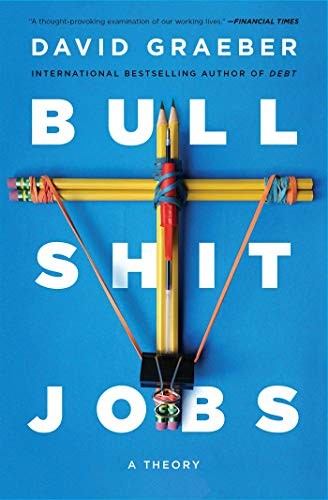
The critical insight from David Graeber’s Bullshit Jobs is that a substantial fraction of the cognitive work AI will automate is already experienced by the people doing it as meaningless. Graeber’s research found that 37 to 40 percent of workers in developed economies believed their jobs made no meaningful contribution to the world. The automation of these jobs does not eliminate purpose — it eliminates the purposelessness that was masquerading as employment.
History offers a long catalog of jobs that technology erased — and that few, in retrospect, mourned. Before the tractor, millions spent their lives bent double in fields, hand-picking vegetables and grain in brutal twelve-hour shifts with no mechanical help. Before the automobile, a significant slice of every major city’s workforce existed solely to manage horse manure: sweeping streets, hauling carcasses of animals that collapsed in public, carrying feed and water to horses stabled throughout dense urban neighborhoods. New York City in 1900 had over 100,000 horses producing an estimated 2.5 million pounds of manure daily — an entire industry of sanitation workers whose sole purpose was managing that waste. File clerks managed entire rooms of steel cabinets, cross-referencing paper records by hand — an occupation that employed hundreds of thousands before digital records made it obsolete. Telephone switchboard operators manually connected every call in the country. Human “computers” — entire rooms of people performing repetitive calculations — ran the numbers that now execute on a laptop in milliseconds. These were not lost civilizations of meaningful labor. They were the bullshit jobs of their era, performed by people who would have chosen something better if something better had existed. AI is offering the same liberation — again.
The Gallup data supports this framing: the work that people find most meaningful — direct caregiving, teaching, creative production, skilled craft, community organizing, mentorship — is, not coincidentally, the work that is least automatable. The skills that most reliably resist automation are precisely the skills most tightly correlated with human flourishing: empathy, creative synthesis, complex judgment, physical presence, relationship maintenance. AI is optimized for pattern recognition and information processing. It is not optimized for being a teacher someone remembers thirty years later, or for sitting with a patient through a difficult diagnosis, or for the kind of creative risk that produces a work of art.
The Automobile Blueprint: What Technology Actually Creates
The most instructive analogy for AI is the automobile — because it is recent enough that we can trace the economic explosion it produced in detail, and counterintuitive enough that its full scope is still underappreciated.
When the car arrived, the obvious story was displacement: horse breeders, stable hands, farriers, carriage makers, and the sanitation workers managing horse waste across every American city were put out of work. That is the story the pessimists always tell — vivid, immediate, and true as far as it goes. What they consistently miss is everything that came after.
Nobody in 1900 predicted the gas station. Nobody predicted the convenience store, the car dealership, the auto mechanic, the suburban neighborhood, the highway motel, the shopping mall, or the drive-in movie theater. Nobody predicted that the automobile would trigger the largest construction boom in American history as the interstate system was built — creating millions of jobs in concrete, steel, signage, and services along every mile. Nobody predicted that car radio would transform the music and entertainment industry, creating entirely new distribution, new stars, and new revenue streams. Nobody predicted that cities would export their populations into suburbs, spawning thousands of new towns, schools, hospitals, and commercial districts that had never existed. The automobile did not replace a horse-and-buggy economy with a car economy. It built a dozen entirely new economies that no one had imagined.
AI will do exactly the same — and we can already see the first contours. Robotic fleet technicians are emerging as a distinct profession as humanoid robots deploy at scale in factories and warehouses — people who maintain, troubleshoot, calibrate, and train physical AI systems in environments that did not exist five years ago. Drone logistics is already a credible career path: Walmart has completed over one million drone deliveries and is actively building a workforce of remote pilots, airspace coordinators, and ground operations specialists. AI diagnostics specialists are bridging clinical medicine and machine intelligence in hospitals. Prompt engineers, AI trainers, machine ethics auditors, and automation integration consultants are occupational categories that did not appear in any Bureau of Labor Statistics report before 2022. These are the gas stations of the AI economy — the first visible instances of what will become industries. The ones we cannot yet name are where the real magnitude lies. Nobody in 1900 could name “convenience store manager.” That did not make the job any less real when it arrived.
The argument that “this time is different” ignores the fact that it has always been different — and always produced the same direction of result. The public has never been able to imagine what new technology will build. They never can. That inability to imagine it is not a reason to fear the technology. It is the whole point.
The Velocity Problem
The historical transitions — agricultural to industrial, industrial to service — each took decades to centuries to play out. The agricultural revolution unfolded over millennia. The industrial revolution transformed labor markets over three to four generations. The AI transition may compress equivalent displacement into a decade. This is not an argument against the transition. It is an argument for deliberate social investment in the infrastructure that accelerates the redirection of freed human energy toward purposeful work.
The countries that navigated the industrial transition best — the Nordic economies, parts of Western Europe — were not those with the least automation. They were those with the strongest social infrastructure for transition: robust educational systems that could retrain workers rapidly, social safety nets that provided stability during displacement, and civic cultures that maintained community connection across economic disruption. The mental health infrastructure and longevity research both point in the same direction: the societies that invest in well-being infrastructure during technological transitions produce better outcomes on every measure.
What Humans Will Do
The answer history gives is consistent: when a major category of labor is removed from survival necessity, human energy flows toward meaning, creativity, and transcendence. The loom eliminated hand-weaving as a livelihood. The freed energy produced the novel, the symphony, the public museum, the research university, the voluntary hospital, and the political reform movement. The tractor eliminated farm labor as the primary human occupation. The freed energy built the internet, mapped the genome, and put a man on the moon.
When AI eliminates routine cognitive work as the primary human occupation, the freed energy will flow somewhere. The Arc — the consistent directional pattern of human progress across every technological transition in recorded history — suggests it flows upward: toward teaching more deeply, healing more attentively, creating more boldly, connecting more intentionally, and building the civic and relational infrastructure that AI, by its nature, cannot build.
The connection to the current AI labor shift is already visible: the fastest-growing occupational categories in AI-augmented economies are not AI engineers (a relatively small group). They are educators, therapists, coaches, caregivers, community organizers, and creative producers — people whose work becomes more valuable, not less, as AI handles the cognitive tasks that previously competed for their time.
The Arc
The pessimists have been wrong about automation and purpose every time. When the loom replaced the hand-weaver, humanity did not dissolve into purposelessness — it built the novel, the symphony, the public hospital, and the university. When the tractor replaced the field hand, humanity did not collapse into idleness — it built modern medicine, the research university, and the global creative economy. When AI removes the cognitive equivalent of the loom, the same pattern will hold, for the same reason: human purpose is not a finite resource exhausted by technological change. It is a generative capacity that expands into whatever space technology opens. The freed human energy will flow somewhere. The Arc suggests it flows up — toward the work that is most distinctly human, most inherently meaningful, and most irreducibly ours.
Affiliate disclosure: This article contains affiliate links. Bold Arc may earn a small commission at no cost to you.