
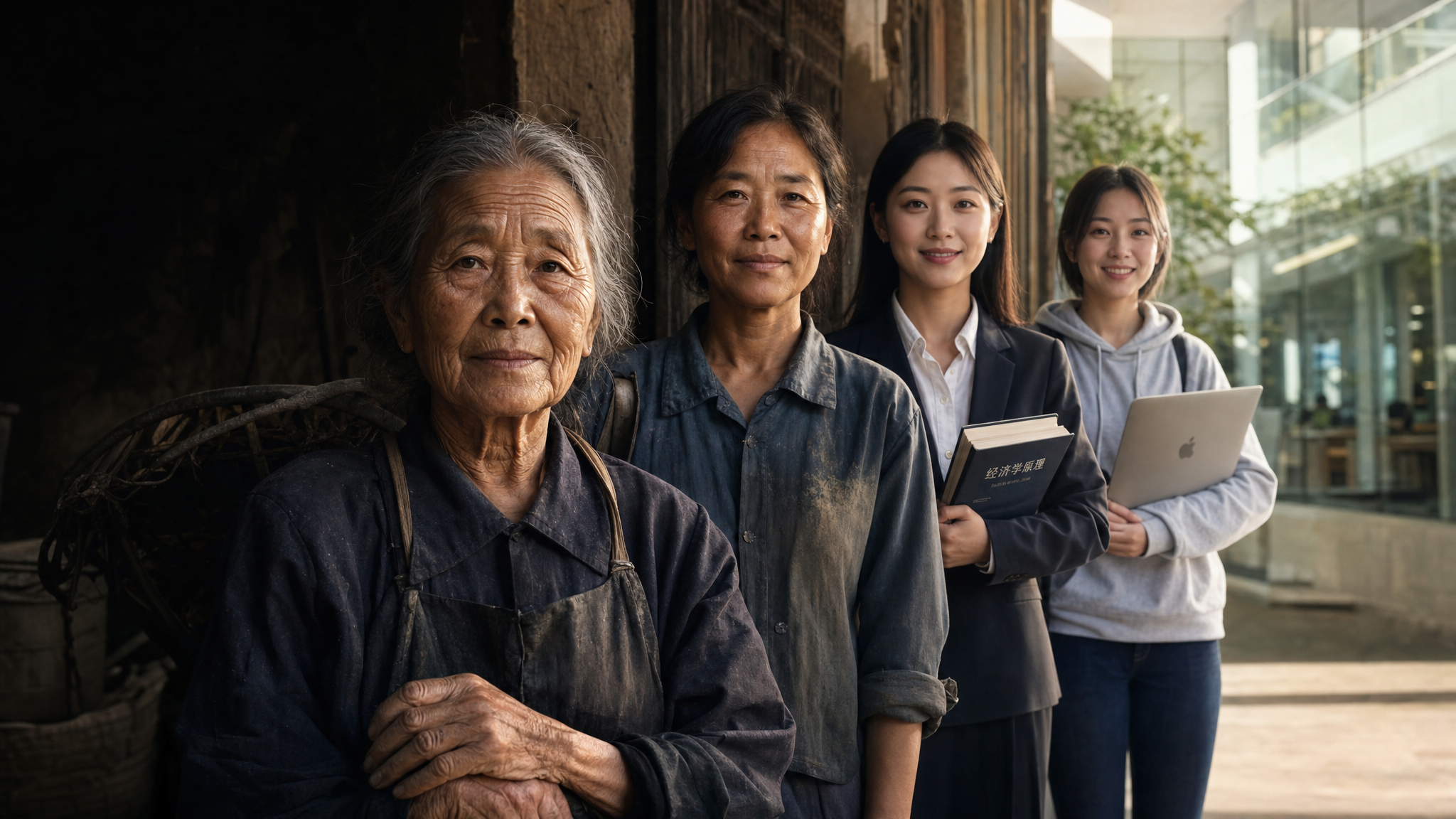
She cannot read. That is the first fact you need to know about her.
Her name is Park Soon-yi. She is 34 years old and she lives in a village in South Gyeongsang Province, South Korea. The year is 1952. The Korean War is still being fought to the north. Her husband works the fields when there is no fighting nearby. She raises three children and tends a small kitchen garden. Every decision she makes — where to plant, what to trade at market, when to move the children — is organized around one question: will there be enough to eat?
Park Soon-yi is not making economic decisions in the way a textbook would describe. She is not optimizing utility. She is not responding to price signals. She is following a rule far older and more reliable than any economic model: do what is most important for you and your family, right now. Food. Warmth. Survival. Everything else — education, opportunity, savings, the future — is noise she cannot afford to hear yet.
This is The Grandmother’s Principle. It is not a theory. It is an observation about human behavior that holds across every culture, every era, and every level of development ever documented. It is what every grandmother everywhere has always done. And it turns out to be the most accurate predictor of how people, families, and entire nations develop over time — more accurate than any economic model, any GDP forecast, or any policy program built without it.
The Hierarchy Nobody Teaches
In 1943, Abraham Maslow published a paper called “A Theory of Human Motivation.” His central claim: human beings pursue needs in a predictable hierarchy. Survival first. Safety second. Health and connection after that. Knowledge and freedom higher still. At the apex — what Maslow called self-actualization — the full expression of human potential. The arc of a human life, he was saying, always bends upward. Always toward more.
The hierarchy is not a theory about what people should value. It is an observation about what they actually pursue, in what order, under real conditions. You do not move to the next tier until the one below is reasonably secured. You cannot pursue education when you are hungry. You cannot build institutions when you are afraid. You cannot seek meaning when you have no shelter. The ascent is real. The sequence is not optional.
What no economics course teaches — and what the data makes undeniably clear — is that this same ascent governs nations. Countries do not develop randomly. They rise in sequence, driven by the same engine that drives individuals: the Grandmother’s Principle, applied at scale. Each family’s upward climb, aggregated across millions of families across decades, is what national development actually looks like. The arc of progress is not a macro-economic phenomenon. It is the sum of billions of grandmothers doing what matters most.
Four Generations of the Same Family
Return to Park Soon-yi. Follow her family forward through time. The data is real — this is the story of millions of Korean families compressed into one.
“Four generations. Same family. Completely different human needs — and therefore completely different economic behaviors, decisions, and contributions to the world. South Korea’s miracle is not a policy story. It is the aggregate of millions of families making exactly this climb.”
Why the Arc Cannot Be Forced — Only Followed
The dominant theory of inequality in most policy circles is essentially this: the gap between rich and poor is primarily a resource problem. Give poor schools more money. Redistribute income. Fund programs. Close the gap through transfer.
The Maslow framework says this theory of change is operating on the wrong model. Inequality is not primarily a resource problem. It is a sequencing problem. And sequencing cannot be compressed by money alone.
The teacher problem
You can double a school’s budget tomorrow. You cannot double its supply of excellent, experienced teachers. Teacher quality is the single most powerful predictor of student outcomes — and a deep teacher workforce is itself a product of generational investment. You need educated adults to educate children. You need educated parents at home to reinforce what school teaches. You need stable neighborhoods that make consistent attendance possible. None of these can be purchased in a budget cycle.
The parental literacy problem
The most consistent finding in educational research is that parental education — not school funding — is the primary predictor of a child’s academic outcomes. Children of literate, educated parents arrive at school with thousands more hours of language exposure, a relationship with books, a belief that knowledge is accessible to them. No per-pupil spending figure compensates for that difference. Each generation of education investment compounds into the next — or the deficit compounds instead.
This is not an argument that school quality doesn’t matter. It does. It is an argument that school quality is a Tier 4 solution. Before it can work fully, the lower tiers — food security, physical safety, stable housing — must be substantially solved. A child who is food insecure, afraid, or sleeping in a different home each week cannot optimize for Tier 4 regardless of what her school spends per pupil.
The stability prerequisite
The physiological and safety tiers are prerequisites for the education tier to function — not because this is morally convenient, but because it is how human neurology works under stress. Chronic poverty, neighborhood violence, food insecurity, and housing instability all activate the brain’s threat-response systems in ways that directly impair the cognitive functions — working memory, executive function, delayed gratification — that academic learning requires. You cannot policy your way around neurology. You have to solve the prior tier.
“Redistribution can move resources. It cannot move a generation. The clock of human development runs at its own speed, and no transfer payment has ever found a way to make it run faster.”
The Countries That Climbed — and What They Did
The fastest human development stories in history are instructive precisely because they succeeded. They succeeded by following the sequence — not by skipping it.
The pattern is uniform. No successful developer skipped the sequence. None redistributed their way to the top. Every fast climber solved the lower tiers through commerce — through market integration that generated the surplus and stability that made upper-tier investment possible — and then invested that surplus systematically in the next tier.
What Actually Moves the Arc
This is the point that most development literature avoids saying plainly: markets are the fastest mechanism ever found for moving the physiological tier. Not aid. Not redistribution. Trade and commerce.
Eight hundred million people escaped extreme poverty between 1990 and 2020 — the most rapid reduction in human deprivation in recorded history. The driver was not a development program. It was the integration of China, India, Vietnam, and Indonesia into global trade. Factories needed workers. Workers needed to be paid. Paid workers could afford food. Families with food could think about safety. The sequence ran — driven by market demand, not government transfer.
This is not an ideological claim. It is what the data shows happened. Aid programs that attempted to build the education tier in food-insecure countries largely failed — not because aid is wrong, but because the sequence was wrong. Trade integration that first solved the physiological tier and created stable income flows succeeded. The mechanism that moves the base of the arc fastest is the one that creates the economic activity families use to climb. You cannot pull the arc from the top. You have to build from the bottom.
The Optimistic Conclusion
Nothing in this article is a reason for pessimism. It is a reason for the right kind of patience — and the right theory of change.
Park Soon-yi’s great-granddaughter runs a company. That journey took 70 years and four generations. It is considered one of the great development stories in human history. The arc bent upward — relentlessly, generation by generation, tier by tier — because the sequence was followed.
The families that are in Tier 1 today — hungry, without shelter, without safety — will climb. Their children will be in Tier 2. Their grandchildren in Tier 3. Their great-grandchildren, if the sequence is followed and the lower tiers are genuinely solved, will be pursuing knowledge, connection, purpose. This has happened before. It is happening now. It will happen again.
What it will not do is happen faster than the human generational clock allows. That clock cannot be overridden by a transfer payment or a policy program operating on a four-year political cycle. It runs at its own speed. The Grandmother’s Principle does not yield to impatience.
The correct response is not despair. It is accuracy. Build the right theory of change. Meet people where they actually are on the hierarchy. Solve the tier in front of them — not the tier you wish they were on. And trust that once the base is genuinely secured, the arc bends upward on its own. It always has.
Park Soon-yi did not know she was climbing a pyramid. She did not know she was part of a national development story or an economic miracle. She was doing what was most important for her family. Four generations later, the arc has risen from subsistence farming to a technology company. The Grandmother’s Principle ran the whole time. The tier changed. The rule never did.
The arc of progress always rises. Not because history is generous, or economics is efficient, or governments are wise. Because grandmothers always do what matters most — and their children do the same, one tier higher.
The argument in this article rests on a foundation built by three economists and one psychologist across eighty years: Ludwig von Mises’s praxeology, Maslow’s hierarchy, Amartya Sen’s capabilities approach, and Manfred Max-Neef’s human-scale development. A deeper piece explores how their work connects — and what the synthesis reveals about why nations develop the way they do and what policy follows.
Read: The Economic Ascent Principle → Coming soon