
In 1990, 12.5 million children under the age of five died every year. That number is so large it resists comprehension. Thirty-four thousand children per day. One every three seconds. Death from pneumonia. From diarrhea. From malaria. From diseases that had been preventable for decades in rich countries and were killing children in poor ones at industrial scale.
In 2022, that number was 4.9 million.
A reduction of more than 60%. An additional 20,800 children surviving every single day who would have died under 1990 conditions. The numbers are not approximate. They are documented. They are verified. They are the most dramatic improvement in child survival in recorded human history.
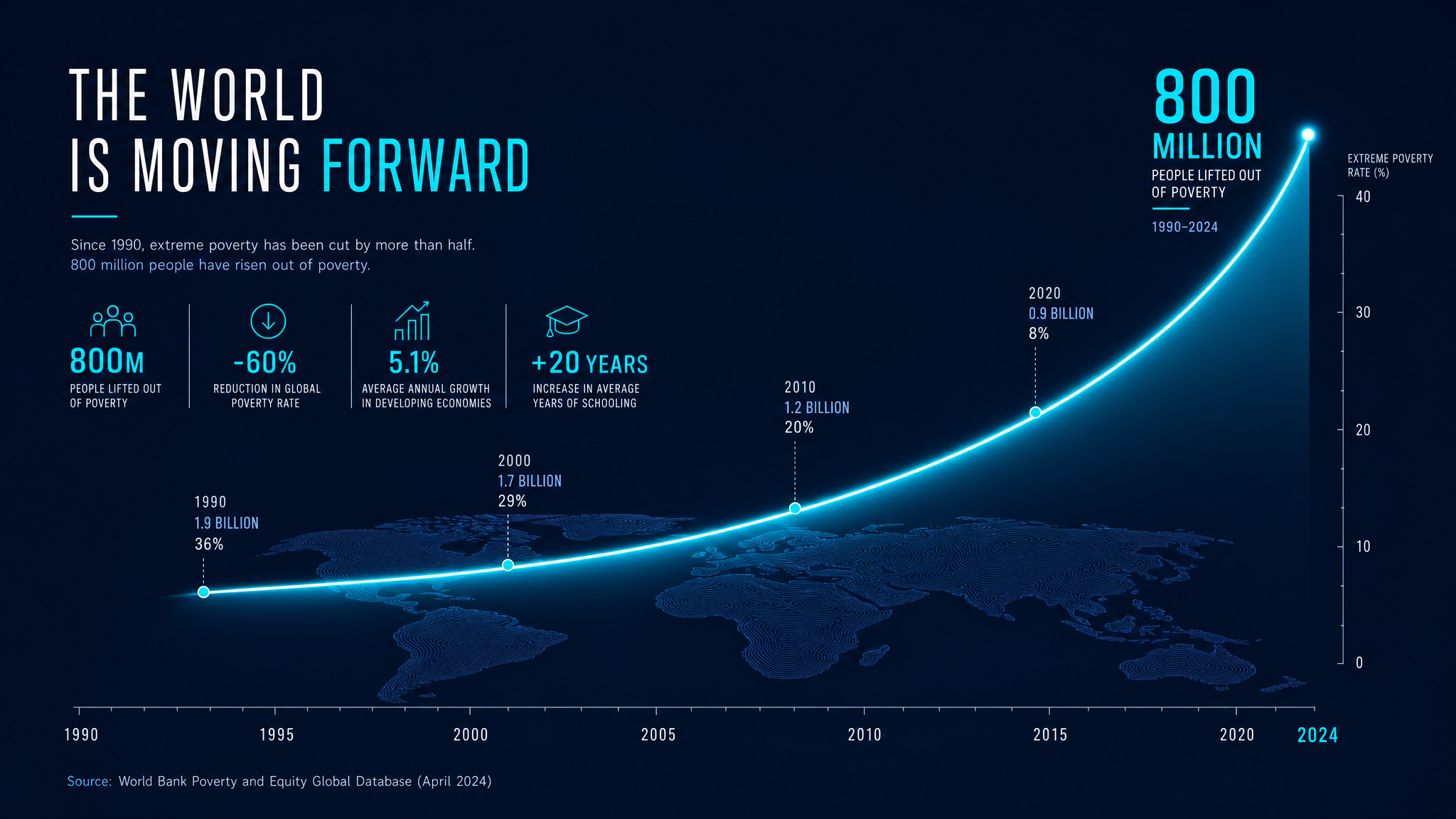
And it happened so quietly that a 2019 YouGov poll found that over 80% of people in ten surveyed countries believed the proportion of the world living in extreme poverty had either stayed the same or increased since 1990. Child mortality — even more dramatically improved — is virtually unknown as a success story. The greatest humanitarian achievement of the modern era is happening in silence.
Bold Arc will not let it stay there.
The Scale of What Changed
The numbers are worth sitting with. 7.6 million additional children survive each year that would not have survived under 1990 conditions. That’s more than the entire population of Switzerland — saved, not statistically, but in actual children who are alive and growing up. Every year.
The disease-by-disease picture is equally striking. Pneumonia — historically the single largest killer of young children — has seen a 70% reduction in under-five deaths since 2000. Diarrheal disease deaths fell by 60% over the same period. Malaria deaths in children under five dropped from roughly 600,000 per year in 2000 to under 450,000 in 2022 — a reduction achieved despite population growth of more than three times in the most affected regions of sub-Saharan Africa.
The neonatal picture is also improving. Newborn deaths — long considered the hardest to address — have fallen by 52% since 1990. Simple interventions: kangaroo mother care, clean birth practices, postnatal monitoring. Applied at scale. They work.
The Mechanism: What Actually Worked
Credit for this achievement has been assigned to many parties. Most of the assignments are wrong. The mechanism deserves precision.
Vaccination is the most unambiguous driver. The Gavi vaccine alliance, founded in 2000, helped deliver vaccines to over 1 billion children in lower-income countries over two decades, preventing an estimated 17.3 million deaths by its own reckoning — and this estimate is considered conservative by independent reviewers. Measles vaccination alone prevented an estimated 31 million deaths between 2000 and 2020. Oral rehydration therapy (ORT) — a solution of salt and sugar in clean water — reduced diarrheal disease deaths by orders of magnitude at negligible cost. Insecticide-treated bed nets became a mass-market commodity and drove malaria deaths down even as the affected population grew.
But the countries with the most dramatic improvements were not the ones receiving the most foreign aid. They were the ones with the fastest economic growth.
Rwanda cut child mortality by 75% in 20 years — one of the fastest sustained improvements ever recorded. It did so through a combination of market-oriented health system reforms, decentralized community health workers paid to deliver basic services, high vaccination coverage, and economic growth that lifted household incomes enough to afford better nutrition and clean water access. The Rwandan model is studied at Harvard and the London School of Hygiene and Tropical Medicine as a template — not because of what aid organizations did, but because of what a functioning government and growing economy enabled.
Bangladesh similarly defied predictions. Its child mortality rate fell from 144 per 1,000 live births in 1990 to under 29 today — in a country that remains one of the most densely populated and flood-prone on earth. The mechanism: economic growth, female education, microfinance expansion, and NGO-delivered health services that operated more like businesses than charities.
Ghana. Ethiopia. Vietnam. Each story follows the same pattern. Where markets opened, economies grew, and governments invested efficiently in basic health infrastructure — child mortality fell fastest.