
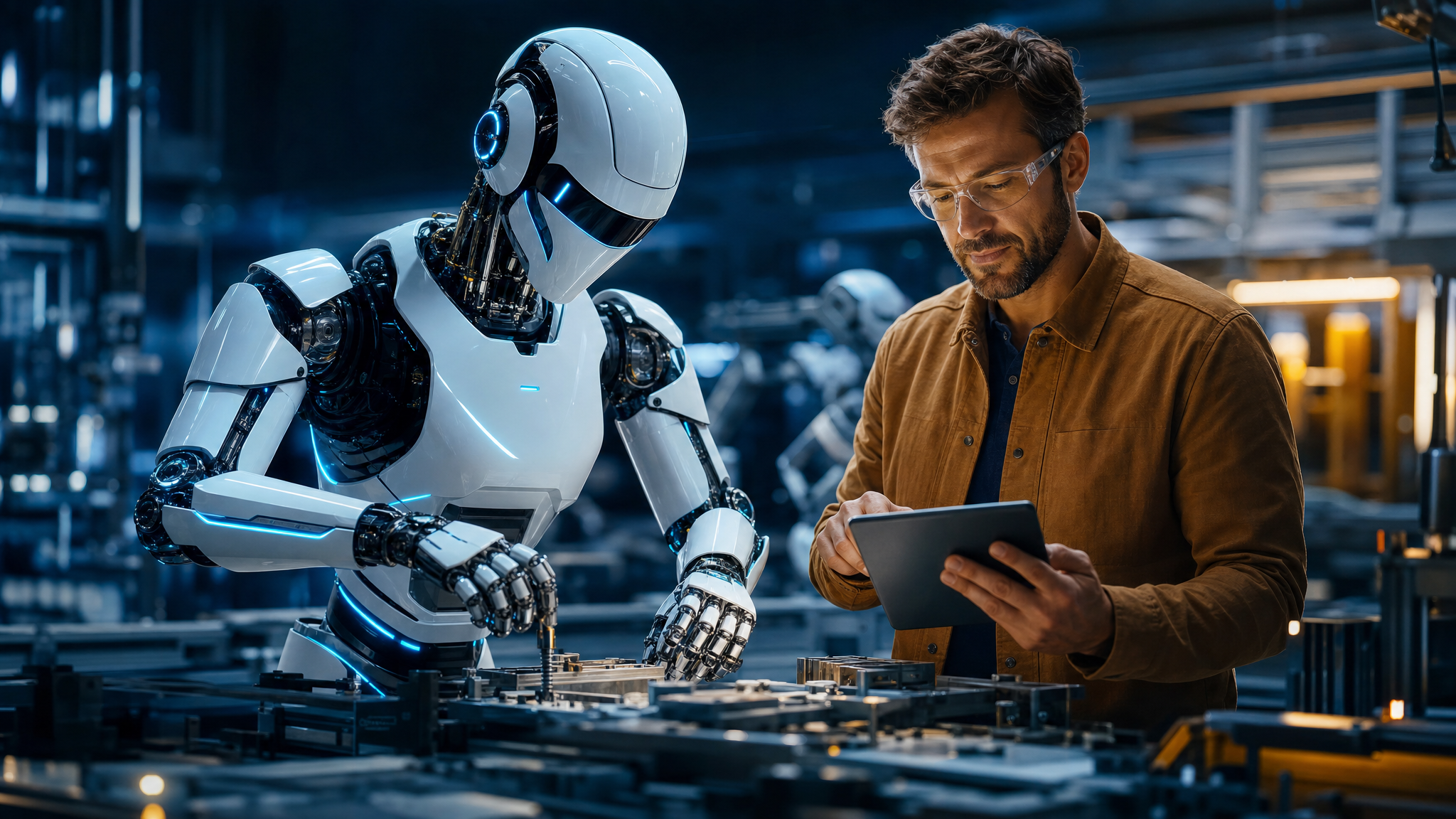
In 2024, a humanoid robot showed up for work at a BMW factory in Spartanburg, South Carolina. Not a concept. Not a demo. A commercially deployed unit from Figure AI — a bipedal machine about the size of a person — performing repetitive assembly tasks alongside human workers on an active production line. It was the first commercial humanoid deployment in the automotive industry.
The headlines missed the significance. Most framed it as a curiosity. A few ran the obligatory “robots are coming for our jobs” piece. Almost none asked the harder question: what does it mean when machines that can see, reason, and move through unstructured physical space become commercially viable? And what does history tell us about what actually happens next?
The answers are surprising — and more optimistic than the coverage suggests.
The Factory Floor Has a New Colleague
The BMW deployment was not an isolated experiment. It is one data point in a deployment curve that accelerated dramatically in 2024 and 2025.
Tesla’s Optimus program has surpassed 1,000 units operating inside Tesla’s own factories as of late 2024. Elon Musk has set a production target of one million Optimus units per year by 2027 — a figure that drew skepticism when first stated and somewhat less skepticism now. Boston Dynamics’ Atlas robot, once famous for its dramatic falls in early demos, is now fully electric, fully commercial, and actively being deployed by Hyundai in manufacturing settings. Agility Robotics’ Digit robot is running inside Amazon fulfillment centers. Apptronik has active commercial partnerships with NASA and GXO Logistics. 1X Technologies, backed by OpenAI, has units deployed in security and light industrial settings.
These are not the shaky, falling-over robots of YouTube compilation videos from five years ago. The hardware has converged. The software — particularly the vision and reasoning capabilities — has caught up to the hardware. The combination of improvements in dexterity, battery life, sensor fusion, and large language model reasoning has produced machines that can handle tasks that were considered well beyond robotic capability as recently as 2022.
The threshold that matters is not “can a robot do this task in a lab.” It is “can a robot do this task reliably enough, at low enough cost, to justify deployment in a real facility.” That threshold is being crossed, across multiple companies, in 2024–2025. The factory floor has a new colleague. And unlike most technological transitions, this one is happening in full public view.
What “Physical AI” Actually Means
The phrase “physical AI” refers to something more specific than industrial robots — a category that has existed since the 1960s. Traditional industrial robots are powerful but brittle: they perform one predetermined sequence of movements, in one precisely calibrated environment, with no ability to adapt to variation. Move a bolt two inches to the left and the robot arm misses. Add a new component to the line and the entire system requires reprogramming.
Physical AI is different in kind. It refers to robotic systems that integrate three capabilities that have historically been separate: vision (the ability to perceive and interpret an unstructured environment), reasoning (the ability to make decisions based on what is perceived), and dexterity (the mechanical ability to manipulate objects with fine motor control). The convergence of these three capabilities — enabled by advances in computer vision, transformer models, and actuator design — is what makes physical AI categorically different from the industrial robots that have been on factory floors for fifty years.
The practical implication is reach. Traditional industrial robots work only in environments designed around them. Physical AI robots can, in principle, work in environments designed around humans — homes, hospitals, construction sites, warehouses, retail floors. The market for environments that can accommodate traditional industrial robots is finite and largely already served. The market for environments that require human-like physical intelligence is vast and almost entirely unserved by existing technology.
This is why the investment figures are striking. Goldman Sachs’ 2024 analysis projects the physical AI market reaching $38 billion by 2035, with humanoid robots alone representing a $6 billion segment. DARPA has committed more than $100 million to physical AI programs. The strategic importance is not lost on governments or capital allocators.
The Jobs It Will Take — And Won’t
The honest assessment requires separating two questions: which jobs will physical AI actually displace first, and which jobs does the public fear it will displace? These are not the same list.
The jobs physical AI will displace first share a specific profile: repetitive, physically demanding, highly predictable in their environment. Warehouse order picking and inventory counting. Agricultural harvesting of uniform crops. Construction assembly of standardized components. Quality inspection in manufacturing. These are jobs where the task, while physical, is highly structured — the variation is bounded and manageable. Agility’s Digit units at Amazon are doing exactly this: tote-moving and bin-retrieval tasks that are physically demanding but follow predictable patterns.
The jobs that dominate the public fear narrative — the creative, the relational, the complex and adaptive — are largely not at risk from physical AI, at least not in the near term. A physical robot cannot navigate the social complexity of a hospital room, manage the contextual judgment of a police incident, or adapt to the infinite variation of a custom home renovation. The physical world, outside controlled environments, is deeply unstructured. That remains the hardest frontier.
The jobs that physical AI will create are genuine and net-new: robot maintenance technicians, remote supervisors, deployment engineers, training data specialists, safety auditors, and the entire ecosystem of companies that build, service, and insure physical AI fleets. These roles require skills that are teachable — they are not exclusively reserved for people with four-year degrees. And they tend to pay better than the repetitive physical labor they replace.
The structural picture: physical AI will automate a layer of physically demanding, repetitive work. It will create a layer of technically skilled maintenance and supervision work. And it will expand the overall economic pie in ways that generate demand for human labor in sectors adjacent to the automation — the same pattern that has played out in every prior wave of automation.
The ATM Lesson: Why Automation Creates More Than It Destroys
The ATM was introduced in the United States in the early 1970s. The standard prediction was immediate: bank teller jobs would disappear. The machines could dispense cash. Why would banks pay humans to do the same thing?
What actually happened is one of the most cited and least absorbed lessons in labor economics. ATMs reduced the cost per bank branch. Lower branch costs made it economical to open more branches in more locations. More branches required more tellers. From 1970 to 2010, as ATM deployment grew from zero to 400,000 units, the number of bank tellers in the United States increased. The automation that was supposed to eliminate the job instead changed it — tellers shifted from cash-handling to customer relationship management — and expanded the total employment in the sector.
The ATM story is not exceptional. It is the pattern. The mechanization of agriculture in the 19th and early 20th centuries freed labor for manufacturing. The automation of manufacturing in the late 20th century freed labor for services. In each case, the catastrophist prediction — that automation would create permanent mass unemployment — failed to account for the expansion of economic activity that lower costs and higher productivity enable.
The Bureau of Labor Statistics data on manufacturing is instructive. Between 1990 and 2010, US manufacturing employment fell by approximately five million jobs, largely due to automation and offshoring. Over the same period, US GDP per manufacturing worker roughly doubled. The productivity gains generated by automation created wealth that flowed into consumption, which created jobs elsewhere. The jobs lost in manufacturing were real and the displacement was painful for affected communities — that cost should not be minimized. But the catastrophist prediction of permanent net job destruction was wrong then, and the evidence does not support it now.
“Every prior wave of automation was supposed to end human work. Every time, it changed the nature of work instead — and expanded the total amount of it.”
The Labor Shortage Physical AI Will Solve
Here is the context that the automation-fear narrative consistently omits: the United States currently has more than 8 million unfilled job openings. Not hypothetical future jobs — open positions, right now, that employers cannot fill. Japan faces a structural labor deficit so severe that the country has been running immigration programs and productivity campaigns for decades without closing the gap. Germany’s demographic cliff — an aging population, low birth rate, and historically restrictive immigration — has created labor shortages in manufacturing and logistics that threaten its industrial base.
Physical AI is not arriving into a labor market with surplus workers waiting to be displaced. It is arriving into a labor market with structural deficits in exactly the physically demanding, repetitive roles that robots are best positioned to fill. The shortage in warehouse workers, agricultural laborers, and manufacturing line operators is not a temporary fluctuation. It is a demographic trend. The working-age population in developed economies is shrinking relative to the total population. The work still needs to be done.
This changes the frame entirely. The question is not “will robots take jobs that humans need?” The question is “will robots fill roles that humans increasingly cannot or will not take?” In warehouses running three shifts in high-heat environments. In agricultural fields requiring 12-hour days of repetitive harvesting. In construction sites demanding physically demanding labor in dangerous conditions. These are not jobs with long lines of applicants. They are jobs with chronic unfilled positions.
Amazon’s experience is instructive. The company has deployed more than 750,000 robots across its global fulfillment network — and its human workforce has grown alongside the robot deployment. The robots handle the repetitive, physically demanding tote-movement and bin-retrieval tasks. The humans handle the complex, variable, judgment-intensive tasks that robots cannot yet reliably perform. The result is higher throughput, faster delivery, and — crucially — a safer working environment for the human workers who remain.

