
In March 2021, a single container ship got stuck sideways in the Suez Canal for six days. That was all it took. Four hundred ships backed up. Roughly $9.6 billion in trade halted every day. Insurance markets moved. Commodity prices spiked. Supply chains from Europe to Asia unraveled — because the entire system ran through one ditch, and one ship blocked it.
The Suez incident was a tutorial, not an anomaly. The same structural fragility runs through every major system civilization depends on: energy, water, internet, food, and the raw materials that make modern technology possible. In each case, the system was built for efficiency — centralized routing, concentrated processing, a single critical path. And in each case, that efficiency created a vulnerability that any disruption — accident, weather, geopolitical conflict, or deliberate attack — can exploit.
The Strait of Hormuz is not a bug. The undersea cables that carry the internet are not a mistake. The Chinese rare earth processing complex did not happen by accident. They are the predictable outcomes of building systems optimized for cost and speed, not resilience. You build the cheapest route. The cheapest route tends to be the narrowest one.
That narrowness is now being priced. And every chokepoint in the world is simultaneously a business opportunity for someone with a better route.
What a Chokepoint Actually Is
A chokepoint is any node in a system where traffic concentrates to the point that disrupting it disrupts everything downstream. The definition applies whether the system moves oil, data, water, minerals, or food.
The pattern that creates chokepoints is always the same. A resource exists somewhere. The most efficient path to move it passes through a particular geography, facility, or single producer. Over time, the whole system routes through that path because it is cheaper. Infrastructure, contracts, and industries grow up around it. The path becomes load-bearing. And then the path becomes a pressure point — for nature, for hostile actors, and for markets.
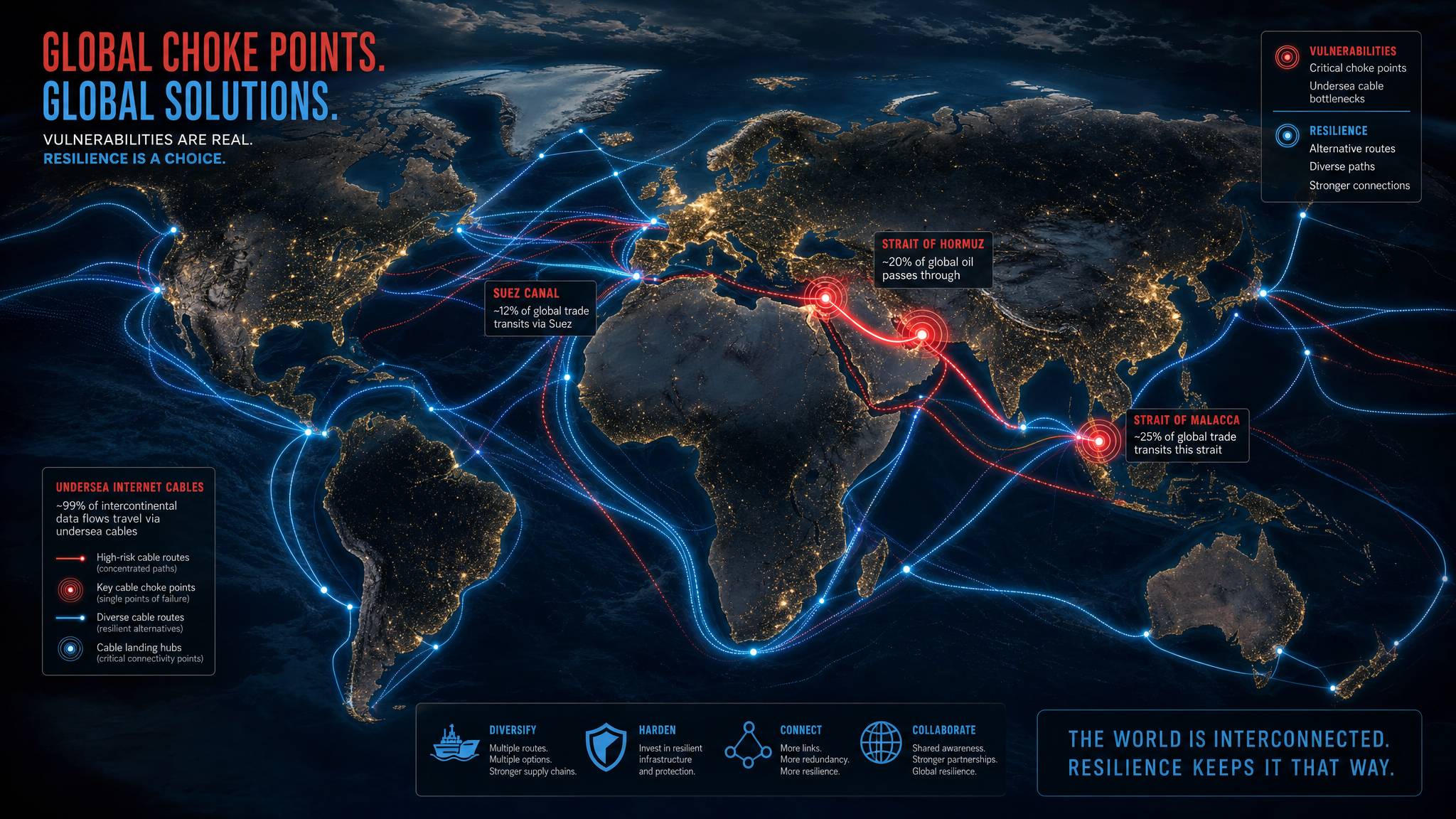
Here is the global chokepoint map today:
| Chokepoint | What it controls | What breaks if it closes | Risk level |
|---|---|---|---|
| Strait of Hormuz | 21% of global oil supply (~21M barrels/day); 20% of global LNG | Energy prices globally; Asian manufacturing; European heating | Critical |
| Suez Canal / Red Sea | 12% of global trade; 30% of container shipping | European-Asian supply chains; food imports to North Africa and Middle East | Critical |
| Strait of Malacca | 80% of China’s oil imports; major Asia trade route | Chinese manufacturing; Southeast Asian economies | Critical |
| Chinese rare earth refining | 85% of global rare earth processing; 60% of mining | EV production; wind turbines; semiconductors; defense systems | Critical |
| Taiwan semiconductor fabs | ~90% of world’s most advanced chips (TSMC) | Every device with a processor: phones, cars, aircraft, medical equipment | Critical |
| Undersea internet cables | 97% of global internet traffic; 10 Tbps+ through key cables | Financial transactions; cloud services; communications across continents | High |
| Colorado River | Water for 40 million Americans and 5.5 million acres of farmland | Agriculture in the American Southwest; water supply for Phoenix, Las Vegas, Los Angeles | High |
| Ukraine / Black Sea grain corridor | 12% of global wheat; 40%+ of sunflower oil | Food prices across Africa, Middle East, and South Asia | High |
The table above is not a list of unlikely scenarios. Every one of these chokepoints has been disrupted within the last five years. The Suez Canal blocked. Houthi attacks on Red Sea shipping rerouting 15% of global container traffic around the Cape of Good Hope — adding 10–14 days and 30% shipping cost to every Europe-Asia voyage. China cutting off rare earth exports to Japan during a territorial dispute. Russian gas to Europe severed. The Colorado River over-allocated for decades, now running 20% below what downstream users have legal rights to draw.
These are not edge cases. They are the operating reality of a world that built for efficiency and is now paying for fragility.
Why Chokepoints Form — A Maslow Problem
The chokepoint map above looks like a list of failures. It is not. Every one of those chokepoints was built on purpose, by rational actors making rational decisions. To understand why they exist — and why solving them follows such a predictable pattern — you need Abraham Maslow.
Bold Arc’s Economic Ascent Principle, developed by Edward Kopko, applies Maslow’s hierarchy of human needs to economies as a whole. The insight: economies don’t develop randomly. They ascend a hierarchy in sequence, driven by the same unmet-need-to-pursuit engine that drives individual human psychology. And at each stage, what an economy builds — and how it builds — reflects exactly where it sits on that hierarchy.
The pattern this produces is consistent across every domain. A country’s food system starts with a single import route — any wheat is better than no wheat. As the economy ascends to the Safety level, it starts caring about where else wheat can come from. It builds domestic agriculture. It signs supply agreements with multiple exporters. It invests in food storage and drought-resistant crops. Eventually, at the highest stages, it develops precision agriculture and vertical farming that remove geographic dependency entirely.
The same pattern runs through energy, internet, water, and materials. The physiological stage builds the chokepoint. The safety stage recognizes it. The higher stages dissolve it.
“Chokepoints aren’t a failure of planning. They’re what physiological-stage infrastructure looks like. Diversification is what Safety-stage economies do next — always.”
This is why the most dangerous chokepoints in the world right now are the ones that developed economies built during their own physiological stage — and left in place because the efficiency was too good to replace. Hormuz. The rare earth processing complex. The undersea cable routes. They were rational at the time. They are vulnerability now. And the transition from chokepoint to resilient system is not a policy choice — it is the next natural stage of the Economic Ascent. It happens because the need to solve it exists, and markets respond to unmet needs.
Energy: The Strait That Decides Everything
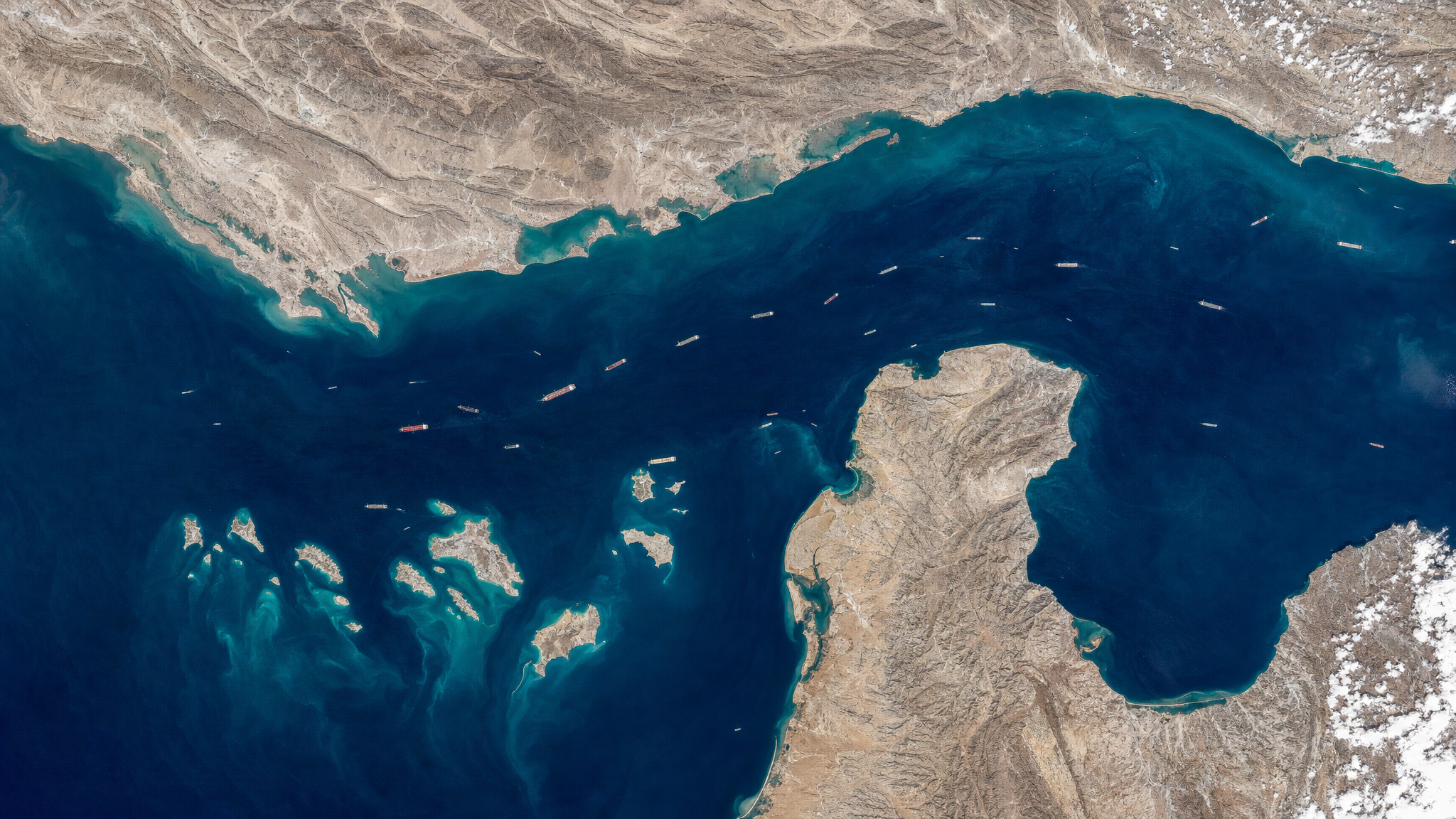
The Strait of Hormuz is 21 miles wide at its narrowest point. Through it passes roughly 21 million barrels of oil per day — one-fifth of global supply. Also 20% of the world’s liquefied natural gas. There is exactly one sea passage out of the Persian Gulf, and it runs between Iran to the north and Oman to the south.
Iran has threatened to close Hormuz so many times that the threat has become background noise. It is not background noise. Saudi Arabia, the UAE, Iraq, Kuwait, and Qatar — five of the world’s largest oil producers — have no alternative export route that can absorb that volume. The pipelines that bypass Hormuz (the East-West Pipeline in Saudi Arabia, the UAE’s Habshan-Fujairah line) carry perhaps 20% of current Hormuz throughput. The remaining 80% has nowhere else to go.
What does it actually mean if Hormuz closes? Oil prices would spike to levels not seen in the modern era — estimates range from $150 to $300+ per barrel, depending on duration. Jet fuel, diesel, plastics, fertilizer — all priced to oil — would follow. Asian manufacturing would seize. European heating costs would become politically destabilizing. A closure lasting more than 60 days would be a global recession trigger, not a market correction.
The solution the market is building: renewable energy diversification. Not as an environmental preference — as geopolitical insurance. Every solar panel installed, every battery storage system deployed, every nuclear plant kept running is one less barrel of oil that has to pass through Hormuz. This is why the IEA’s headline finding — that peak oil demand is approaching — matters beyond climate: it means Hormuz’s leverage over the global economy is declining, slowly but measurably, as the energy system diversifies its sources.
Internet: The Cables Nobody Talks About
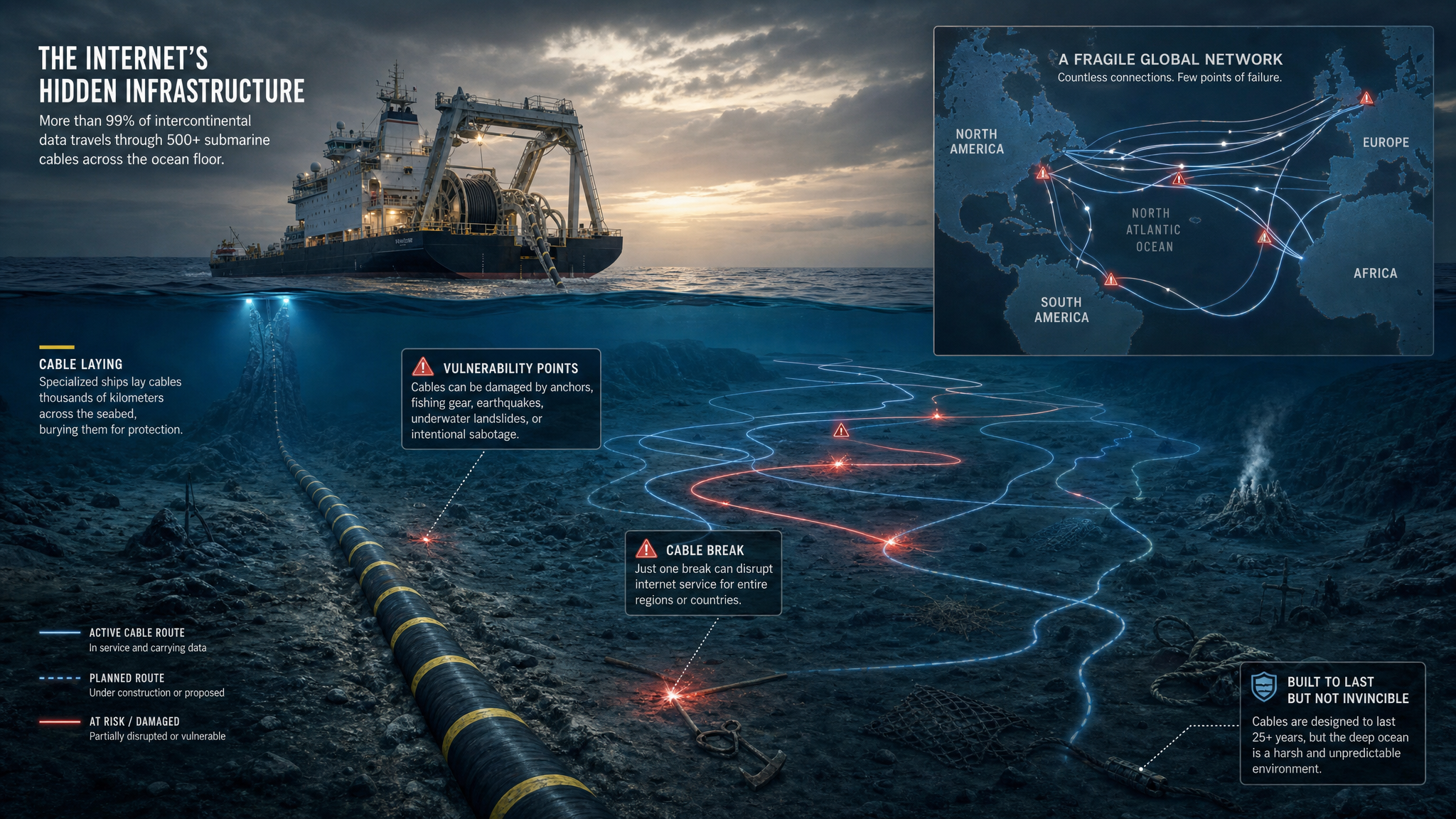
The internet is described as a distributed network — designed to route around damage. That description is accurate for the software layer and mostly false for the physical one.
Roughly 400 undersea cables carry 97% of all international internet traffic. They are remarkably thin — about the diameter of a garden hose in deep water — and they run along the same seabed routes that shipping lanes have used for centuries. They get cut by fishing trawlers. They get dragged by ship anchors. They get damaged by earthquakes. And increasingly, they get cut deliberately.
In November 2024, two undersea cables in the Baltic Sea — connecting Finland to Germany and Sweden to Lithuania — were severed within days of each other. Both incidents coincided with ships from the Chinese-flagged Newnew Polar Bear container vessel dragging anchor across the cables’ mapped paths. In 2024, Houthi operations in the Red Sea damaged four major cables serving the Europe-to-Asia route simultaneously, forcing rerouting through backup cables that significantly degraded service and capacity across the corridor.
The business opportunity is exactly what Starlink represents: connectivity that doesn’t need the ocean floor. Low Earth orbit satellite internet is not a cable alternative for price-sensitive consumers — it is a cable bypass for anyone who needs connectivity that cannot be cut with an anchor. Starlink’s V3 constellation, delivering 1 Gbps from orbit at under 20ms latency, is the first technology that can serve as a genuine infrastructure substitute for undersea cable in high-demand environments.
“The internet feels like a cloud. It runs through cables on the ocean floor. And those cables can be cut.”
Every enterprise, government, and military network that adds Starlink (or Amazon’s Project Kuiper) as a backup layer is reducing its exposure to undersea cable vulnerability. This is not a niche application. It is the same logic that drove the adoption of backup power generators — once optional, now standard in any facility where downtime is unacceptable.
Rare Earths: The Chokepoint Inside Your Phone
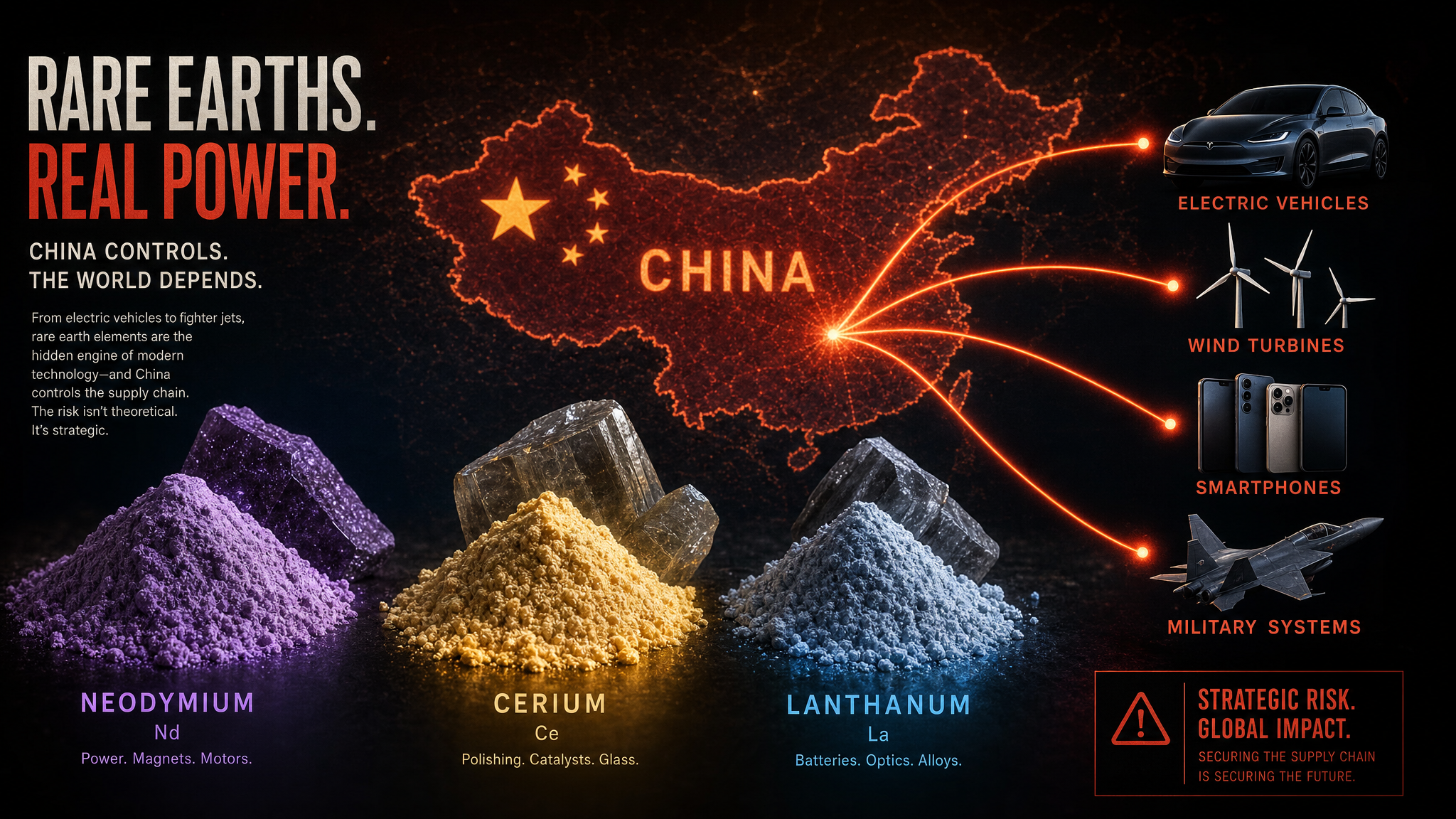
Rare earth elements are not, despite the name, particularly rare. They exist in meaningful quantities in Australia, Brazil, the United States, and across Africa. The problem is not the mining — it is the processing. Separating, refining, and converting raw rare earth ore into usable oxides and metals is chemically complex, environmentally messy, and capital-intensive. For three decades, China was willing to do that work cheaply. The rest of the world was happy to let them.
The result: China now controls approximately 85% of global rare earth refining capacity. Sixty percent of mining. And 90%+ of the permanent magnet manufacturing that takes refined rare earths and turns them into the motors in every electric vehicle, the generators in every wind turbine, the actuators in every precision-guided missile, and the speakers in every smartphone.
The chokepoint is not theoretical. China has already used it. The question is not whether rare earth supply concentration is a vulnerability — it demonstrably is. The question is how fast the market can build alternatives, and whether the speed of diversification outruns the next use of the leverage.
“China cut rare earth exports to Japan in 2010. In 2025 it did it again, broader. The world got the warning twice. The market is finally listening.”
Water: The Chokepoints That Are Already Here
Water chokepoints are different from the others: they are slower-moving, less visible, and their consequences are already being felt. The disruption is not a future event — it is the present condition for hundreds of millions of people.
The Colorado River has been over-allocated for 100 years. The seven US states with water rights to the river have legal claims totaling 17.5 million acre-feet per year. The river now delivers an average of 12–14 million acre-feet. The gap has been covered by draining Lake Mead and Lake Powell — which hit their lowest recorded levels in 2022. Phoenix, Las Vegas, Tucson, and large areas of California agriculture depend on a river that no longer has enough water to fulfill existing legal entitlements. The chokepoint is not a strait or a cable. It is the arithmetic of demand exceeding supply in a geography that has no alternative source.
The Mekong River is a different version of the same problem. China has built 11 dams on the upper Mekong, controlling flow into Vietnam, Thailand, Laos, and Cambodia. Downstream agriculture — rice, fishing, delta ecosystem — depends on flow patterns that China now regulates unilaterally. In drought years, China has throttled the river to fill its own reservoirs. The downstream nations have no lever to pull back.
The technology solving water chokepoints at the individual and community level is atmospheric water generation — pulling moisture from ambient air and converting it to clean drinking water with no pipe, no aquifer, and no municipal infrastructure required. SOURCE Hydropanels, Beyond Water, and Miranda Water Technologies are commercially deploying these systems across drought-stricken and under-served communities. Beyond Water alone has produced 100 million liters across 300+ installations worldwide. The cost curve is following the same trajectory solar followed in 2005 — viable and improving, not yet mass-market, but moving fast.
The Pattern: Every Chokepoint Is a Business Plan
The chokepoints described in this article were not created maliciously. They emerged from rational decisions made over decades by actors optimizing for cost, scale, and efficiency. The Suez route is cheaper than sailing around Africa. Chinese rare earth processing is cheaper than building Western alternatives. Persian Gulf oil is cheaper to produce than most alternatives. Undersea cables are cheaper per bit than any satellite alternative has historically been.
Chokepoints are the price of optimization. And the bill comes due when a disruption hits.
What the market does with that signal — and has always done with it — is price the risk and build alternatives. The alternatives start more expensive. Then learning curves run, competition arrives, and scale drives cost down. Eventually the alternative becomes cheaper than the original, and the chokepoint loses its leverage. This is how every major technology transition in history has worked. Coal to oil. Telegram to telephone. Mainframe to distributed computing.
“Chokepoints are the price of optimization. The bill comes due when disruption hits. The market’s response, always, is to price the risk and build the bypass.”
The rare earth diversification happening now — at Mountain Pass, in Texas, in Australia — is not charity or strategic patience. It is the market responding to a demonstrated vulnerability with capital. The LEO satellite internet buildout is not a government program. It is private capital building the bypass around an undersea cable network that was already showing fragility. The distributed energy transition — solar, storage, SMRs — is not solely climate policy. It is insurance against Hormuz.
What the Reader Can Do With This
Chokepoint risk is not abstract geopolitics. It shows up in your energy bill when tanker insurance spikes in the Gulf. It shows up in your car delivery wait time when Taiwanese chip fabs face shipping disruptions. It shows up in your grocery prices when Black Sea grain corridors close. The chokepoints described here affect every household, every business, and every government budget in the world.
The Arc of Access
Human progress has always required access — to energy, water, food, communication, and the materials that make technology possible. The great story of the last two centuries is that access has expanded dramatically and continuously. The great vulnerability of that expansion is that it was built through chokepoints: concentrated, centralized, optimized for efficiency rather than resilience.
But Maslow tells us this is not a failure. It is a sequence. The physiological stage of any economy builds what it can, as fast as it can, through whatever path is most efficient. The safety stage then does what safety stages always do: it asks what happens when the path breaks — and builds the redundancy that answers that question.
The world’s most advanced economies are doing Safety-stage work right now, on infrastructure that was built in a Physiological-stage world. Domestic rare earth processing. Onshored semiconductor fabs. LEO satellite internet. Distributed energy generation. Atmospheric water collection. These are not separate trends. They are a single, coherent signal: the global economy is ascending the Maslow hierarchy, one chokepoint bypass at a time.
The chokepoints are real. The bypasses are being built. The question for every business, every government, and every investor is the same: are you on the exposed side, or the resilient one?