Part 1 of 3: The Autonomous Agent Revolution
Category: Arc Index | Freedom & Agency | Economy
The Invisible Workforce
The invisible workforce is not a metaphor. It is the first nonhuman labor force in history capable of extending human effort across every dimension of progress at once.
It does not sleep, eat, get sick, or commute. In software form, it reads, writes, analyzes, coordinates, and acts 24 hours a day. In physical form, it is already on factory floors and in warehouses — and will increasingly move into heat, cold, toxic zones, disaster sites, and eventually space, where human labor is dangerous or impossible.
This is the thesis: the invisible workforce is not just a productivity tool. It is the enabler of the Arc accelerating — giving civilization more working hours, more problem-solving capacity, and more reach. At the individual level, it means something even more personal: the ability to effectively clone yourself. To do more. Make more. Create more. And enjoy more — because more of your life can shift away from repetitive execution and toward judgment, creativity, and freedom.
The Numbers That Matter
| Signal or forecast |
Why it matters |
| OpenClaw reached 38 million monthly visitors and 3.2 million active users in about 7 months. |
The digital layer of the invisible workforce is already scaling at internet speed. |
| The training compute for notable AI models is doubling about every 5 months. |
The capability base underneath digital labor is compounding fast. |
| 4,281,585 robots are already operating in factories worldwide, with 541,302 installed in a single year. |
Physical robotic labor is already here. The future story is how fast it spreads beyond today’s industrial base. |
| Goldman Sachs projects a $38 billion annual humanoid-robot market by 2035, with roughly 1.4 million annual shipments. |
Major capital is now underwriting humanoids as a real industrial category within a decade. |
| Morgan Stanley projects a $5 trillion humanoid ecosystem by 2050 and more than 1 billion robots deployed worldwide. |
If even part of that proves right, physical nonhuman labor becomes one of the largest economic platforms in history. |
Digital agents are scaling at breakout speed. Physical robots are already working, mostly inside narrower industrial environments. Humanoids are the bridge — machines that can enter spaces built for humans and dramatically widen where nonhuman labor operates. We are not looking at a niche robotics story. We are looking at the possible birth of a new labor layer for civilization.
Physical Labor Is Already Here. It Just Hasn’t Broken Out Yet.
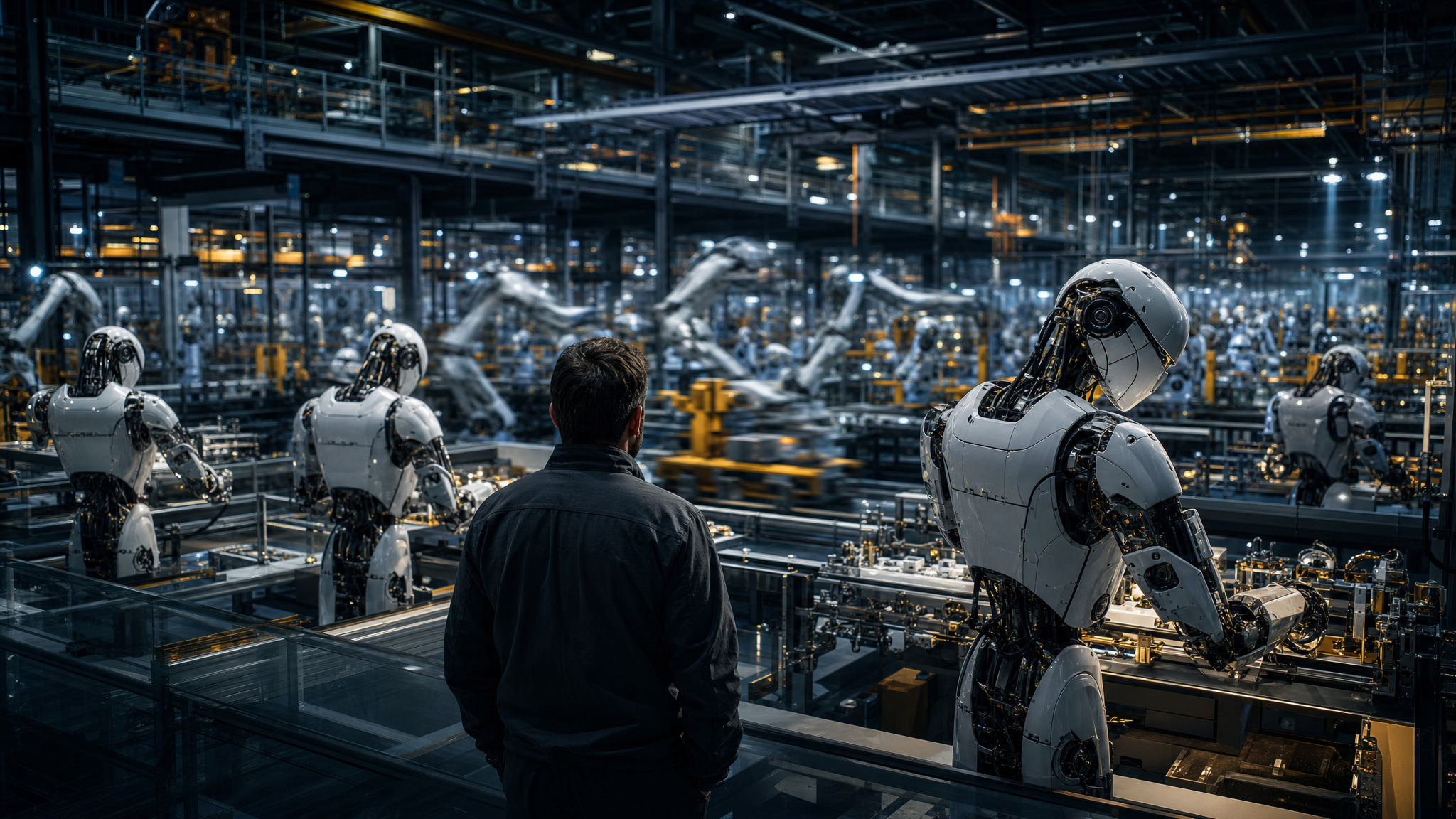
Robots already move materials, load production lines, transport parts, perform repetitive assembly steps, and conduct visual inspections on factory floors around the world. Warehouses deploy robotics for picking, movement, stacking, and inventory handling. Physical robotic labor is not a future concept.
What is not fully here yet is
generalized autonomous physical labor — the moment when nonhuman workers become easy enough, flexible enough, and cheap enough to spread explosively across ordinary operating environments. That breakout hasn’t happened yet.
Humanoids matter precisely because they attempt to expand robotic labor into spaces already built for human beings, without requiring every environment to be rebuilt around the machine. Tesla’s wager captures the scale of the bet: Optimus is being treated not as a side project, but as a potential business category larger than the automobile business that made Tesla famous.
The key breakthrough isn’t robotics alone — it’s robotics fused with AI: large language models, computer vision, reinforcement learning, and falling actuator and battery costs. Without AI, humanoids were expensive machines. With AI, they become trainable workers.
What an Autonomous Agent Actually Is
A traditional AI model responds. You type a question; it returns an answer.
An autonomous agent is different in one critical way: it
acts.
You give it a goal — “monitor my inbox for emails from priority clients and draft a response within two hours” — and it executes, step by step, across multiple tools and platforms, without being reinstructed at each stage. It reads. It decides. It writes. It sends. It logs the outcome.
The distinction between responding and acting is the entire ballgame. Every productivity jump in human history came from extending the reach of human action — from the plow to the steam engine to the assembly line to the personal computer. The autonomous agent is that extension applied to cognitive work.
In November 2025, open-source software called OpenClaw was released. It connected AI models to apps people already used — messaging platforms, email, calendars — and let those models take actions autonomously, without being prompted at every step. Nobody called a press conference. It launched quietly, into the hands of a few thousand people who immediately understood what they were looking at.
Seven months later: 38 million monthly visitors, 3.2 million active users. In China, growth hit 1,436 percent in a single month. More than a thousand people lined up outside Tencent’s headquarters in Shenzhen — not for a phone launch, not for a concert — to get help installing an AI agent. Since January 2026, OpenClaw installations worldwide have processed 19.2 trillion tokens. Roughly 150 times the entire text content of Wikipedia — in five months.
This is what the beginning of a revolution looks like from the inside.
The Power Chart That Explains Everything
There is a chart that tracks organizational output per human employed across nearly three centuries — from biological power to mechanical to the knowledge-worker era. For long stretches the line rises slowly. Then it stalls. The Solow Paradox captures the frustration perfectly: computers were everywhere, except in the productivity statistics.
Then the chart breaks.
November 30, 2022: public release of ChatGPT. January 30, 2026: the beginning of agentic AI at operational scale. That is the inflection point — the moment the curve stops behaving like a normal productivity line and starts turning hyperbolic.
The Bold Business Human Horse Power framework makes the jump concrete: five humans orchestrating seventeen agents generate 95.75 HHP. Compared to a traditional 95-person team costing roughly $14.25 million a year, the HHP model delivers about 19 times the output per human at roughly $877,000 — a 94 percent cost reduction.
That belongs on the same historical chart as steam, electricity, and computing. For the first time, cognitive work — the work that produces plans, decisions, communications, analysis, and coordination — can be scaled the way physical work was scaled by the steam engine.
The Ecosystem Nobody Is Counting
OpenClaw is the largest single platform, but not the only one. In the seven months since the agentic revolution began, between 25 and 50 OpenClaw-equivalent platforms have emerged globally — each connecting AI models to workflows, each enabling autonomous execution at scale. Hermes. AutoAgent. Swarm. Dozens of others, mostly unknown outside the developer communities building on them.
Four of the six most-used AI model providers running inside these platforms are Chinese companies. Together, Chinese providers account for more than 54 percent of global token consumption across the agent ecosystem. The most widely used individual model — Step 3.5 Flash by Chinese firm Stepfun — processes more tokens than the entire Anthropic portfolio combined.
The agentic revolution is not primarily an American story. It is a global one. And the country moving fastest is not the one most Western observers are watching.
What This Means for the Arc of Human Progress
General-purpose technologies — electricity, the internet, the autonomous agent — improve everything at once, because they amplify every human endeavor that depends on cognitive work at scale. Consider what the autonomous agent makes possible:
- Health and Longevity: Agents monitoring patient records, flagging deteriorating indicators, surfacing treatment options before a crisis — and eliminating the documentation burden consuming 30–50% of a doctor’s time.
- Education: Personalized tutoring agents operating 24 hours a day, adapting to each student’s pace, available in any language, at zero marginal cost per additional learner.
- Safety and Security: Agents monitoring infrastructure, financial systems, and supply chains for anomalies in real time, at a scale no human analyst team could match.
- Housing: Agents compressing the permitting, design, procurement, and coordination timelines that make construction slow and expensive.
China is not waiting. Germany is not waiting. OpenClaw’s single-month growth figures — China +1,436%, Germany +992% — are early signals of a country-level adoption race already underway. The United States is growing too — +611% in the same period. But 611% in second place is still second place, in a race where the leaders are compounding faster.
The Individual Imperative
At the individual level, the autonomous agent changes the fundamental equation of what one person can accomplish. A solo entrepreneur, a freelancer, a knowledge worker operating independently can now access cognitive execution capacity that previously required a team.
It is the closest thing yet invented to cloning yourself for productive work. The ceiling on individual human output has been removed. What replaces it is the orchestration question: how well can you direct the fleet?
That same question will apply to physical labor. The critical roles of the next era may not be defined by worker versus machine, but by who supervises, trains, orchestrates, repairs, and handles exceptions for growing fleets of digital and physical workers.
This is Part 1 of a three-part series.
Cross-links:
Human Horse Power: The End of Headcount
The Public Has Always Been Wrong About New Technology. The Pattern Is Accelerating.
Free Trade Lifted 800 Million People Out of Poverty. That Is Not a Coincidence.