
Every electric vehicle rolling off a production line in Detroit, Stuttgart, or Shenzhen carries inside it a quiet crisis. The battery pack powering the motor requires cobalt, nickel, manganese, and lithium — materials that, for now, are overwhelmingly sourced from a handful of politically fraught terrestrial deposits concentrated in the Congo, Indonesia, the Philippines, and Chile. As EV production scales from millions to tens of millions of units per year, the arithmetic of supply and demand grows uncomfortable. The minerals required for the clean energy transition are, in significant part, running low on land.
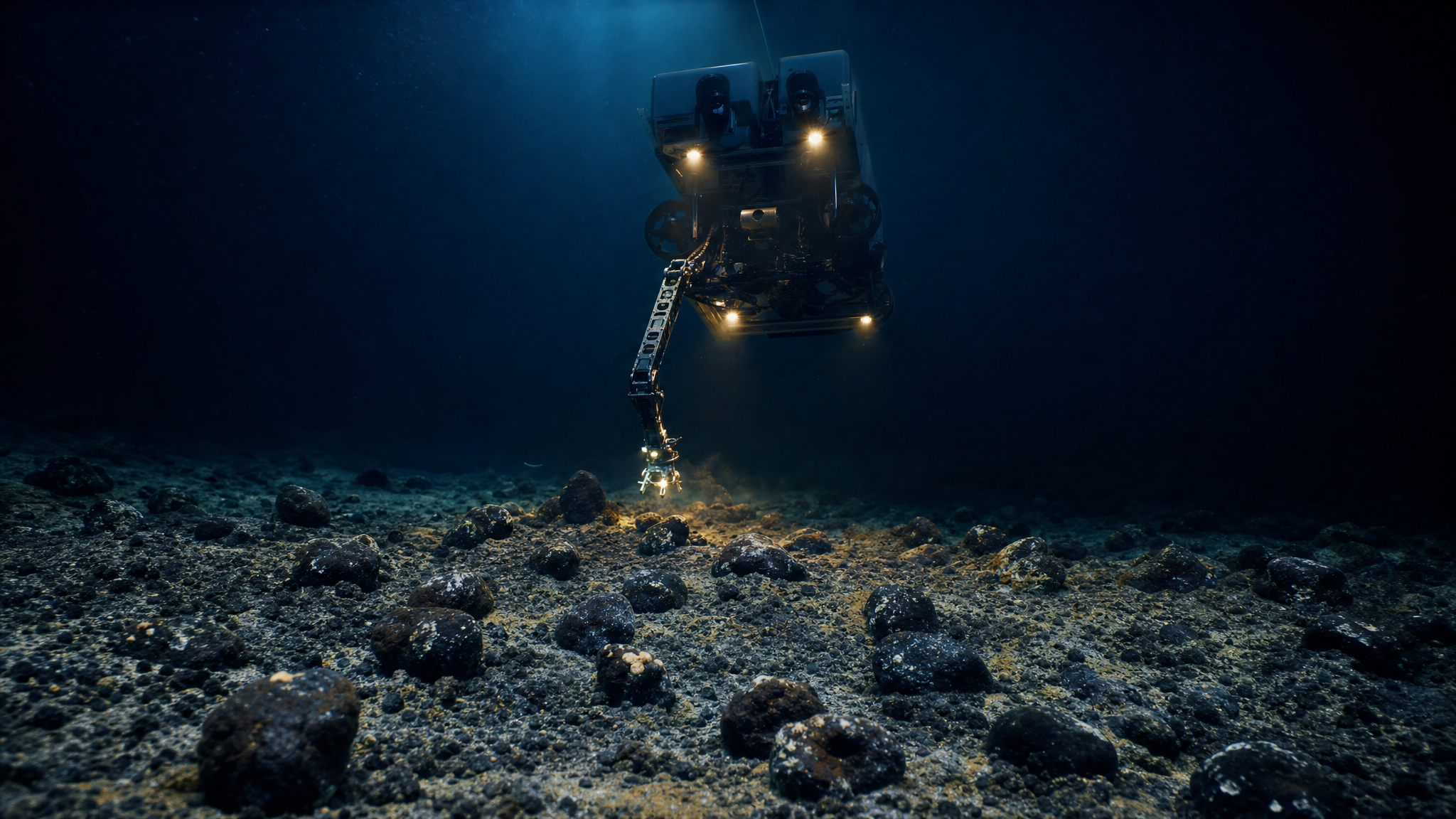
What most people don't know — and what the market is beginning to price — is that the largest untapped reserve of these exact minerals sits on the floor of the Pacific Ocean, under 4,000 to 6,000 meters of water, scattered across an abyssal plain roughly the size of the continental United States.
The Clarion-Clipperton Zone (CCZ), a band of deep ocean stretching between Hawaii and Mexico, contains an estimated 21 billion tonnes of polymetallic nodules — lumpy, potato-sized accretions of manganese, iron, cobalt, nickel, and copper that have been accumulating on the seafloor for millions of years. Within those 21 billion tonnes sits an estimated quantity of cobalt that exceeds all known terrestrial reserves combined. The nickel content rivals the world's largest land-based deposits. This is not a geological curiosity. It is, increasingly, a geopolitical and commercial flashpoint — and the market has noticed.
The Supply Chain Problem Is Real
The International Energy Agency's clean energy scenarios are unambiguous: reaching net-zero by 2050 requires a four- to sixfold increase in overall mineral demand compared to today. Cobalt demand alone — driven primarily by EV battery chemistry — is projected to grow more than 20-fold by 2040 under aggressive electrification scenarios.
The problem is not that these minerals don't exist. The problem is where they exist on land, and who controls them. Over 70 percent of the world's cobalt currently comes from the Democratic Republic of Congo, where supply chains intersect with serious governance risks. Indonesia controls a large share of the global nickel supply and has periodically restricted exports. Chile and Peru hold the dominant copper and lithium positions but face political and regulatory uncertainty.
The Race to the Bottom of the Ocean
The regulatory framework governing the international seabed was established in 1982 under the United Nations Convention on the Law of the Sea (UNCLOS), which created the International Seabed Authority (ISA) to manage mineral resources in the ocean floor beyond national jurisdiction. By 2026, the ISA had issued 32 active exploration contracts with 22 contractors, including national agencies and private companies from Korea, China, Germany, France, India, Russia, Japan, Belgium, Singapore, the UK, and small Pacific island nations acting as sponsoring states for commercial ventures.
The list of contractors is itself a snapshot of global mineral competition. China holds three contracts and has moved more aggressively than any other nation to vertically integrate seabed mineral rights with battery supply chains and processing capacity onshore. India's government-sponsored contractor holds three contracts. Germany's Federal Institute for Geosciences and Resources has two.
The Technology Is Further Along Than the Coverage
Collecting nodules from 4,000 to 6,000 meters of water depth requires engineering solutions that did not exist a decade ago. The leading approach involves remotely operated collector vehicles — essentially large vacuum systems that move across the seafloor, collecting nodules and pumping them to a surface support vessel through a riser pipe. The technology is analogous, in principle, to deep-water oil extraction systems that the offshore energy industry has operated for decades.
The Metals Company — formerly DeepGreen — has conducted the most advanced nodule collection trials to date, operating collector systems at full ocean depth and demonstrating that the basic recovery process is technically viable. The company holds exploration contracts through its Pacific island nation sponsors and has reported recovery rates consistent with commercial viability.
The Environmental Question
The most serious opposition to deep seabed mining comes from marine scientists who argue that nodule fields are ecosystems — slow-growing, poorly understood, and potentially irreplaceable. Nodules take millions of years to form. The benthic fauna that colonize them are adapted to conditions that exist nowhere else on Earth. Collector vehicle operations disturb the seafloor sediment in ways that create sediment plumes, and the scale of commercial recovery operations would disturb areas measured in thousands of square kilometers.
These are legitimate concerns. The scientific community is not wrong that deep seabed ecosystems are understudied and that the consequences of large-scale disturbance are uncertain. But the framing of the debate — seabed mining versus pristine nature — obscures the actual tradeoff: seabed mining versus terrestrial mining, with all its documented human costs and political risks. The cobalt that powers a smartphone comes from somewhere. The question is whether that somewhere should be the Congo or the Pacific abyssal plain.
The Arc
The pessimist claim on deep seabed mining is that it represents a new frontier of environmental destruction — that humanity, having degraded terrestrial ecosystems, is now turning to the last pristine environments on Earth. The arc says something more complicated: the clean energy transition requires minerals, and the choice is not between mining and not mining, but between mining with political risk and environmental consequences on land, or mining in international waters under a global governance framework with the possibility of better oversight.
Markets do not wait for this debate to resolve. The 32 exploration contracts already in place, the capital flowing into recovery technology, and the explicit mineral security strategies of major economies suggest that deep seabed mining will happen — at commercial scale, within this decade — regardless of where the environmental debate lands. The relevant question is not whether, but how: with what governance, what environmental safeguards, and what distribution of the economic benefits among the nations that share the international seabed.
The arc of human progress has always included the expansion of the resource frontier — from surface to subsurface, from land to sea, from low orbit to deep space. Each expansion has brought environmental costs and economic benefits that were distributed unevenly and managed imperfectly. The deep seabed is the next frontier in that arc. The 21 billion tonnes of nodules in the CCZ will not stay on the bottom indefinitely. The question is who extracts them, under what rules, and to what end.
Related: The Solar Cost Collapse: What Swanson's Law Built · Nuclear Energy's Unexpected Renaissance · Free Trade Lifted 800 Million Out of Poverty
Further reading: Cobalt Red by Siddharth Kara — a ground-level account of the human cost of terrestrial cobalt mining and why the supply chain problem is urgent.