Most conversations about economic opportunity focus on what’s visible: cities, factories, data centers, farmland. The ocean covers 71% of Earth’s surface and it rarely comes up. That omission is becoming harder to justify.
In 2023, the global ocean economy generated $2.2 trillion in measurable output — $1.3 trillion in services and $900 billion in goods — representing roughly 7% of world trade. That figure comes from a landmark June 2025 report by UN Trade and Development (UNCTAD), the most comprehensive accounting of ocean economic activity assembled to date. The number is large. What makes it remarkable is the context around it.
From 1995 to 2020, the ocean economy grew 2.5 times. The global economy, in the same period, grew 1.9 times. The ocean has been outpacing the world economy for a quarter century — quietly, consistently, without the headlines that AI or biotech commands. And unlike those sectors, the ocean economy was not driven by a single breakthrough. It was driven by compounding across fishing, shipping, tourism, aquaculture, offshore energy, and coastal development simultaneously.
The story of that 25-year run tells you something important about what comes next.
600 Million Livelihoods, One Underreported Asset
The human scale of ocean dependence is striking. An estimated 600 million people worldwide rely on the ocean economy for their livelihoods — fishermen, port workers, tourism operators, offshore energy technicians, seafarers, aquaculture farmers, and the extended supply chains that connect ocean production to consumers. That is roughly 1 in 13 people on earth. The sector supports approximately 100 million jobs directly.
Ocean tourism alone generated $725 billion in 2023 — nearly one-third of all ocean economic activity. Coastal and marine tourism is now the single largest segment of the ocean economy, ahead of shipping and far ahead of fishing. That figure reflects the extraordinary demand for ocean access: cruise lines, coastal resorts, dive tourism, recreational fishing, yacht charters, and the vast hospitality infrastructure that serves them.
Yet ocean aid — international development funding specifically directed at ocean-related issues — reached only $2.4 billion in 2022. The gap between what the ocean produces and what the world is investing in its capacity is a structural mismatch of historic proportions. The UN has called for a $2.8 trillion “Blue Deal” to address it. The scale of that ask is itself a signal: policymakers and institutions are beginning to treat the ocean not as a commons to be managed, but as a platform to be built.
The Ceiling That Technology Broke
For most of recorded history, humanity’s relationship with the ocean as a food source was extractive. Cast a net. Haul a catch. The sea was a fishery — enormous, seemingly inexhaustible, essentially passive on our part.
Then the catch started to plateau. Wild marine capture reached roughly 90 million tonnes per year in the late 1990s and has stayed near that level ever since. The ceiling wasn’t political — it was biological. Fish populations, even in well-managed fisheries, have limits. The world’s appetite for seafood, growing alongside its population and rising incomes, was on a collision course with a hard natural constraint.
Aquaculture was the routing maneuver.
In 1995, global aquaculture production was approximately 22 million tonnes. By 2022, it had reached 94 million tonnes — a more than four-fold increase in 27 years, produced not by taking more from the ocean but by farming it. Aquaculture now accounts for 57% of all aquatic food consumed globally. Wild capture, the dominant mode for millennia, is now the minority share.
Aquaculture didn’t just compensate for wild capture limits — it surpassed them. That is the Arc pattern: technology doesn’t just solve the constraint. It redefines the system.
This is not a story about fish. It is a story about what happens when a natural ceiling meets human ingenuity at scale. The ocean was hitting a limit. The response was not to accept the limit — it was to build a parallel system that made the limit irrelevant. That transition took less than three decades. The implications reach well beyond food.
Every sector of the ocean economy is facing some version of the same question: what does aquaculture-style reinvention look like for offshore energy, for deep-sea minerals, for ocean-based carbon sequestration? In each case, the ocean shifts from a resource to extract to a platform to engineer.
What We Don’t Know
There is a fundamental asymmetry at the center of ocean economics: the asset is enormous and the audit is incomplete. Less than 25% of the ocean floor has been mapped at any meaningful resolution. The remaining 75% represents the largest unexplored terrain on Earth — larger than all the land surface of every continent combined.
This is not a metaphor. Oceanographers and marine biologists routinely discover thousands of new species annually in deep-sea expeditions. Hydrothermal vent ecosystems, first discovered in 1977, have upended our understanding of where life can exist and what metabolic pathways are possible. Deep-sea genomics is generating novel enzymes with pharmaceutical and industrial applications. Ocean sediment cores contain climate data stretching back millions of years that we are only beginning to decode.
The exploration frontier is now accelerating. AI-powered autonomous underwater vehicles (AUVs) are pushing into depths that were previously inaccessible or prohibitively expensive. In July 2025, a new AUV deployed by URI and the Ocean Exploration Cooperative Institute imaged the Mariana Trench area — the deepest point on Earth — at a resolution and scale that was not possible with previous generation technology. These vehicles now routinely operate at depths exceeding 8,000 meters, and their operational cost curves are falling in ways that parallel early commercial drone economics.
The exploration gap creates a compounding problem for economic planning. We cannot model what we cannot see. And the consequences of ocean-floor disturbance — from deep-sea mining, bottom trawling, or subsea cable routing — are poorly understood precisely because the baseline ecology is poorly understood. The case for accelerating ocean mapping is simultaneously commercial and conservationist: you cannot value what you have not counted, and you cannot protect what you do not know exists.
Offshore Energy: The Platform Is Scaling
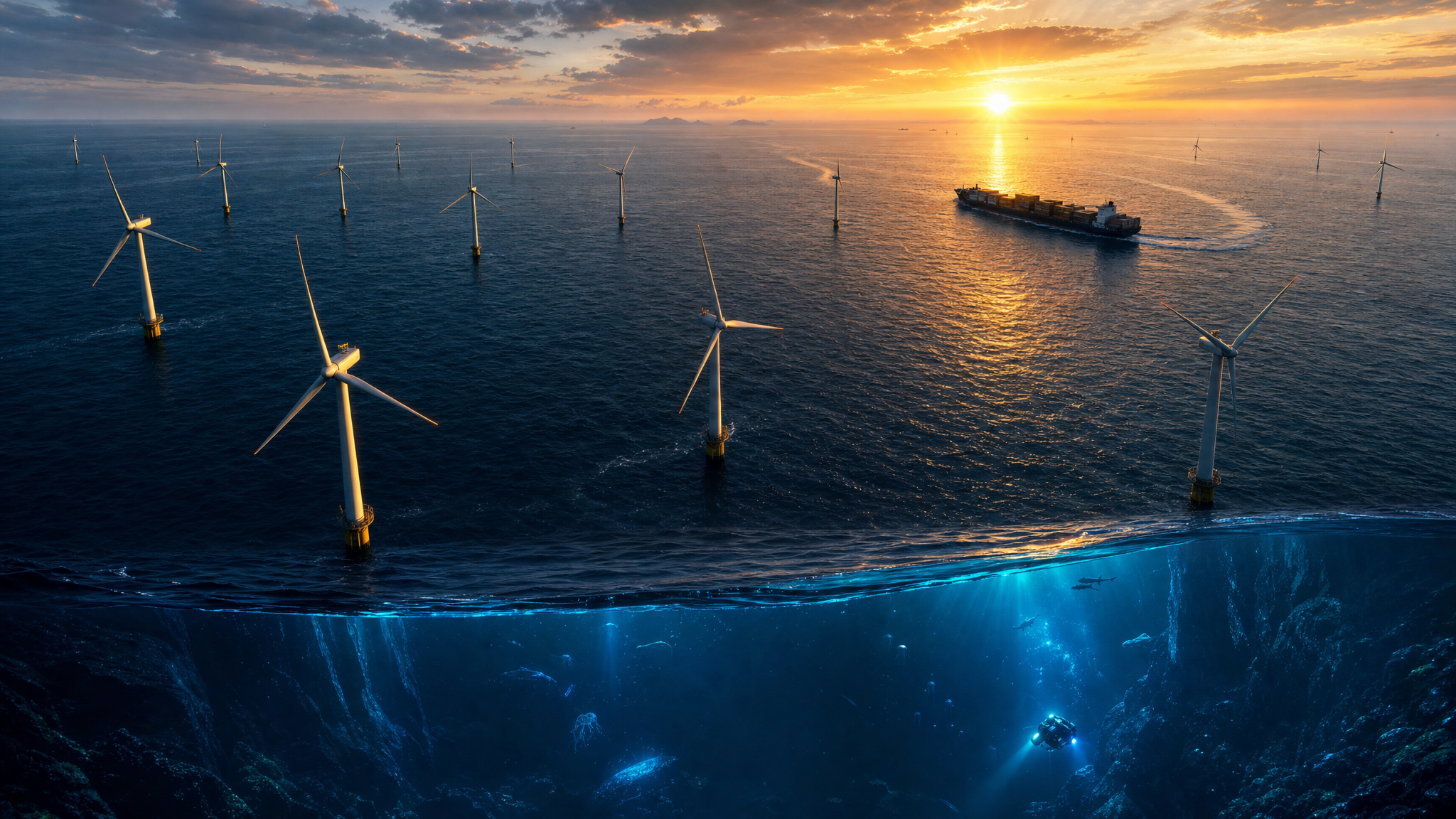
The offshore wind sector entered 2026 with the largest turbines ever built and a pipeline of development that, even after a cautious 2025, reflects the structural direction of global energy policy. Roughly 30 gigawatts of new offshore leases were awarded in 2025 — a pace that, if maintained, would more than double current global offshore wind capacity within a decade.
The economics of offshore wind are increasingly compelling on their own terms. Turbine sizes have scaled dramatically — where 5 MW turbines were state-of-the-art a decade ago, the current generation exceeds 15 MW and prototype units are pushing toward 20 MW. Larger turbines mean more energy per installation, lower per-MWh costs, and fewer structures per unit of capacity. The learning curve dynamics that drove onshore solar down 90% are now playing out in offshore wind, with the added variable that ocean sites access stronger, more consistent wind resources than most land-based alternatives.
Beyond wind, the ocean energy opportunity includes tidal and wave energy (early stage but technically validated), ocean thermal energy conversion (exploiting temperature differentials between surface and deep water), and the emerging potential of offshore hydrogen production — using abundant renewable energy at sea to produce green hydrogen for onshore use. Each of these remains in various stages of early commercialization. None is irrelevant on a 20-year horizon.
The Gap Is the Opportunity
The juxtaposition of these numbers is worth holding for a moment. A $2.2 trillion annual economy. A $2.4 billion annual aid and investment flow. A $2.8 trillion development package the UN says is needed to unlock the ocean’s potential. Less than a quarter of the ocean floor mapped. AUVs now capable of imaging the deepest point on Earth, deployed for the first time in 2025.
These numbers do not describe a mature, efficiently priced market. They describe a market in the early innings of its own discovery — where the asset base is poorly known, infrastructure is thin relative to potential, capital formation is far below what the opportunity warrants, and the technological tools needed to change all three of those conditions are only now reaching commercial viability.
The ocean economy has outpaced the global economy for a quarter century, largely on the basis of what was already accessible and already understood. Aquaculture, coastal tourism, and near-shore shipping drove most of that growth. The deep ocean, the energy platform, the biological frontier — those remain largely untouched by capital. The tools to touch them are arriving.
The surface has barely been scratched. That sentence is almost literally true about the ocean. And that is precisely the point.
The Bold Arc covers the patterns of human progress — the compounding curves where technology meets constraint and a new system emerges. The ocean is one of the most compelling such patterns in the world right now. It is not hidden. The data is there. The story just hasn’t been told at scale yet.
We will tell it in four parts. This is Part 1.
Primary source: UN Trade and Development (UNCTAD), Global Trade Update, June 2025. AUV/deep-sea exploration data: URI / Ocean Exploration Cooperative Institute, July 2025. Offshore wind lease data: Global Wind Energy Council, 2025.
-
Part 1
The Ocean Economy Is a $2.2 Trillion Platform the World Has Barely Started to Build On The full scope of the Blue Economy — size, growth, livelihoods, and why now.
-
Part 2
The Wild Ceiling and the Farm: How Aquaculture Redefined What the Ocean Can Feed Wild capture plateaued at 90M tonnes. Aquaculture hit 94M. How technology routed around a hard biological constraint — and what it means for every other ocean sector.
-
Part 3
Ocean Energy: Offshore Wind, Tidal Power, and the Blue Energy Platform 30 GW in new leases. Record turbine sizes. The ocean as the world’s largest renewable energy surface — and what the cost curves look like from here.
-
Part 4
The Deep Frontier: AI, AUVs, and the 75% of the Ocean Floor We’ve Never Seen Less than 25% of the ocean floor is mapped. AI-powered AUVs are now diving 8,000+ meters. The largest unexplored terrain on Earth is opening — and what’s down there changes everything.