Economy · Nutrition & Food
Wild Catch Hit a Ceiling 30 Years Ago. What Happened Next Fed a Billion More People.
Ed Kopko
·
June 2026
·
16 min read
For most of human history, the ocean was the world’s largest free pantry. Wild-caught fish required no farmland, no irrigation, no fertilizer. You sent boats, you pulled nets, and food came back. The assumption baked into every projection was that this would continue to scale — that as demand grew, the ocean would simply supply more.
In the early 1990s, that assumption ran into biology. Wild capture fisheries plateaued at roughly 90 million tonnes per year. Not because of policy, not because of fishing effort declining — but because the ocean’s productive capacity had a ceiling. Stocks were fully exploited. The pantry had a bottom shelf, and humanity had reached it.
The pessimists seized the moment. Seafood demand was rising. Populations were growing. The arithmetic pointed one direction: toward shortage, collapse, protein crisis. The most widely cited 2006 study in Science predicted that if trends continued, all commercial fish stocks would collapse by 2048.
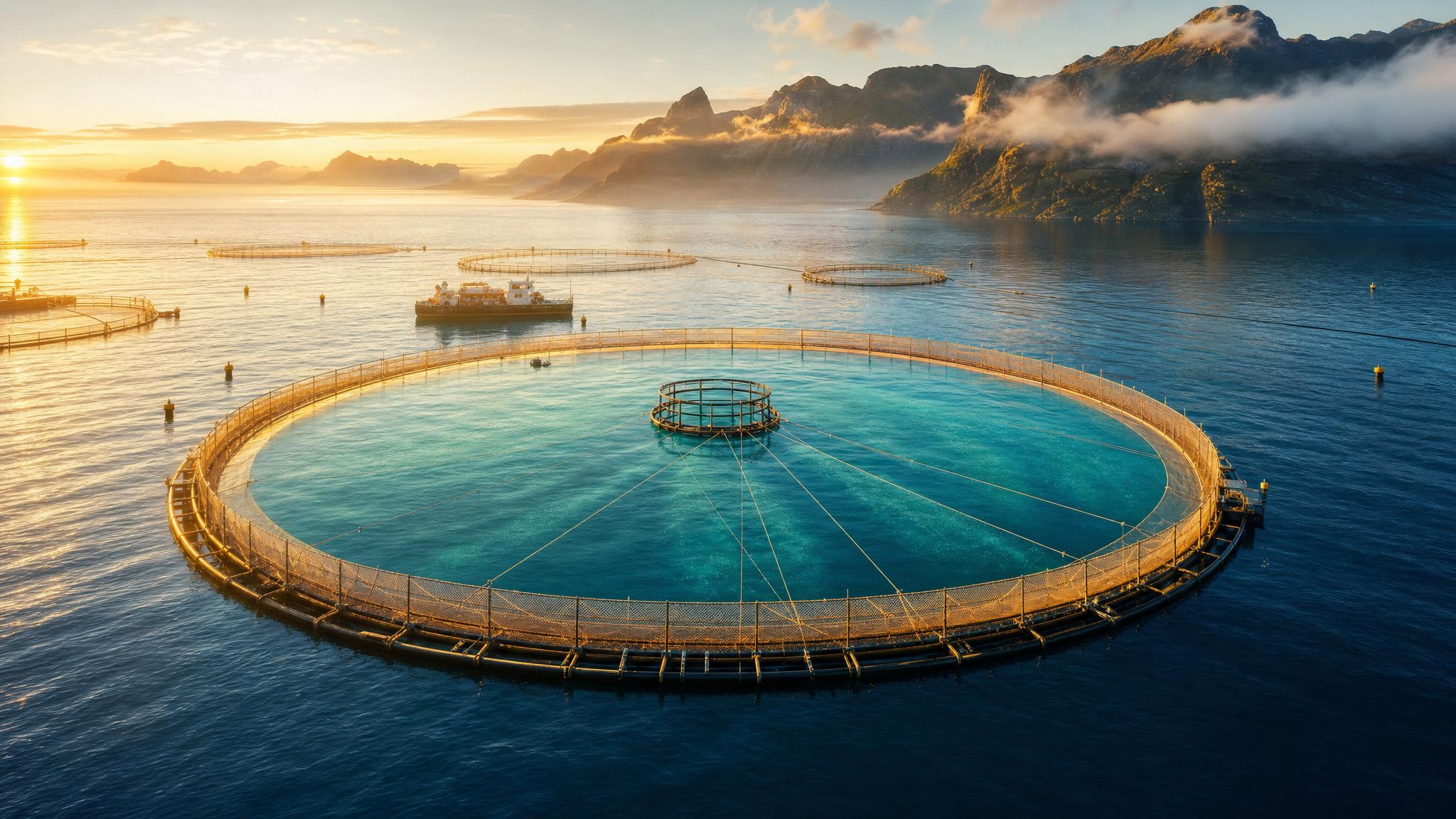
Something else happened instead. A revolution — quiet, unglamorous, and relentlessly productive — took place not on the open ocean but in ponds, tanks, cages, and coastal waters. Aquaculture didn’t just fill the gap. It rewrote the entire food equation.
The Ceiling Nobody Talks About
The wild capture plateau is one of the most important facts in global food history — and one of the least discussed. In 1990, the world pulled approximately 85 million tonnes of fish and seafood from wild sources. In 2022, the figure was just under 90 million tonnes. Thirty-two years. Near-zero growth. This in a world whose population added 2.5 billion people and whose middle class expanded by hundreds of millions of new protein consumers.
The plateau was not uniform. Some stocks recovered as management improved. Others collapsed. Pacific salmon runs fluctuated wildly with climate cycles. Atlantic cod — once the most abundant commercial fish in the ocean — was commercially decimated off Newfoundland by 1992 and has never recovered. The plateau was not a stable equilibrium. It was the aggregate signal of a stressed, fully-exploited system holding roughly steady because some areas improved while others declined.
What the plateau established beyond argument: the ocean’s wild fisheries are a finite resource operating near maximum sustainable yield. They cannot be the primary mechanism for meeting rising global seafood demand. That mechanism had to come from somewhere else.
It came from farming.
The 4x Revolution That Happened Underwater
In 1990, global aquaculture production stood at roughly 22 million tonnes. By 2022, according to UNCTAD and FAO data, it had reached 94 million tonnes — a fourfold increase in three decades. That growth trajectory made aquaculture the fastest-growing food production sector on the planet for three consecutive decades. Not the fastest-growing agriculture sector. The fastest-growing food sector, period.
The milestone was crossed quietly. As of 2022, aquaculture now supplies 57% of all aquatic food consumed globally. The majority of the fish, shrimp, shellfish, and seaweed on the world’s plates did not come from wild-catch boats. It came from farms. The crossover happened without a press conference, without a policy announcement, without a UN declaration. It happened because millions of farmers, entrepreneurs, and engineers in dozens of countries figured out how to grow seafood reliably, at scale, at falling cost.
This is the exact arc of every other great food revolution in human history. Livestock didn’t scale by hunting more animals. Grain didn’t scale by gathering more wild wheat. The transition from extraction to cultivation is the oldest story in agriculture, and aquaculture has now completed that transition for the ocean’s most important products.
94M
Global Aquaculture Production, 2022
Up from 22 million tonnes in 1990 — a fourfold increase in three decades. Wild capture, by comparison, grew by less than 5% over the same period.
Salmon, Shrimp, and Seaweed: The Three Engines
Aquaculture is not one industry. It is dozens — each with its own biology, geography, economics, and innovation curve. But three sectors define the modern era of farmed seafood.
Salmon is the signature success story of the Global North. Norway industrialized salmon farming in the 1980s and now produces 1.5 million tonnes per year — more than any other country by a wide margin. The economics are staggering: the cost of farmed salmon has fallen approximately 80% since 1990, making it a genuinely affordable protein in markets where it was once a luxury. Scottish, Chilean, and Canadian farms followed Norway’s model. Salmon went from a periodic treat to a weekly staple in supermarkets from Tokyo to Toronto. The mechanism was exactly what drove solar costs down: learning curves, process optimization, and scale.
Shrimp is the dominant story of the Global South. The largest aquaculture sector by value globally, shrimp farming transformed the coastal economies of Vietnam, India, Ecuador, Bangladesh, and Thailand over the past three decades. Vietnam went from a negligible exporter to the world’s third-largest seafood exporter — a direct product of shrimp aquaculture industrialization. Ecuador’s shrimp sector generates billions in annual export revenue from what was previously underutilized coastal land. Shrimp farming created middle classes in coastal regions that had none, and fed demand from markets that had never consumed seafood at scale.
Seaweed is the quiet giant. With more than 35 million tonnes farmed per year, seaweed is the single largest aquaculture crop by volume on Earth. Most people in Western markets have never thought about it. Most people in East Asia have eaten it three times today. Seaweed farming requires no freshwater, no fertilizer, no land. It actively absorbs CO2 and nitrogen from the ocean. It produces food, animal feed, fertilizer, biofuel feedstock, and industrial inputs — all from a crop that grows in saltwater with minimal inputs. Seaweed farming is, by most measures, the most environmentally benign food production system that operates at scale anywhere on the planet.
57%
Aquaculture’s Share of Global Aquatic Food, 2022
For the first time in history, the majority of the world’s seafood now comes from farms, not the wild ocean. The crossover happened without a headline. UNCTAD confirmed the figure in June 2025.
“The pessimists predicted seafood collapse. Instead, aquaculture delivered a fourfold production increase — while wild fisheries held stable. The ocean didn’t fail us. We built a new system.”
The Next Generation: RAS, Open Ocean, and AI-Optimized Farms
The aquaculture revolution has already happened. The next wave is just beginning.
Recirculating Aquaculture Systems (RAS) are indoor fish farms that operate in closed loops — filtering and recirculating water instead of drawing from and discharging into natural water bodies. They can be built anywhere: landlocked Kansas, urban Singapore, desert Nevada. They use up to 90% less water than traditional pond aquaculture. They eliminate the disease transmission that has historically been the primary limitation on open-water fish farming. A salmon farm in the Norwegian fjords can’t be built in Ohio. A RAS facility can. The geographic constraint on where seafood can be produced is dissolving.
RAS is expensive today — capital-intensive infrastructure with high energy requirements. But the cost trajectory follows the same logic that drove solar and salmon costs down: as more facilities get built, the technology gets refined, the energy efficiency improves, and the cost per kilogram of fish falls. Several major RAS facilities are now operating profitably in the United States and Europe. The breakthrough to mass-market economics is a matter of engineering time, not physical impossibility.
Open ocean aquaculture represents the largest untapped frontier. The U.S. Exclusive Economic Zone — the 200-mile ocean territory under American jurisdiction — covers 11.4 million square kilometers, the largest of any nation. NOAA has estimated that aquaculture development in the US EEZ could produce more seafood annually than the United States currently consumes from all sources combined. Today, US offshore aquaculture is minimal, constrained by permitting complexity rather than technology or economics. Several other nations — Norway, China, Chile — are moving faster, deploying submersible cage systems and semi-offshore installations that access deeper, cleaner water while reducing coastal impact.
AI and precision monitoring are transforming the efficiency of existing farms. Underwater sensors now track individual fish health indicators in real time. Computer vision systems count biomass, detect early disease signatures, and optimize feeding schedules automatically. The result: feed conversion ratios — the kilograms of feed required to produce one kilogram of fish — are falling sharply. Feed typically represents 50–70% of operating costs in fish farming. AI-optimized feeding systems are demonstrating 20–30% waste reduction, with direct impact on both cost and environmental footprint. The feedback loops are tightening in the same way they tightened in semiconductor manufacturing — more data, faster iteration, falling cost per unit.
What This Means for Global Food Security
3.3 billion people rely on seafood as their primary source of animal protein. Not a secondary source. Not an occasional supplement. The primary one. For coastal communities across Asia, Africa, and Latin America, affordable seafood is not a lifestyle preference — it is the nutritional foundation of the diet. The aquaculture revolution did not just create economic value. It prevented a protein crisis that would have been devastating in the world’s most vulnerable food systems.
The global hunger story has been one of sustained improvement against enormous odds. Aquaculture is a major, underreported reason why. The calories and protein that would have been unavailable as wild catches plateaued were replaced — and exceeded — by farmed production. The substitution was so efficient, so economically driven, and so globally distributed that it happened without most observers noticing. This is what successful technological transitions look like. They don’t announce themselves. They just start showing up in the supply chain.
The next twenty years offer an extension of this story into regions where aquaculture penetration is still low. Sub-Saharan Africa has 38% of the world’s suitable inland aquaculture water resources and currently accounts for less than 3% of global production. That gap is not destiny. It is an investment opportunity and a food security intervention waiting to be made. The technology exists. The economics, at scale, are proven. The constraint is capital, infrastructure, and technical training — all solvable problems.
Climate change complicates the picture in both directions. Warmer ocean temperatures stress wild stocks and alter the geographic range of farmed species. But they also extend the viable aquaculture zone in some northern regions and accelerate seaweed growth in others. RAS systems, precisely because they operate in controlled environments, are substantially insulated from climate variability. The more aquaculture shifts toward recirculating systems, the more climate-resilient the global seafood supply becomes.
The pessimists had the data right — wild capture really did plateau. Where they failed was in assuming the plateau was a ceiling on the total food system rather than a transition point. The pattern holds across every domain of human progress: when one source of supply reaches its natural limit, human ingenuity doesn’t accept scarcity as the final answer. It builds a new system.
Aquaculture is that new system. It took thirty years to build. It is now feeding more than half the world’s seafood demand. And by the measures that matter — cost, technology, geographic reach, and environmental efficiency — it is nowhere near its ceiling.
Wild Capture vs. Aquaculture Production — 1990 to 2022
Wild Capture — 1990: ~85 million tonnes | 2022: ~90 million tonnes → +6% in 32 years
Source: FAO The State of World Fisheries and Aquaculture, 2024
Aquaculture — 1990: ~22 million tonnes | 2022: ~94 million tonnes → +327% in 32 years
Source: UNCTAD, June 2025; FAO SOFIA 2024
Aquaculture share of total: ~20% (1990) → 57% (2022) — majority crossover confirmed
Source: UNCTAD Ocean Economy Report, June 2025
Seaweed farming: 35M+ tonnes/year — largest aquaculture crop by volume; carbon-negative production
Source: FAO SOFIA 2024
Arc Close
Every great transition in human food history has followed the same arc: extraction reaches its natural limit, pessimists predict collapse, and then farming technology steps in and resets the constraint entirely. The domestication of livestock. The grain revolution. The Green Revolution of the 20th century. Each time, the pessimist had the scarcity data right and the human response wrong.
Aquaculture is now that transition for the ocean. Wild catch plateaued at 90 million tonnes — and has stayed there, more or less, for thirty years. Aquaculture responded with a fourfold increase over the same period. The ocean is not failing. The extraction model for ocean protein simply reached its ceiling. The farming model picked up the load, and then some.
The data from UNCTAD’s June 2025 report makes the direction unmistakable. Aquaculture will not merely match wild capture — it will increasingly dwarf it. RAS systems, open ocean platforms, and AI-optimized operations will compound the production capacity of the sector for decades. The economics are proven. The technology is advancing. The demand is guaranteed — 3.3 billion people need affordable seafood protein, and that number is not declining.
The world needed a new food frontier when the old one maxed out. It built one, quietly, underwater, over the course of a generation. That’s not an accident of history. That’s the arc doing exactly what it always does.
Further Reading
The Perfect Protein — Andy Sharpless (with Suzannah Evans)
Four Fish: The Future of the Last Wild Food — Paul Greenberg
Bottomfeeder: How to Eat Ethically in a World of Vanishing Seafood — Taras Grescoe
Next in the Blue Economy Series
Offshore wind, tidal energy, wave power, and OTEC — why the ocean may be the largest clean energy source humanity has yet to tap at scale.
From crewless cargo vessels to AI-piloted LNG carriers — autonomous shipping is no longer a concept. It’s a $14 billion industry in motion.