
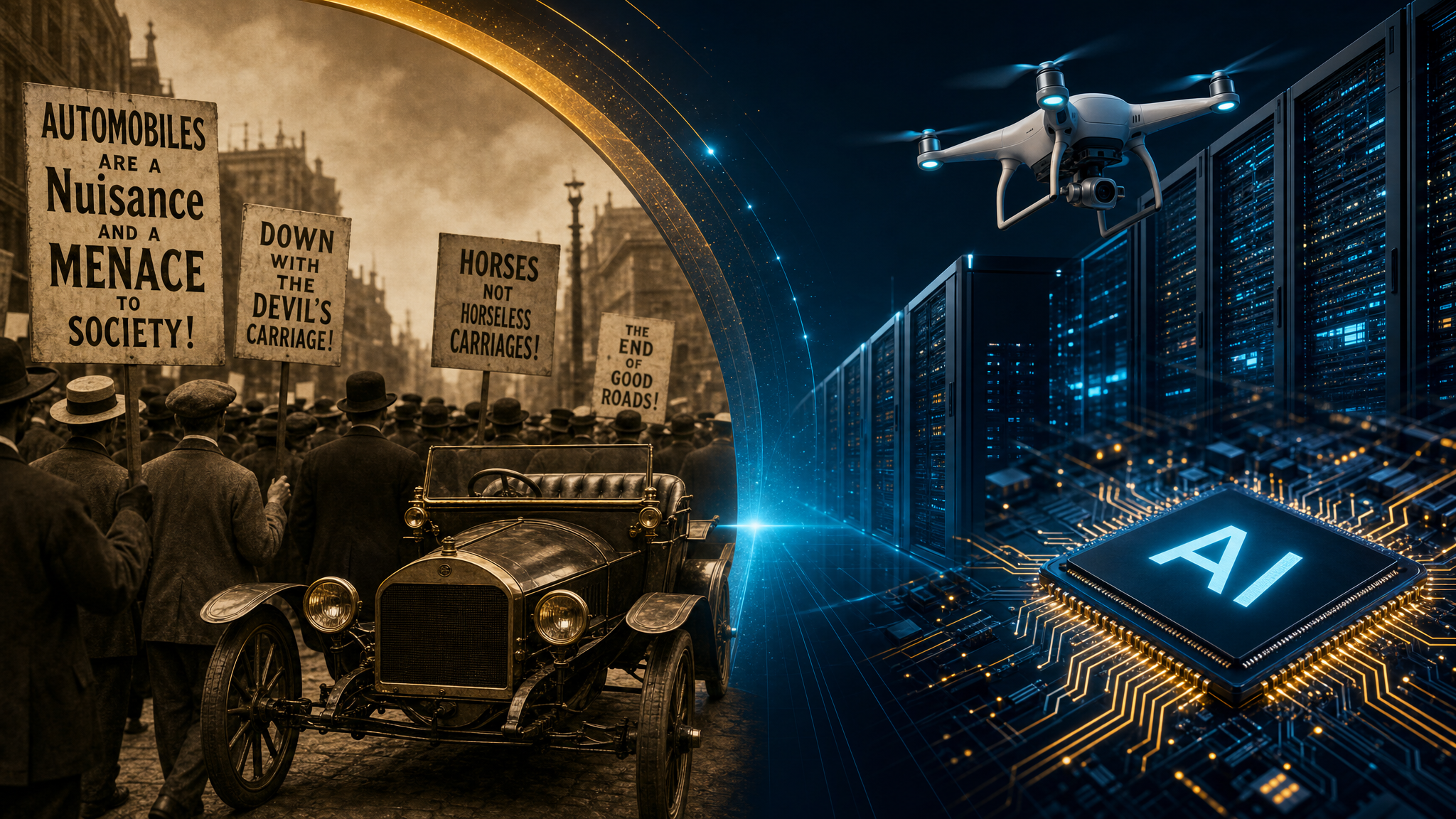
In 1865, the British Parliament passed the Locomotive Acts — a set of laws requiring any self-propelled vehicle on a public road to be preceded by a person walking with a red flag. The speed limit was four miles per hour in the country. Two miles per hour in town. The stated purpose was public safety. The actual effect was to make the automobile illegal in practical terms for thirty years.
The flag carrier wasn’t a joke. It was the policy outcome of genuine, widespread public fear. The horseless carriage was noisy, dangerous, unreliable, and — critically — a toy of the wealthy. Ordinary people had no use for it and every reason to resent it. Parliament listened to its constituents and acted accordingly.
The Red Flag Laws were repealed in 1896. Within two decades, the automobile had reshaped civilization. The Members of Parliament who demanded the flag carrier are not remembered as prudent stewards of public safety. They are remembered as obstacles — men who looked at one of history’s most consequential inventions and saw a threat to horses.
History has a name for people like that. It just takes a generation or two to assign it.
The Pattern Is Older Than You Think
Every generation faces its version of the red flag moment. The details change. The structure does not. And the people who end up on the wrong side of it do not know, in the moment, that they are fools. They believe — sincerely — that they are being careful.
The Railroad (1820s). Medical experts testified before Parliament that the human body could not survive travel at 30 miles per hour — that the speed would cause brain hemorrhaging. The Quarterly Review declared rail travel “a gross exaggeration of the powers of steam.” Farmers organized against rights-of-way. Coaching inn operators lobbied for restrictions. The opposition was not ignorant. In several cases it was the expert consensus of the day. It was wrong.
Electricity in the Home (1880s). Newspapers ran detailed accounts of electrocution deaths. There were formal proposals to ban residential alternating current on safety grounds. Thomas Edison — not above exploiting public panic — staged demonstrations of animals being electrocuted by AC current to discredit his competitor Westinghouse and influence regulators. Public opinion was weaponized against a technology that would light the world.
The Telephone (1876). Western Union’s internal assessment of Alexander Graham Bell’s invention concluded: “This telephone has too many shortcomings to be seriously considered as a means of communication. The device is inherently of no value to us.” They passed on purchasing Bell’s patent for $100,000. That memo is now displayed in business schools as a monument to institutional failure of imagination. Western Union’s assessment shaped investment decisions and regulatory posture for years.
In Vitro Fertilization (1978). The year Louise Brown — the world’s first IVF baby — was born, 60% of Americans opposed the procedure. Multiple US state legislatures introduced bans. The Vatican called it a moral abomination. Today, more than eight million people alive on this planet were born via IVF. The grandchildren of the people who voted to ban it may owe their existence to the technology their grandparents opposed.
Nuclear Power (1970s–present). The objections were not irrational — Three Mile Island and Chernobyl were real events. But nuclear energy is the safest energy source per terawatt-hour ever produced — safer than solar, safer than wind, far safer than coal. Public fear drove a policy retreat from nuclear that filled the gap with coal and natural gas for decades. The fear was understandable. The policy response cost lives — measured in air quality, in climate consequences, in the health of communities downwind of coal plants. The politicians who led that retreat believed they were protecting their constituents. Their constituents paid the price.
History Has a Name for These People
The historical record is not kind to the flag carriers. It is worth being specific about this, because specificity is what makes the pattern legible — and applicable to today.
Sultan Bayezid II banned the printing press in the Ottoman Empire in 1485 — within decades of Gutenberg’s invention — to protect the guild of professional scribes and on religious grounds. The ban was enforced for 242 years, until 1727. In the interval, Europe experienced the Renaissance, the Reformation, the Scientific Revolution, and the Enlightenment — all of them enabled, in critical ways, by the free circulation of printed text. The Ottoman Empire, cut off from that information revolution, fell progressively further behind. Bayezid II was protecting a constituency. He hobbled a civilization.
Senator Ted Stevens, Republican of Alaska, was in 2006 the Chairman of the Senate Commerce Committee — the most powerful regulatory position over the US internet. During a debate on net neutrality legislation, he explained the internet to his colleagues as “a series of tubes.” He voted accordingly. His committee shaped internet policy for years. His explanation of the technology he was regulating is now a permanent exhibit in the museum of legislative incomprehension.
The French government spent the 1990s protecting its state-owned Minitel network — an early networked computer system — so aggressively that France delayed widespread internet adoption by nearly a decade. France had been ahead of the United States in networked computing. By protecting yesterday’s investment at the cost of tomorrow’s infrastructure, it fell behind. The bureaucrats who made that decision were not incompetent. They were doing exactly what bureaucracies do: protecting the existing system from disruption.
These people did not think of themselves as obstacles. They thought of themselves as prudent. Responsible. Protective of their constituents. They were wrong in ways that shaped history — and they are now remembered for it.
“The politicians who tried to ban the telephone, electrify the red flag laws, and block the railroad were not remembered as careful stewards. They were remembered as obstacles. History will apply the same label to their successors — it just takes a generation.”
Why the Public Gets This Wrong — Every Time
This is not a story about ignorance. Many of the people who opposed railroads, electricity, and automobiles were educated and acting in good faith. The systematic error runs deeper than knowledge. Three forces produce it reliably.
Vividness bias. The costs of new technology are vivid, immediate, and photogenic — a car crash, an electrocution, a data center’s cooling tower. The benefits are diffuse, future-facing, and largely invisible. The child who received medicine in twenty-three minutes because a drone flew it there. The cancer patient diagnosed by an AI system that caught what the doctor missed. The startup that exists because a data center in Virginia processed its transactions. Vivid costs beat invisible benefits in every poll ever taken.
Status quo anchoring. People compare new technology to the current moment — not to the counterfactual. In 1900, New York City’s streets were killing thousands annually — not from automobiles, but from horses. Manure-borne disease. Kicks. Runaways. Collapsed animals left to rot. The car looked dangerous compared to nothing. Compared to what it replaced, it was a safety improvement. The public, anchored to the status quo, almost never asks the counterfactual question.
The constituency problem. The people harmed by new technology are organized, present, and vocal. The Luddite weavers. The horse breeders. The postal workers. The scribes. They have names, addresses, votes, and legitimate grievances. The people who will benefit are diffuse, future-facing, and in many cases not yet born. Democracy is structurally biased toward the organized opposition. This is not a flaw. It is a predictable feature — and it produces predictable outcomes when allowed to set technology policy without constraint.
Today’s Flag Carriers
The pattern is not history. It is current events — and the people enacting it believe, exactly as their predecessors did, that they are being careful.
Artificial Intelligence. A 2025 Pew Research Center survey of 5,273 employed American adults found that 52% are worried about AI’s impact on the workplace, and 32% believe it will reduce their job opportunities. Legislators have introduced sweeping regulation proposals and AI development moratoriums. The same Pew survey found that AI experts — the people who actually build and study these systems — are far more excited than concerned. The gap between expert assessment and public fear is wider on AI than on almost any technology in recent history.
The senators proposing ten-year AI moratoriums are not malicious. They are responding to their constituents’ fears exactly as Parliament responded to fears about the horseless carriage. They will be assessed by history using the same standard.
Drone Delivery. A 2024 Vanderbilt survey found that 51% of Americans oppose airspace expansion for delivery drones and 77% want local governments empowered to impose stricter rules than federal regulations. Meanwhile, Walmart has completed one million drone deliveries at an average of 23 minutes per order. The technology works. The public opposition is structurally identical to opposition to the automobile in 1900: noise, class resentment, safety concerns, and a preference for the status quo.
Data Centers. This is the sharpest contemporary case — because it contains its own refutation.
On June 2, 2026 — twelve days ago — residents of Monterey Park, California became the first in the United States to permanently ban data centers by public vote. The margin was not close: 86.3% voted yes. City councilmember Jose Sanchez declared a “landslide victory” and said the quiet part loud: “We hope that other communities will use the model set by residents here in Monterey Park as inspiration to stop data centers from encroaching in their backyard.”
A template is now being set. Monterey Park is not the end of this story. It is the beginning of a replication strategy.
The scale of the opposition movement is larger than most people realize. According to Data Center Watch, in Q2 2025 alone — just three months — 20 projects were blocked or delayed, affecting $98 billion in potential investment. That is more disruption in a single quarter than in all previous quarters since 2023 combined. Opposition groups have surged 125% in that period. There are now 188 active anti-data-center groups across 17 states, targeting 30 projects simultaneously. Of the projects they target, 66% end up blocked or delayed.
Data center project cancellations have quadrupled: 2 in 2023. 6 in 2024. 25 in 2025. The movement is not slowing down. It is learning, coordinating, and winning at an accelerating rate.
Meanwhile in Missouri, a town called Peculiar amended its zoning ordinance to make data centers categorically illegal after a group called “Don’t Dump Data in Peculiar” organized against a $1.5 billion proposal. In Arizona, a $14 billion project was withdrawn after community pressure. The wave is spreading — and now it has a model city.
The internal contradiction sits at the center of all of it: the residents of Monterey Park stream Netflix, use Google Maps, store photos in iCloud, and conduct work on AI tools. Every one of those actions runs through a data center. They voted — by 86% — to ban the infrastructure that powers the life they already live.
The city officials who formalized that ban are not villains. They were responding to organized constituents with real concerns about noise, water, and utility costs. But they will be assessed by history the same way the Members of Parliament who demanded the flag carrier are assessed today: as people who looked at essential infrastructure and voted against it. And they have handed a replication playbook to 188 other groups who are now planning to do the same.
The Market’s Answer: Leave Earth
Here is where the story takes its most striking turn. When you block infrastructure on the ground, the infrastructure doesn’t disappear. It finds another location. And increasingly, that location is orbit.
As of 2026, eight companies are actively competing to build data centers in space. SpaceX filed an FCC application in January 2026 for orbital computing infrastructure — a logical extension of its merger with xAI, which combined SpaceX’s launch capability with xAI’s 220,000+ Nvidia GPU computing cluster. Google, Starcloud, Axiom Space, and others are in the same race. The orbital data center market is moving from concept to regulatory filings.
The drivers are not purely technical. Orbital data centers offer something that no earthbound facility can: they are beyond the reach of any zoning board, city council, or ballot initiative. No noise complaint. No water board. No “Don’t Dump Data in Peculiar.” No Monterey Park model to replicate.
This is the market’s answer to the flag carrier. You cannot ban the demand. You can only determine where it gets built. Block it in your backyard, and it moves to the next county. Block it in enough counties, and it moves to another state. Block it nationally, and it moves offshore. Block it on Earth entirely, and it goes to orbit — literally, carrying your Netflix and your AI and your cloud storage with it, 250 miles above the zoning ordinance that tried to stop it.
Robots and Automation. Manufacturing robots face organized opposition structurally identical to the Luddites — and the outcome is likely to be identical. The historical record on automation and employment is unambiguous: automation displaces specific jobs and expands overall employment. The hand-loom weavers lost their jobs. The industrial economy employed more people at higher wages. The pattern has held across every wave of automation in recorded history. The current wave is not different in kind — only in speed.
The Principle That Follows
The argument is not that the public is stupid, or that its concerns should be dismissed. Some objections to new technology lead to genuinely better outcomes — safety standards, efficacy testing, privacy protections. The question is not whether to regulate. The question is what to regulate.
The historical record supports one clear principle: regulate demonstrated harm, not anticipated fear.
Regulate what drones can do with footage they capture. Don’t give every city council veto power over national drone networks. Require data centers to meet water efficiency and noise standards. Don’t let a zoning board make data centers categorically illegal. Require AI systems to label generated content. Don’t impose decade-long development moratoriums.
Safety standards for automobiles made cars safer. The Red Flag Laws, had they persisted, would have kept the horse. One approach addresses real harm. The other bets against the technology — and history has not paid that bet in two centuries of trying.
The Cost of Getting It Wrong
The nuclear case is the most sobering measure of what fear-based policy actually costs. The retreat from nuclear filled the energy gap with coal and natural gas for decades. The health consequences of that choice — in air quality alone — are measured in millions of lives. The politicians who led that retreat believed they were protecting their constituents. Their constituents paid the price in ways that were diffuse, invisible, and never attributed to the original vote.
The same calculation runs forward. Every year of delayed AI development in medicine is measured in diagnoses not made and drugs not discovered. Every drone network blocked by local ordinance is deliveries that took hours instead of minutes. Every data center project killed by a zoning board is infrastructure and economic capacity that moved elsewhere.
The costs are real. They are just invisible — distributed across millions of people, across years, across counterfactuals that never get counted in the town hall meeting.
The Arc Bends Forward
The arc bends the same way every time. Initial fear. Organized opposition. Policy battles. Early adopters prove the value. Benefits become undeniable. Opposition fades. The technology becomes essential infrastructure. The generation that opposed it becomes dependent on it.
The only variable is how long the fear-based delay lasts — and how much progress is lost in the interval.
The forces that drive technology forward — competition, investment, human ingenuity, the pressure of markets — have never permanently lost to public fear. They have been slowed. Detoured. Set back by decades, as in the Ottoman Empire’s 242-year printing press ban. But the direction has not changed.
The red flag carrier walked in front of the automobile for thirty years. Then Parliament got out of the way, and the twentieth century began.
The people who made him walk are not remembered well. The people making their equivalents walk today will not be either. The only question is how many years of progress — how many cures, how many deliveries, how many breakthroughs — we surrender to the flag carrier while we wait.
Sources: Data Center Watch, “$64 Billion in US Data Center Projects Blocked or Delayed” (2025); Pew Research Center, “Workers’ Views of AI Use in the Workplace” (February 2025, n=5,273); Vanderbilt Policy Accelerator, “Americans Are Worried About Unregulated Drone Delivery Services” (June 2024, n=1,031); Virginia Mercury, data center opposition reporting (2025); UK Locomotive Acts (1865–1896); Western Union internal memorandum on Bell’s telephone patent (1876); Senator Ted Stevens, Senate Commerce Committee floor debate (June 2006); Ottoman printing press ban historical record (1485–1727).