
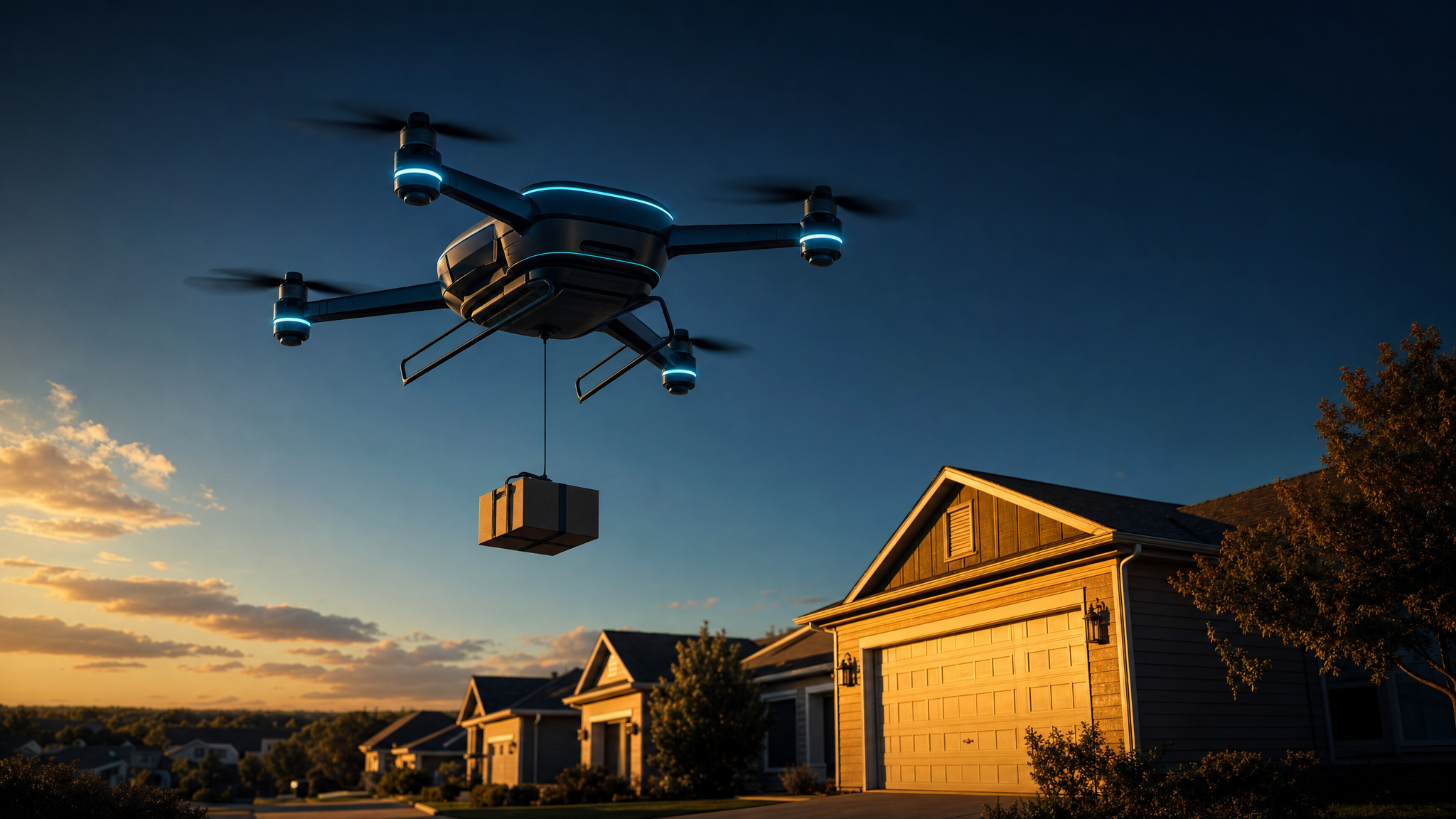
When Amazon first demonstrated a drone dropping a package in a backyard a decade ago, it looked like a publicity stunt. Smart observers rolled their eyes. The obstacles were obvious: limited range, tiny payload, noise complaints, and a regulatory landscape that treated autonomous aircraft the way city hall treats food trucks — with suspicion and paperwork.
Robert Poole, the transportation policy analyst at the Reason Foundation and one of the sharper minds tracking infrastructure trends, admits he was one of the skeptics. His concern was reasonable: drone delivery seemed structurally limited. The physics aren’t generous. Most commercial drones top out at three to ten pounds of cargo. That’s not a refrigerator. That’s not even a case of water.
And yet Poole’s skepticism is now being tested by data. In May 2026, Walmart announced it had crossed one million drone deliveries. Not a pilot program. Not a demonstration. One million deliveries to real customers who ordered real products and got them — on average — in 23 minutes.
That number deserves more attention than it’s getting.
The Milestone in Context
Walmart isn’t doing this itself. That’s the first smart decision worth noting. The company contracted two specialized providers: Wing Aviation, an Alphabet (Google’s parent) spinout, and Zipline, which built its name doing drone medical deliveries in Rwanda and Ghana before turning to commercial logistics in the US.
This is the free market working exactly as it should. Rather than building a drone fleet from scratch, Walmart let two competing companies develop the technology, bear the capital cost, and prove the model. The retailer gets the service. The vendors compete for the contract. The customer gets a 23-minute delivery window.
The current footprint is still small: 66 Walmart stores across four states, primarily Texas (which accounts for over 200,000 of the million deliveries). But the expansion curve is the story. 40% of all one million deliveries happened in a single recent quarter. That’s not a plateau. That’s acceleration.
Wing and Walmart have already announced plans to expand to more than 270 store locations by 2027 — covering nearly 20 major markets from Los Angeles to Miami, with new cities including Memphis, Philadelphia, Phoenix, San Diego, and the San Francisco Bay Area announced in June 2026. Wing’s Chief Business Officer, Heather Rivera, noted that the company’s top 25% of customers now use drone delivery three times per week. That’s not novelty. That’s habit.
How the Technology Actually Works
The two drones Walmart is using solve the same problem in different ways — which tells you something about where the technology is going.
Wing’s drone is a hybrid: it takes off and lands vertically (like a helicopter) but cruises on fixed wings for efficiency. That increases range and reduces battery drain. Its limitation is payload: three pounds maximum.
Zipline’s P2 was designed specifically for dense urban environments. It solves the “downwash” problem — the blast of air a hovering drone creates at ground level — by staying high and lowering the package on a tether using a small “droid.” This makes apartment and suburban delivery cleaner and quieter. The P2 can carry up to eight pounds. Walmart’s published overall limit across the system is ten pounds.
Neither drone is going to deliver a piece of furniture. But the product mix Walmart has identified is instructive: bananas, snack food, pizza toppings, printer ink, and cold medicine are its most common drone deliveries. Read that list again. These are impulse needs and forgotten essentials — exactly the category where speed matters most and package size is naturally small.
The fastest delivery Walmart has recorded: four minutes and 44 seconds from order to drop.
What Does It Cost?
Poole flagged the pricing question and the source article left it unanswered. The answer is both simple and strategically revealing.
Walmart+ members pay nothing. Drone delivery is a free perk of Walmart’s membership program — no order minimum. For non-members, the fee is a flat $19.99 per delivery, regardless of order size.
That $19.99 figure is the real signal. It’s a premium price for a premium service — and Walmart isn’t hiding it. But for Walmart+ members, drone delivery becomes another reason to stay subscribed: the same logic Amazon used when it bundled free two-day shipping into Prime and turned a logistics feature into a loyalty engine. The one million deliveries aren’t just proof of demand. They’re proof the membership flywheel is working.
The Skeptic’s Case — And Why It Still Has Teeth
Poole’s updated view is worth quoting directly: “Walmart appears to have found a market niche for drone delivery.” Coming from a former skeptic, that’s a significant concession. But he flags the concerns that haven’t gone away.
Weight limits are real. Ten pounds is a ceiling for the entire system. Heavy groceries, bulk household goods, anything in a box that requires two hands — these aren’t drone deliveries. The market is structurally limited to small, urgent items.
Noise is real. Drones aren’t silent. A single drone overhead is a curiosity. A delivery network with dozens of drones operating across a neighborhood is a different acoustic environment. Early Wing deployments in suburban Texas drew noise complaints. It’s a manageable problem, but not a solved one.
Privacy concerns are real and broadly held. A June 2024 survey of 1,031 Americans by the Vanderbilt Policy Accelerator found that 66% of respondents did not want drone delivery companies capturing video or images of their homes during delivery. A drone making a delivery necessarily has a camera, and it necessarily flies over people’s property.
Job displacement is a real political issue. The same survey found 74% of Americans are concerned about delivery workers — postal workers, UPS and FedEx drivers — losing jobs to drone automation. Whether or not that concern tracks with economic reality — and automation historically creates more jobs than it destroys — it shapes public opinion and therefore shapes regulation.
What the Public Actually Thinks
The Vanderbilt survey is the most comprehensive recent data on American attitudes toward drone delivery. The headline: 51% of Americans oppose legislation to expand airspace for delivery drones. Only 13% actively support it. That’s a wide gap.
The more striking finding is the partisan breakdown — or rather, the absence of one. On virtually every question, Democrats, Independents, and Republicans agreed within a few percentage points. This isn’t a culture-war issue. It’s a neighborhood issue. People across the political spectrum share the same instincts: they don’t want corporations recording their homes, they don’t want noise disturbing their neighborhoods, and they don’t want federal regulators overriding local authority.
The 77% who want local government authority over federal preemption is the single most important data point for anyone tracking the regulatory outlook.
The Real Obstacle: The Local Government Veto
The FAA governs US airspace, and federal preemption arguments have generally protected drone operators from a patchwork of city-by-city bans. But that legal protection is contested — and the 77% public consensus against federal preemption gives politicians on both sides a mandate to act.
Poole puts it plainly: “I would not be surprised if such opposition comes about.” The history of disruptive logistics technologies includes plenty of cases where incumbents used local regulation to slow or kill competition. Taxi cartels used city councils. Hotel associations used zoning boards. Delivery worker unions have both economic interest and genuine public concern on their side when they push for local drone restrictions.
Zipline’s urban-specific P2 design — staying high, using a tether, minimizing noise and downwash — is as much a regulatory strategy as an engineering one. If you make the drone less intrusive, you reduce the political surface area for opposition. But no engineering solution fully eliminates the local government veto risk.
The Market Mechanism Behind the Milestone
“Each engineering problem solved — noise, payload, urban obstacle avoidance — gets solved because the company that solves it first wins the contract. The curve doesn’t emerge from labs. It emerges from competition.”
Here’s what the drone delivery coverage consistently misses: the reason this technology is improving has nothing to do with government programs or research grants. It has everything to do with competition.
Wing (backed by Alphabet’s capital), Zipline (backed by private investors and billions in overseas commercial contracts), Amazon Prime Air, and a half-dozen smaller operators are all racing to prove their model at scale. Each delivery makes the system smarter. Each route optimized reduces cost.
This is Wright’s Law in action: cost per unit falls predictably as cumulative experience doubles. It’s the same curve that made solar panels 90% cheaper in 13 years, the same curve that made Falcon 9 launches routine. Wright’s Law isn’t a law of physics — it’s an observation of what competition does to price. The companies racing to out-deliver each other are the mechanism, not the metaphor.
Walmart’s decision to use outside contractors rather than build its own fleet isn’t just operationally smart — it’s structurally healthy for the market. Multiple competing providers means multiple innovation paths, multiple cost curves converging, and no single point of failure.
What Comes Next
The expansion numbers tell the story: from 66 stores today to 270+ by 2027. From five metro markets to nearly 20. From 1 million deliveries to a run rate that will exceed that in a single quarter.
The product mix will expand as drone weight limits increase — which they will, as battery density improves and motor efficiency climbs. Today’s ceiling is ten pounds. Tomorrow’s will be higher.
But Walmart crossing one million deliveries changes the political calculation in one important way: there are now hundreds of thousands of customers who have received a drone delivery, liked it, and will notice if their city council takes it away. The politics of drone bans look different when the constituency against them has a face and an address.
Poole ended his analysis with characteristic restraint: “It will be interesting to follow its development.”
That’s an understatement. What Walmart just proved is that drone delivery isn’t a stunt, isn’t a niche, and isn’t going away. The question is only how fast it scales — and whether local governments decide that speed is their problem to solve.
Sources: Walmart corporate announcement (May 2026); DroneXL / Rafael Suarez (May 2026); TechCrunch Wing expansion (June 2026); Robert Poole, Reason Foundation Surface Transportation Newsletter (June 2026); Vanderbilt Policy Accelerator, “Americans Are Worried About Unregulated Drone Delivery Services,” June 2024 (n=1,031); Walmart.com drone delivery help page.