
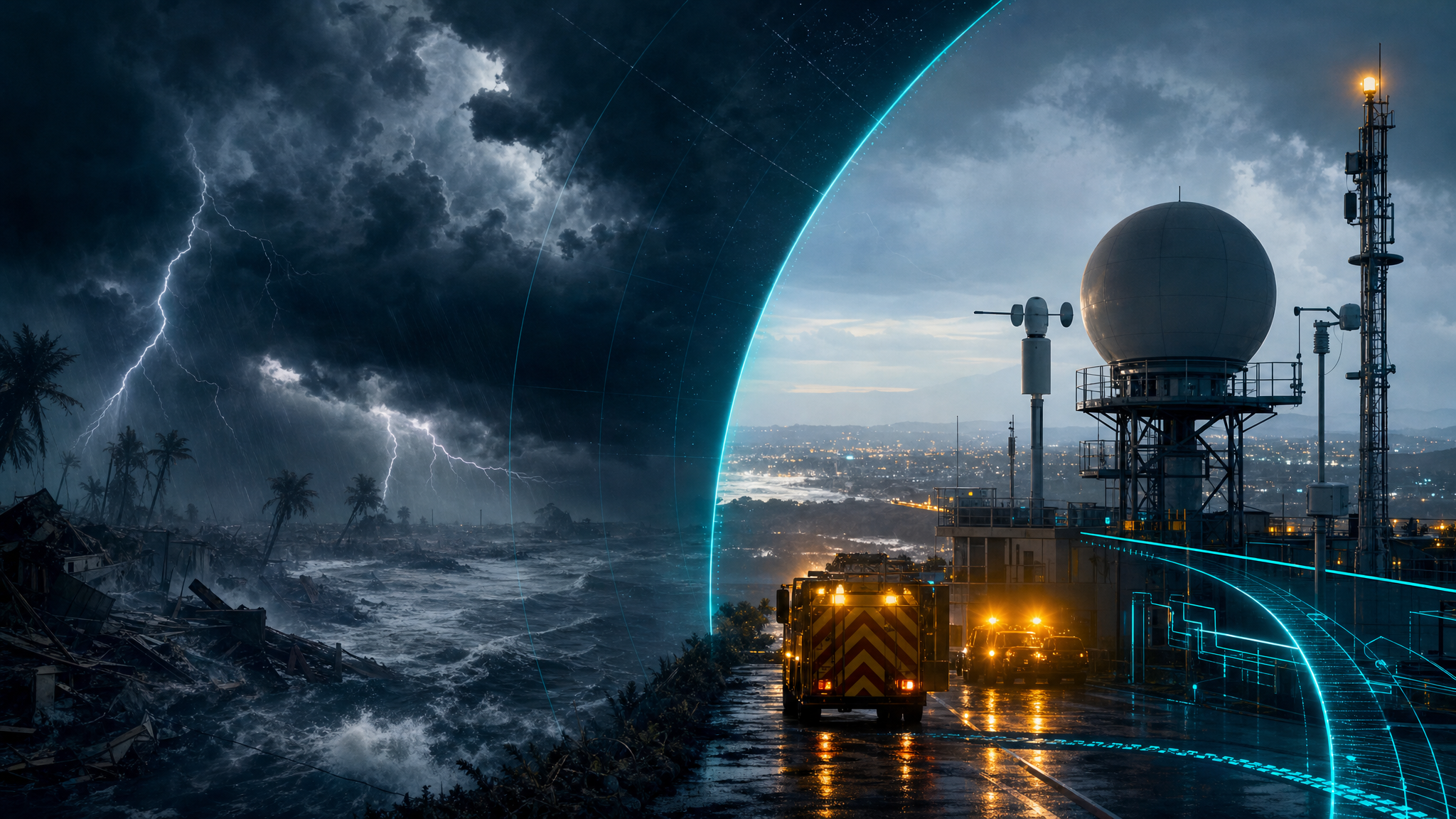
In the 1920s, natural disasters—floods, storms, droughts, earthquakes—killed well over a million people per year on average. Some years were catastrophic: the 1931 China floods killed an estimated 1 to 4 million people. The 1920 Haiyuan earthquake in China killed 200,000. The 1923 Great Kanto earthquake in Japan killed over 140,000. These were not anomalies. They were the baseline.
In the 2020s, the same categories of disasters kill approximately 10,000 to 20,000 people per year globally. The world’s population has more than tripled over that period. The death rate per capita from natural disasters has fallen by more than 90%.
The standard narrative about climate change and natural disasters claims that disasters are getting worse and more deadly. The mortality data says something more nuanced and more important: the disasters may be intensifying, but humanity’s ability to survive them has improved dramatically—and faster than any intensification from climate. The arc on disaster deaths bends strongly downward.
What Changed
The reduction in disaster mortality did not happen because disasters became less frequent or less powerful. Earthquake frequency is geologically determined. Hurricane energy has, if anything, increased with warmer ocean temperatures. Flood frequency has risen in many river systems. The reduction happened because human systems became dramatically better at detecting, warning, sheltering, and responding.
Early warning systems are the single largest factor. In 1970, Cyclone Bhola struck Bangladesh (then East Pakistan) and killed an estimated 300,000 to 500,000 people. The storm was not predicted with sufficient lead time for mass evacuation. Thirty years later, the same coastline was hit by Cyclone Sidr in 2007—a comparable storm—and killed approximately 3,500 people. The difference was a national early warning system that issued alerts 48 hours in advance, enabling mass evacuation to concrete cyclone shelters built specifically for that purpose.
The technology behind that transformation—meteorological satellites, numerical weather prediction models, telecommunications networks, and digital alert dissemination—was developed largely by private technology companies competing for satellite, telecom, and computing contracts. The warning systems that save hundreds of thousands of lives today are the downstream product of market competition in technology sectors that had nothing to do with disaster preparedness as their primary purpose.
The Infrastructure Arc
Building codes are the second major factor. Modern earthquake-resistant building standards emerged from the insurance industry’s relentless pressure to reduce claims. After the 1906 San Francisco earthquake, insurance companies funded the engineering research that produced modern seismic codes. After the 1994 Northridge earthquake caused $20 billion in insured losses, California’s building code was substantially upgraded. After the 2011 Tohoku earthquake and tsunami, Japan revised its coastal infrastructure standards again.
This is a market feedback loop: catastrophic loss → insurance pressure → engineering research → updated codes → reduced loss in subsequent events. The same pattern has played out across flood management (levee engineering driven by agricultural insurance), hurricane construction standards (driven by Florida’s insurance crisis after Hurricane Andrew), and wildfire-resistant construction (driven by California’s insurance market retreating from high-risk areas).
The Climate Adjustment
The argument that climate change is making natural disasters more deadly requires separating two different questions: are disasters becoming more intense, and are they becoming more deadly?
The evidence that storm intensity is increasing in some categories is credible. The evidence that flood frequency is rising in some regions is credible. These trends are real and serious, and the case for reducing greenhouse gas emissions is not undermined by the good news on mortality.
But the mortality question is separate. Deaths from natural disasters depend primarily on warning lead time, infrastructure quality, evacuation capacity, and emergency response capability—not on storm intensity alone. A category 5 hurricane striking a well-warned, well-built coastline with functional emergency management kills far fewer people than a category 3 hurricane striking an unprepared, poorly built coastal population.
The reason disaster mortality has fallen by more than 90% per capita is that warning systems, building standards, and emergency response capability have improved faster than disaster intensity has increased. That is not a reason for complacency—it is a reason to continue investing in resilience infrastructure. It is also a refutation of the claim that climate change has made or is making disasters more deadly in aggregate mortality terms. The data shows the opposite.
The Wealth Effect
One of the most robust findings in disaster research is the strong correlation between national income and disaster mortality. Wealthy countries consistently survive the same disaster events with dramatically lower death tolls than poor countries. The 2010 Haiti earthquake—magnitude 7.0—killed over 200,000 people. The 2011 Christchurch, New Zealand earthquake—magnitude 6.3—killed 185 people. The difference was not geological. It was the quality of building stock, emergency response, and medical infrastructure.
As the developing world has grown wealthier—800 million people escaped extreme poverty since 1990—the resources available for disaster resilience infrastructure have grown accordingly. Bangladesh’s cyclone shelter network, which transforms formerly catastrophic storms into manageable emergencies, was built with a combination of domestic investment and international development funding that would have been impossible without Bangladesh’s sustained economic growth. Wealth is infrastructure. Infrastructure reduces disaster deaths.
The Prediction Problem
The improvement in weather prediction is itself a technology story worth examining. In 1950, a three-day weather forecast was barely useful. Today, a five-day forecast is as accurate as a one-day forecast was 30 years ago. Ten-day forecasts have become operationally useful for emergency management. The improvement came from three converging technologies: numerical weather prediction models (which improved as computing power increased along Moore’s Law), satellite observations (driven by competitive government and private space programs), and data assimilation algorithms (a computational research field with hundreds of active contributors globally).
Each of these improvement streams was driven by competitive pressure. Computational weather modeling improved because agencies and research institutions competed for forecast accuracy benchmarks. Satellite coverage improved because multiple nations and now private companies compete for observation market share. The result is a warning system that saved—and continues to save—hundreds of thousands of lives annually that would have been lost under the warning capabilities of even 40 years ago.
The Arc Ahead
The technology trajectory for disaster resilience points strongly positive. Machine learning is improving storm track prediction and intensity forecasting. Rapid seismic early warning systems—which can provide 10–60 seconds of warning before strong ground shaking—are being deployed in Japan, Mexico, the U.S. West Coast, and increasingly in developing nations. Global flood inundation models now run in near-real time, enabling dynamic evacuation decisions.
The world has become dramatically less violent over the same period. Two billion people gained access to clean water since 1990. The pattern across every dimension of physical safety points in the same direction. The death rate from natural disasters will keep falling as warning and resilience tools spread to the parts of the world where disaster mortality remains highest.
The pessimist argument conflates the intensity of events with the human cost of those events. The data separates them clearly. Events may intensify. Humanity’s capacity to survive them is improving faster. The arc on disaster deaths bends downward—and the mechanism that bends it is market competition in technology and engineering.
Further Reading
- Enlightenment Now: The Case for Reason, Science, Humanism, and Progress — Steven Pinker on why the world is getting better across all dimensions
- Factfulness: Ten Reasons We’re Wrong About the World—and Why Things Are Better Than You Think — Hans Rosling on systematic data literacy
- Progress: Ten Reasons to Look Forward to the Future — Johan Norberg on the data behind human improvement
See also: Humanity is less violent than at any point in recorded history | More of the world lives under democracy today than ever before