
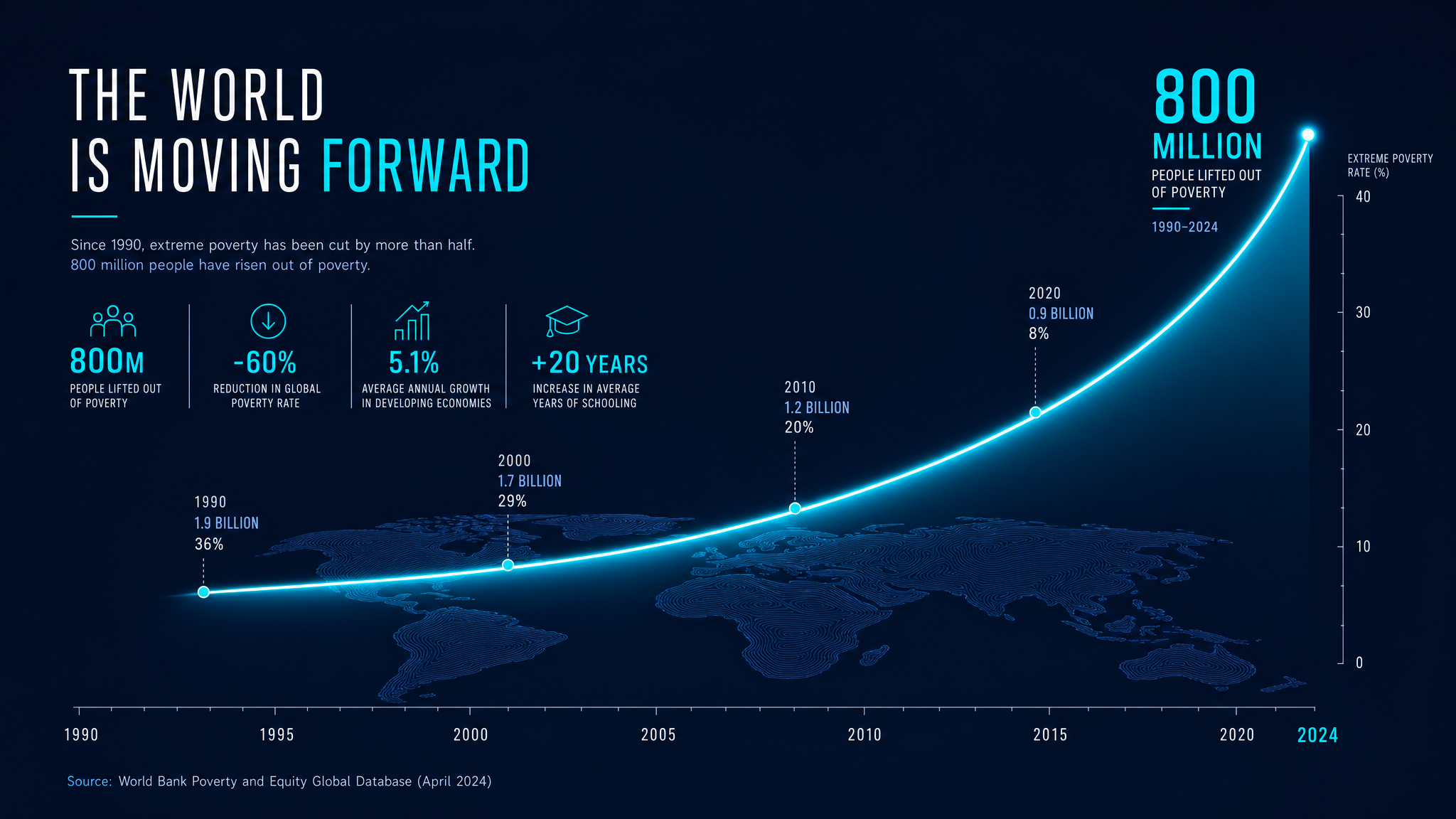
The most consequential humanitarian achievement in human history happened between 1978 and today. More than 1.2 billion people escaped extreme poverty — the largest reduction in human suffering ever recorded. And the places where it happened expose, in plain data, who deserves the credit.
China: 700–800 million people lifted above the poverty line. India: 270 million since 1990. Vietnam. Bangladesh. South Korea. Singapore. Country after country, the same pattern.
Every single one of them opened their markets.
Not UN aid programs. Not foreign debt relief. Not NGO initiatives. Not government redistribution schemes. They opened their economies to trade, foreign investment, and private business formation — and their people climbed out of poverty at rates that have no historical precedent.
This is not a contested claim. It is the documented economic history of the modern era. The only thing being contested is who gets the credit.
The Credit Grab
Every year around the World Bank’s annual poverty report, a familiar ritual plays out. The UN Secretary-General issues a statement citing the Millennium Development Goals. NGO fundraising emails arrive crediting their programs. Aid organizations publish glossy impact reports. And somewhere in the fine print, the actual mechanism gets ignored.
The UN’s SDG framework claims credit for poverty reduction as though the goals caused the outcomes. The data says otherwise. The countries driving virtually all global poverty reduction — China, India, Vietnam, the East Asian Tigers — pursued economic liberalization, not aid dependency. They built manufacturing supply chains. They attracted foreign capital. They let businesses form and compete.
Sub-Saharan Africa, where foreign aid has flowed most heavily for decades, tells the counter-story. Economist William Easterly documented across decades of research that top-down aid programs have a near-perfect record of not producing the results they promise. Jeffrey Sachs’s $2.4 billion Millennium Villages Project — one of the most ambitious foreign aid experiments in history — showed minimal lasting impact on the communities it targeted.
The correlation between market opening and poverty reduction is not subtle. It functions closer to a natural law.
The Actual Mechanism
The poverty-escape machine is well-understood by economists. It is systematically underexplained to the public.
Start with Deng Xiaoping’s 1978 reforms in China. Before 1978, roughly 88% of China’s population lived below the extreme poverty line by World Bank measures — one of the largest concentrations of human deprivation on earth. Deng did not launch a foreign aid program. He opened Special Economic Zones along the coast. He allowed foreign investment. He permitted farmers to sell surplus production at market prices rather than surrender it to the state. He let businesses form and compete.
The result: China’s extreme poverty rate fell from 88% to under 1% between 1981 and 2019. Seven hundred to eight hundred million people crossed out of poverty in a single country, in a single generation. The mechanism was not charity. It was commerce.
India followed its own version of the same playbook. Before 1991, India’s economy was strangled by the License Raj — a bureaucratic permission system requiring government approval for virtually every business decision. Finance Minister Manmohan Singh’s liberalization that year reduced tariffs, opened foreign investment, and unleashed private enterprise. India’s economy grew at 7–8% annually through the 2000s. Poverty rates fell in direct proportion.
The East Asian Tigers — South Korea, Singapore, Taiwan, Hong Kong — are the cleanest natural experiment in modern economics. Starting from devastation in the 1950s and 1960s, each pursued export-led growth, open trade, and foreign investment. South Korea’s per-capita GDP went from approximately $155 in 1960 to over $35,000 today. Singapore, a Third World island with no natural resources in 1965, is now one of the wealthiest countries per capita on earth. The instrument was not foreign aid. It was the market.
The mechanism is not complicated. A company enters a market. It creates products and services people will pay for. Demand grows. Jobs are created — but jobs are just the beginning. Every dollar a company spends ripples outward: the local supplier, the logistics provider, the family running the food stall outside the factory gate, the landlord whose building houses the office. A successful company positively affects every participant in its operating expenditure chain.
And the product itself creates value beyond the wage it pays. An aspirin reduces suffering — that IS the value, not just the pharmacist’s salary. A car enables freedom and enables the Florida orange grower to reach the Indiana grocer, creating commerce and livelihoods across an entire supply chain. The full value business brings to the world is systematically undercounted in political and media narratives. The counted part is already the largest poverty-reduction force in human history.