
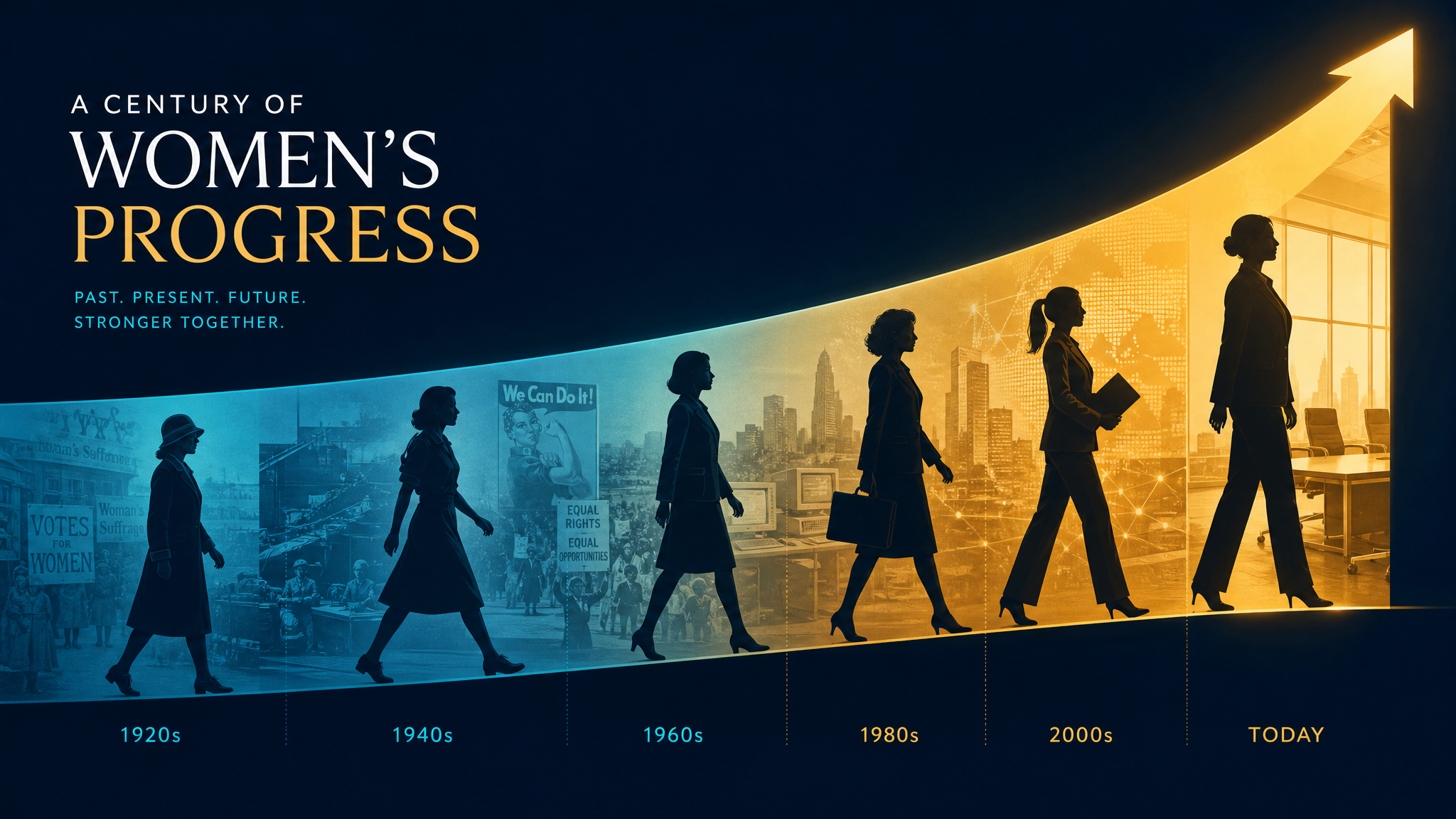
In 1920, half of humanity was formally barred from voting in the world’s leading democracy. In most countries, women could not own property in their own names, enter professional schools, sign contracts, or retain their wages after marriage. The baseline was not merely inequality — it was legal exclusion from economic and civic life.
One hundred years later, women outnumber men on college campuses 60-to-40. Fifty-two Fortune 500 companies are run by women. The global literacy gender gap, once 40 percentage points, has collapsed to under five. Maternal mortality has dropped 40 percent since 2000. The McKinsey Global Institute estimates that closing the remaining gender participation gap would add $12 trillion to global GDP.
This is not a story of work still to be done. It is, first, a story of one of the most compressed and consequential expansions of human capability in recorded history. That it rarely gets framed that way is itself a kind of analytical failure.
The Baseline Was Almost Total Exclusion
The 19th Amendment passed in 1920. New Zealand had led the world in 1893. France waited until 1944. Switzerland — a country that considers itself a model of deliberative democracy — did not grant women’s suffrage in federal elections until 1971.
These are not footnotes. They are the starting line.
When researchers measure progress, the denominator matters. Women did not start from a position of partial inclusion. They started from a position of structural prohibition. Property ownership, contract law, professional licensing, educational access — the entire architecture of economic participation was built to exclude them. Understanding what happened in the century that followed requires holding that baseline clearly.
The story of women’s progress is not a story about closing a gap. It is a story about dismantling a wall.
The Education Reversal That Reshaped Everything
In 1970, the typical American woman who attended college was the exception. By 1982, something remarkable happened: women surpassed men in U.S. college enrollment. It was the first time in the history of American higher education. Most people missed it entirely.
Today, the ratio has widened further. Women earn 57 percent of bachelor’s degrees, 60 percent of master’s degrees, and are approaching parity in law and medicine. In 1970, fewer than 10 percent of law degrees went to women. Today, women make up more than half of law school enrollment.
The global pattern tracks the same direction. The literacy gap that once stretched 40 points between men and women in developing nations has been compressed to under five points globally. In much of Sub-Saharan Africa and South Asia, the change came within a single generation — daughters of illiterate mothers who became doctors, engineers, and heads of state.
This is not background noise. Education access is the single greatest predictor of economic participation, health outcomes, and intergenerational mobility. When half the population enters the knowledge economy, the entire economy accelerates.
Markets Did What Mandates Couldn’t
There is a politically inconvenient truth embedded in this data: markets moved faster than legislation in opening pathways for women.
The Equal Pay Act passed in 1963. The Civil Rights Act added sex discrimination protections in 1964. These were necessary legal foundations. But the actual compression of the wage gap — from 59 cents in 1970 to 84 cents today — correlates more closely with two market dynamics than with any specific mandate: the expansion of the service and knowledge economy, and the explosive growth of female-owned businesses.
The service economy, which scaled dramatically in the 1970s and 1980s, did not require physical strength as a qualification. It rewarded communication, relationship management, and analytical skill — domains where women competed on equal terms from day one. As those sectors grew, female labor market participation followed.
Between 1950 and 2024, the female labor force participation rate in the United States went from 34 percent to 57 percent. That 23-point shift represents tens of millions of workers entering the productive economy. McKinsey estimates that full gender parity in economic participation globally would add $12 trillion to world GDP — roughly the size of the entire U.S. economy as recently as 2003.
The women’s workforce revolution was not primarily driven by government programs. It was driven by market demand. Companies needed talent. Women had it. When markets were allowed to function, they found each other.
For a deeper analysis of how markets outrun policy timelines on social progress, see: What Governments Couldn’t Do in 50 Years, Markets Did in 20.
Alison Wolf’s The XX Factor: How the Rise of Working Women Has Created a Far Less Equal World is the essential economic history of this transition — rigorous, counterintuitive, and indispensable for understanding how women’s workforce entry reshaped global capitalism. Nicholas Kristof and Sheryl WuDunn’s Half the Sky documents how female economic participation in developing nations functions as the single most reliable poverty-reduction mechanism available. Anne-Marie Slaughter’s Unfinished Business bridges the structural and individual dimensions of what remains.
The Leadership Inversion
The Fortune 500 is a useful lens because it is ruthlessly unsentimental. Boards and investors care about execution, not demographics. The climb of women into C-suite leadership tracks real performance — not quota.
In 1972, the number of female Fortune 500 CEOs was zero. Not low — zero. By 2024, it stands at 52, a record. That number includes the heads of UPS, CVS Health, GM, Walgreens, and Citigroup. These are not symbolic roles. They are among the largest, most complex organizations in the world.
The pipeline tells a more aggressive story. Women now hold approximately 30 percent of S&P 500 board seats — up from 16 percent a decade ago. They account for more than 40 percent of managers at major U.S. corporations. At current trajectory, female CEO representation could double again within fifteen years.
The Developing World Acceleration
Progress in OECD countries, while dramatic, is the slower half of this story. The developing world saw gains that compress what took the U.S. fifty years into fifteen.
Since 2000, global maternal mortality has declined by 40 percent. Life expectancy for women in Sub-Saharan Africa has risen faster than almost any other demographic group in the world over the same period — gains that track directly to female education rates, female healthcare worker deployment, and property rights reforms. These are not abstract metrics. Each data point represents a woman who survived childbirth, a girl who learned to read, a family that stayed intact.
Property rights expansion has been among the most economically consequential reforms. When women in Rwanda, Ethiopia, and Vietnam gained the legal right to own land in their own names, female agricultural productivity rose immediately. Women invested in their land, accessed credit, and passed assets to their children. The poverty escape story that has unfolded globally since 1990 is inseparable from the female economic participation story — because in most developing economies, women are the primary agricultural producers and the primary deployers of household income into children’s health and education.
The two arcs — poverty reduction and gender progress — are not parallel stories. They are the same story.
What the Arc Points Toward
The pessimist framing — that progress has stalled, that patriarchy remains entrenched, that women in 2025 face conditions fundamentally similar to those of 1925 — collapses under data review. That is not a political statement. It is an empirical one.
The arc is not complete. Wage gaps persist. Female political representation remains below population share in most countries. Violence against women remains a crisis in many regions. Recognizing progress does not require pretending the work is finished.
But the directionality is clear, the pace is accelerating, and the mechanisms are understood: education access, market participation, property rights, and legal equality. These four forces, wherever they have been allowed to operate, have produced the same result — faster than almost anyone predicted.
The next chapter is the developing world’s leadership rise. It is already underway. Rwanda’s parliament is majority female. The Philippines, Bangladesh, and New Zealand have all been led by women. India’s female workforce participation, long suppressed, is now rising at its fastest rate in a generation. The arc continues.
The most dramatic human progress story in 100 years is not finished. But to deny it is remarkable — and rapidly accelerating — is to misread the data entirely.
Disclosure: This article contains affiliate links (marked with ?tag=boldarc-20). The Bold Arc may earn a small commission if you purchase through these links, at no additional cost to you. We only recommend books we’ve evaluated for editorial relevance.
📚 Recommended Reading

A recommended book that goes deeper on this topic.
View on Amazon →Bold Arc earns a small commission on purchases at no extra cost to you.