
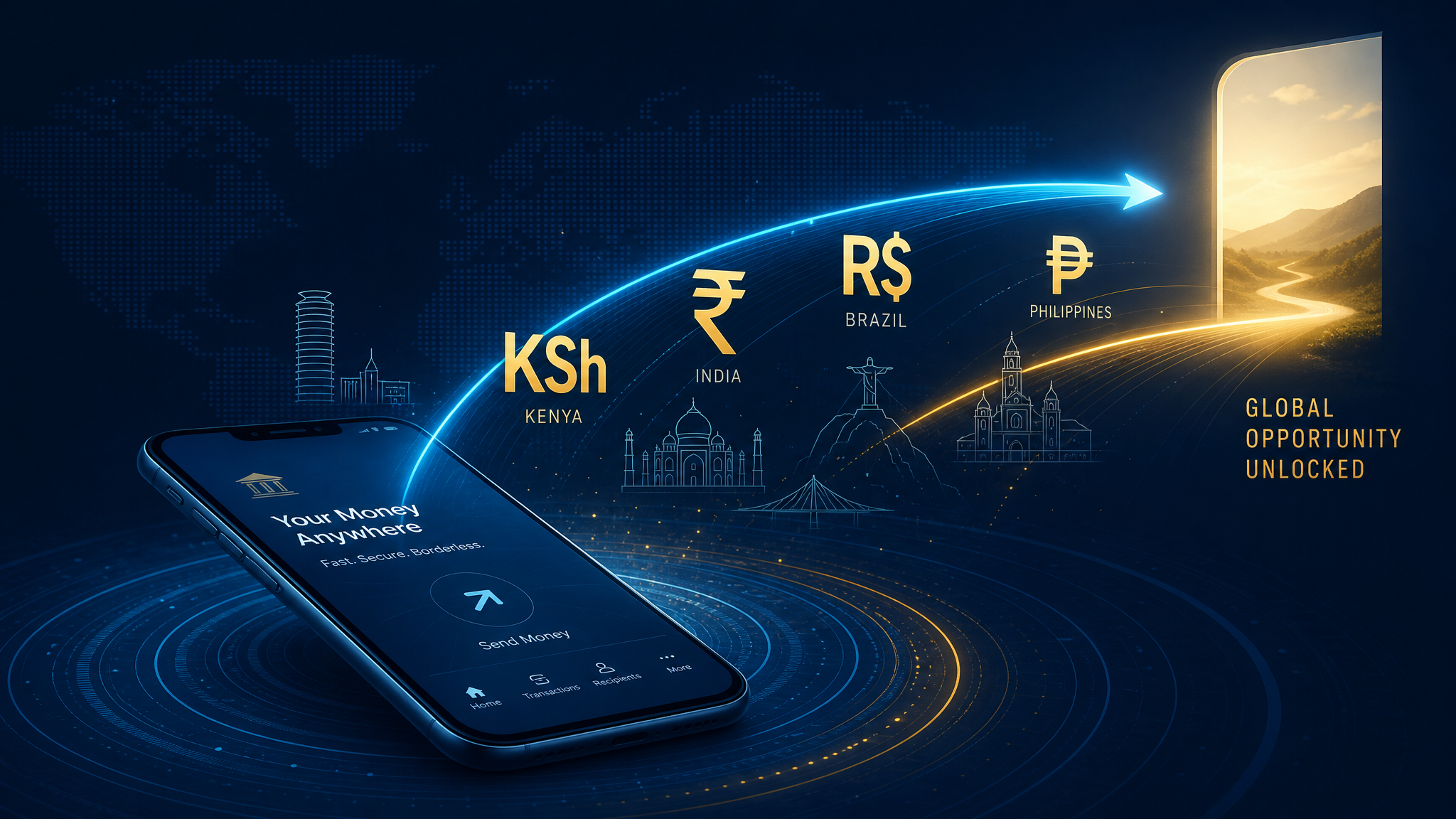
For half a century, the development banking establishment ran on a simple premise: financial inclusion required institutional infrastructure — branches, regulators, international loan programs, development aid. The World Bank would fund it. The IMF would structure it. Multilateral agreements would deliver it.
They didn’t.
In 2011, 2.5 billion adults worldwide held no bank account, no savings instrument, no formal credit access. They transacted in cash or not at all. Emergencies wiped out savings that didn’t exist. Remittances bled out at 9.5 percent fees to money transfer operators. Decades of development programs, microfinance initiatives, and governmental financial inclusion drives made marginal progress against a structural problem that seemed permanently intractable.
Then a Kenyan telecommunications company decided to let people send money by text message.
By 2021, the unbanked population had fallen to 1.4 billion — a drop of 1.1 billion people in ten years. The World Bank’s Global Findex called it one of the most significant expansions of financial access in recorded history. The mechanism wasn’t a treaty, a development bank, or a government mandate. It was the profit motive, applied at mobile-phone scale.
What M-Pesa Did in Two Years That Aid Couldn’t Do in Fifty
Safaricom launched M-Pesa in Kenya in 2007 with a straightforward commercial logic: Kenyans already had mobile phones, they already needed to move money, and the SIM card was a more reliable piece of infrastructure than any branch network. No credit check. No minimum balance. No physical address required. An agent with a phone and cash float could serve as a bank branch.
The uptake was not gradual. Within two years, M-Pesa had more customer touchpoints than all of Kenya’s banks combined. By 2022, 96 percent of Kenyan households used the platform. Today, M-Pesa processes more transaction volume than Western Union globally — not in Africa, not in developing markets: globally.
The mechanism that unlocked this wasn’t charity. Safaricom is a private telecommunications company. It built M-Pesa because there was a market. Agents signed up because there was a margin. Customers used it because it was cheaper, faster, and more accessible than any alternative. The profit motive aligned with the inclusion outcome not by accident but by design — when you build infrastructure for people who have been excluded from it, the market is large.
This is the lesson that fifty years of development banking missed: the unbanked are not a charity case. They are an underserved market.
The IMF subsequently published research linking a 10 percent increase in mobile money penetration to 0.8 percent GDP growth — not correlation, but a causal channel running through reduced transaction friction, increased savings, and expanded small-business credit. What M-Pesa did to Kenya, the platform model has been replicating across continents ever since.
The Global Replication: Markets Moving Faster Than Mandates
Kenya was the proof of concept. The decade that followed was the expansion.
Brazil: Nubank launched in 2013 as a no-fee credit card delivered entirely through a smartphone app. It targeted the 55 percent of Brazilians excluded from formal banking, not as a social mission but as an underserved market with enormous growth potential. By 2023, Nubank had 80 million customers — the largest digital bank in Latin America, and one of the largest financial institutions in the world by customer count. Its valuation exceeded that of Brazil’s legacy banks that had ignored those customers for generations.
India: The Unified Payments Interface, launched by the National Payments Corporation of India in 2016, created an open interoperable rail on which private players could compete. The result: 10 billion transactions per month by 2023. PhonePe, Google Pay, and Paytm — private actors competing on a public standard — drove adoption faster than any state-mandated program could have. India’s unbanked population dropped from over 500 million to under 200 million in under a decade.
Philippines: GCash and Maya brought mobile financial services to a nation of 7,600 islands where physical branch infrastructure was economically impossible to distribute. Millions of Filipinos now receive wages, pay bills, and access credit through apps they have on phones they already owned.
Sub-Saharan Africa: By 2022, 54 percent of adults held mobile money accounts — a proportion that exceeded the share holding traditional bank accounts. The mobile phone leapfrogged the branch. The SIM card leapfrogged the debit card. The market moved where the institution couldn’t follow.
None of this happened because a government convened a task force. It happened because companies saw a market, built products for it, and competed for customers that legacy institutions had written off. Stripe’s infrastructure, Square’s payment terminals, Nubank’s digital-first model — these are not philanthropic enterprises. They are businesses that discovered the most underserved customer segment on Earth and built for it.
For a deeper look at how market forces have consistently outpaced government programs in delivering prosperity, the data on poverty reduction tells the same structural story. The same pattern visible in extreme poverty reduction over four decades applies directly to financial infrastructure: private actors, operating on commercial incentives, have repeatedly moved faster and at greater scale than institutional alternatives.
The Price of Exclusion — and Its Collapse
Financial exclusion has a precise economic cost. When a migrant worker in the Philippines sent money home to Mindanao in 2000, the average remittance fee was 9.5 percent of the transfer amount. A $200 remittance cost $19 before it reached its destination — a regressive tax on labor migration paid disproportionately by the world’s poorest workers.
By 2023, average global remittance fees had fallen to 6.2 percent and continue declining. In corridors served by mobile money infrastructure, fees are as low as 2 to 3 percent. The World Bank estimates that reducing remittance costs to 3 percent globally would put an additional $20 billion annually into the hands of recipient families in developing economies. That’s not aid. That’s infrastructure efficiency.
The financial inclusion story is, at its root, a transaction cost story. The unbanked were not unbanked because they lacked financial needs or financial discipline. They were unbanked because the cost of serving them — through physical branches, paper documentation, regulatory overhead — exceeded the revenue those customers could generate for traditional institutions. Mobile technology obliterated that cost structure.
When the marginal cost of adding a customer drops from hundreds of dollars to fractions of a cent, the market logic of exclusion inverts. The same dynamic that drove out inefficient incumbents in music, retail, and media has now reached financial services — with consequences measured in billions of lives.
Books that illuminate this intersection of markets and development include The Prosperity Paradox: How Innovation Can Lift Nations Out of Poverty by Clayton Christensen, Efosa Ojomo, and Karen Dillon — which argues that market-creating innovations are the primary engine of economic development. For the mechanics of how mobile money reorganized economic life in sub-Saharan Africa, Poor Economics by Abhijit Banerjee and Esther Duflo synthesizes a decade of field research accessibly.
The point is not merely economic efficiency. Financial inclusion is the platform on which every other form of advancement runs. Credit funds the small business. Insurance absorbs the crop failure. Savings accumulate the capital that finances the next generation’s education. The family that moves from cash to mobile money does not just transact differently — it participates in a different economic system, one with risk mitigation, investment capacity, and intergenerational wealth-building potential.
This is the structural insight behind why financial inclusion consistently appears as a multiplier in development economics: it is not one improvement among many. It is the platform. What governments couldn’t do in 50 years, markets accomplished in 20 — not by trying harder, but by changing the incentive structure.
What Comes Next: The DeFi Layer and the Unfinished Work
1.4 billion people remain unbanked. That is not a small number. And mobile money, for all its scale, carries limitations. It operates within national regulatory frameworks that constrain cross-border functionality. It depends on telecom infrastructure that remains uneven in rural areas. It is predominantly used for payments and basic savings — not for the sophisticated credit, insurance, and investment products that constitute full financial participation.
The next phase is already emerging. Decentralized finance protocols built on blockchain rails are beginning to address the cross-border limitation directly. A remittance corridor that today runs at 6 percent can theoretically run at near zero on a DeFi rail — with settlement in seconds, without correspondent banking infrastructure, without currency conversion spreads. Stellar and Ripple are already processing cross-border transactions at fractions of the cost of the legacy SWIFT network. Circle’s USDC and similar stablecoins offer a dollar-denominated instrument accessible to anyone with an internet connection.
This is not speculative. The infrastructure exists. The adoption curve is early but real. In El Salvador, Bitcoin’s legal tender status forced a national experiment in crypto-denominated payment rails. In Nigeria, where currency controls and inflation pushed citizens toward crypto, exchanges processed billions in volume driven by genuine financial utility, not speculation.
The pattern that produced M-Pesa — a private actor identifying an underserved market and building infrastructure for it — is now operating at the protocol layer. The competitive pressure to reduce remittance costs further, to extend credit to people with no credit history but rich transaction histories, to insure agricultural risk through parametric smart contracts — this pressure comes from market actors competing on a global basis, not from government programs operating within national boundaries.
The three billion people who joined the global middle class over the past five decades did so through a combination of market access, technology diffusion, and economic integration that development orthodoxy consistently underestimated. The expansion of the global middle class followed the same pattern now visible in financial inclusion: private infrastructure, deployed at scale, driven by commercial incentive, producing social outcomes that institutional actors failed to achieve.
The pessimist claim — that the financial system excludes the poor and always will — rests on a static model of institutional inertia. It was always wrong about the mechanism. Financial institutions excluded the poor not because exclusion was a policy preference but because the economics of serving them under legacy cost structures were unfavorable. When the cost structure changed, the economics changed. When the economics changed, the market moved.
1.1 billion people did not gain financial access because governments finally cared enough. They gained access because a Kenyan telecom company found a business model. And behind it came Nubank, and PhonePe, and GCash, and Stripe, and a hundred other private actors that looked at the unbanked world and saw a market.
The remaining 1.4 billion are not a policy failure waiting for political will. They are an underserved market waiting for the next iteration of the same force that served the 1.1 billion before them.
The arc bends toward inclusion. The engine driving it is not charity — it is competition.
The connectivity infrastructure enabling this financial expansion runs alongside the Starlink-driven disruption of global internet access — a parallel private-sector story of infrastructure leapfrogging institutional alternatives.
FTC Disclosure: The Bold Arc participates in the Amazon Services LLC Associates Program. Affiliate links to books are marked with ?tag=boldarc-20. Purchases support independent editorial at no additional cost to the reader.