“This article contains affiliate links. Bold Arc may earn a commission at no cost to you.”
The pessimist’s claim: Only the wealthy get quality education. The system is broken. Generational inequality is locked in by ZIP code, tuition bills, and the gatekeeping of elite institutions.
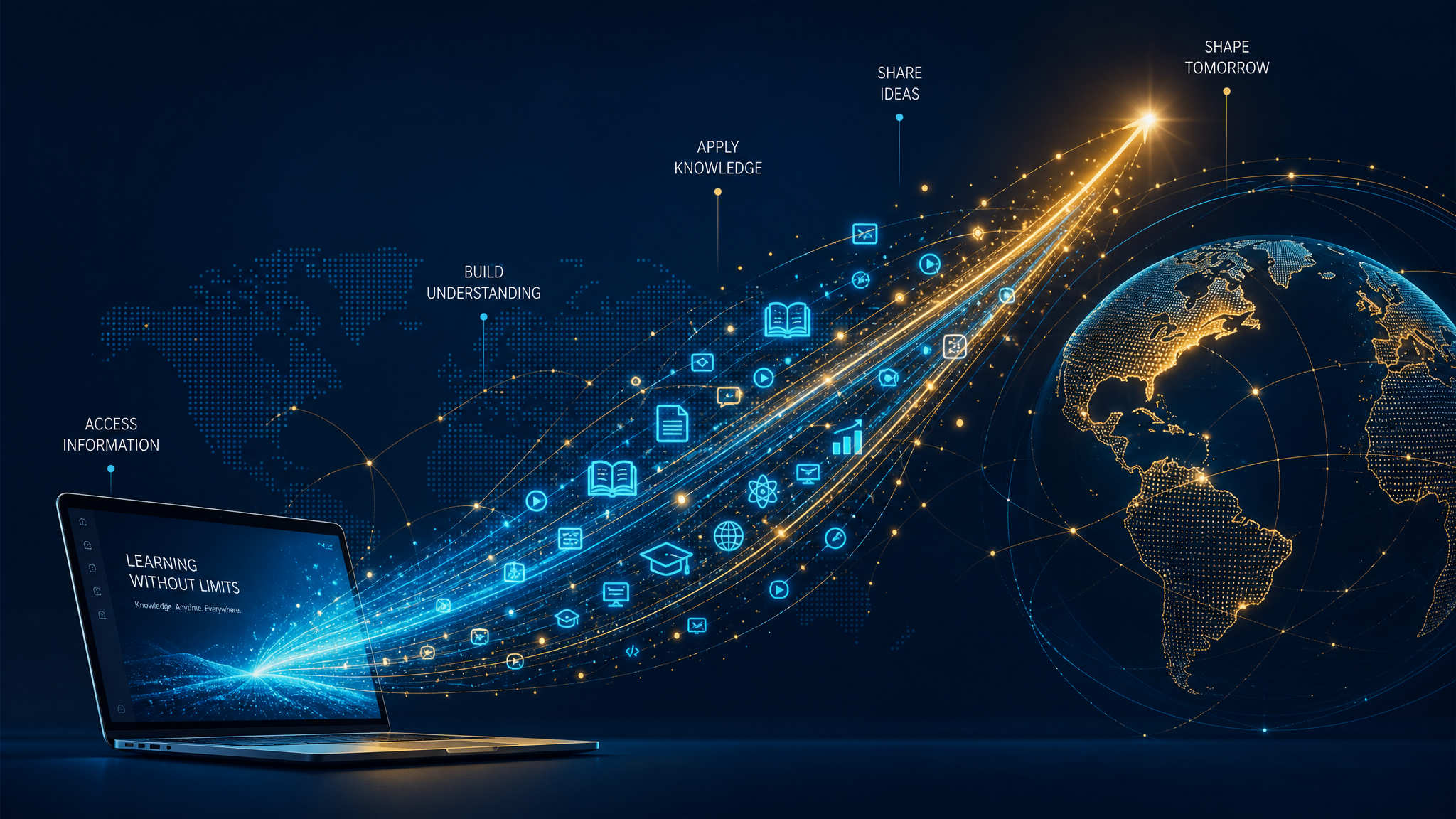
The data: 150 million people are learning on Khan Academy — for free. 148 million learners have taken courses on Coursera from MIT, Stanford, and Yale. Every course MIT has ever taught is available online, right now, at no charge. The world’s best education isn’t locked behind a gate anymore. The gate was demolished — by technology, by markets, and by human ambition.
This is the arc. This is what progress actually looks like when you stop arguing about it and start measuring it.
Before: Geography Was Destiny
Before the internet, quality education required physical proximity to elite institutions. If you were born in rural India, sub-Saharan Africa, or a mid-sized American city without a research university, the options were clear: accept a second-tier education, relocate (if you could afford it), or self-teach from whatever books you could find.
The elite credential system wasn’t cruel by design — it was limited by physics. A professor could teach 30 students in a lecture hall. The best professors were scarce. The buildings and laboratories cost billions. Access required proximity. Proximity required money or extraordinary luck.
This was the baseline. This was the world that existed, largely unchanged, for five centuries after Gutenberg.
Then came the internet. Then came the market.
The Market Did This
The pessimists’ narrative misses the mechanism. Khan Academy was a nonprofit — Salman Khan built it in 2006 from a tool he created to tutor his cousins. That’s a great origin story. But the scale of the transformation wasn’t driven purely by charity.
Coursera, founded in 2012 by two Stanford professors, is a private company. So is Udemy. So is MasterClass. LinkedIn Learning, Pluralsight, Skillshare — the roster of for-profit platforms democratizing education reads like a venture capital portfolio, because that’s exactly what it is.
Competing for learners, these companies drove the price of knowledge toward its marginal cost of delivery: near zero. A single recorded lecture from a Nobel laureate can now be watched by ten million people simultaneously. The economics of education, once constrained by physical scarcity, were obliterated. What remained was pure content — and content can be reproduced infinitely.
This is what markets do. The same mechanism that made televisions, smartphones, and airline travel accessible to people who couldn’t have dreamed of them a generation earlier did the same to knowledge. When private companies compete to solve a problem at scale, costs collapse and quality rises. Online education is not an exception to that rule. It is one of its most vivid illustrations.
The Numbers Are Staggering
The scale of what has happened in the past 20 years has no precedent in educational history:
Khan Academy reaches more than 150 million registered users globally — more students than the entire U.S. K-12 system serves in a year. Its content covers mathematics from basic arithmetic through multivariable calculus, science, history, economics, and test preparation. It is free. It will always be free. It works in 50 languages.
Coursera reported 148 million learners in 2024, accessing more than 7,000 courses from over 300 universities and companies. A learner in Lagos can take the same machine learning course taught by Andrew Ng that a Stanford student takes. The credential costs a fraction of tuition. The knowledge is identical.
edX (now 2U), founded by MIT and Harvard in 2012, has served more than 45 million learners. Critically, 70% of Coursera learners come from developing countries — the demographic the pessimists claim the system has abandoned. The system didn’t abandon them. The old system couldn’t reach them. The new system found them.
MIT OpenCourseWare, launched in 2002, published every course MIT teaches — problem sets, lecture notes, exams, videos — and made them permanently free. That archive has received more than 350 million visits. A student in Vietnam studying MIT’s thermodynamics curriculum alongside its Cambridge undergraduates isn’t a thought experiment. It’s been happening for two decades.
Udemy now hosts 240,000 courses taught by independent instructors, serving 73 million learners. The platform functions as an open market where expertise finds students: a self-taught programmer in Eastern Europe can sell a Python course to 500,000 students in 80 countries.
YouTube, not typically counted in MOOC statistics, may be the largest educational platform on Earth. Billions of educational video views happen monthly — from differential equations walk-throughs to history lectures to surgical technique tutorials. The platform is free. The content is vast. The quality ceiling is limited only by what creators produce.
The Cost Collapse
The contrast deserves to be stated plainly.
A four-year degree at a private university in the United States now costs between $50,000 and $200,000. A professional certificate on Coursera or edX costs between $10 and $50 for most courses — and many can be audited for free. Amazon Web Services, Google, and Microsoft offer free cloud certifications that have credentialed millions of workers for high-paying technical careers without a single semester of traditional coursework.
These aren’t equivalent products in every dimension. A Harvard network is not replicated by a Coursera certificate. On-campus research opportunities, mentorship relationships, and the credentialing signal of an elite degree retain real value. The pessimists are right that these things matter.
But the knowledge itself — the actual content of what is taught — is now freely available to anyone with an internet connection and the motivation to engage with it. The gap between what the wealthy receive and what anyone can access has narrowed from an unbridgeable chasm to a question of network effects and signaling. That is a transformation worth acknowledging.
The Honest Challenge: Completion Rates
No serious account of the MOOC revolution avoids this: completion rates are low. Studies have shown that fewer than 10% of MOOC enrollees complete their courses. Critics have used this number to argue that online education doesn’t work — that access without structure is just the illusion of access.
This framing misunderstands what MOOCs are.
A person who enrolls in an MIT thermodynamics course to understand one specific concept — heat transfer for an engineering project — and watches six lectures before stopping has achieved exactly what they came for. The completion rate treats every enrollment as equivalent. It is not. A library doesn’t measure success by how many people finish every book they check out.
The more relevant metric: skills gained, credentials earned, careers changed. Coursera’s internal data shows learners who complete professional certificates report salary increases and new job placements at rates that justify the investment many times over. The AWS Certified Solutions Architect credential, achievable through free training materials, commands a salary premium of $30,000 or more in many U.S. markets.
This is the arc of access: the completion rate problem is real and worth solving, but it does not erase the fundamental shift in what is available to whom.
The Global Stakes
The most important dimension of this revolution is not American students getting cheaper education. It is the 70% of Coursera learners in developing countries. It is the student in rural Kenya who can now learn Python from the same instructor teaching San Francisco’s startup employees. It is the adult worker in Southeast Asia earning an AWS certification without ever stepping inside a university building.
The pre-internet educational system concentrated human capital exactly where human capital was already concentrated. Elite institutions clustered in wealthy countries, admitted mostly students from wealthy families, and produced graduates who returned to wealthy ecosystems. The feedback loop was hermetic.
Online education breaks that loop. It does not break it perfectly, completely, or without friction. Internet access remains unevenly distributed, though it expands by millions of users annually (see also: the literacy arc and the scientific knowledge explosion). Motivation and time remain scarce resources for adults working multiple jobs. But the barrier that geography and tuition once represented has been fundamentally eroded.
Eight hundred million people escaped poverty in a single generation — not because governments mandated it, but because economic integration, technology, and human ambition compounded together. The online education revolution is the knowledge dimension of that same dynamic. The tools exist. The infrastructure is being built. The uptake is accelerating.
What’s Next: The AI Tutor
If the past two decades built the highway, the next decade will build the vehicle.
Large language models are making personalized, Socratic tutoring available at scale for the first time. Khan Academy’s Khanmigo — an AI tutor built on GPT-4 — doesn’t deliver pre-recorded lectures. It engages students in dialogue. It identifies where the student is confused. It asks questions rather than providing answers, following the pedagogical methods that research has consistently shown produce deeper learning.
This is not a marginal improvement. It is the difference between a textbook and a private tutor. For most of human history, private tutoring was available only to the wealthy — it required a skilled human, compensated by the hour, engaged one-on-one. AI tutors can provide that experience to millions simultaneously at a cost approaching zero.
The pessimist argues the wealthy will get better AI tutors — more sophisticated, more personalized, with better access. Perhaps. They always have access to the leading edge. But the trajectory is consistent with everything that has come before: what begins as a luxury rapidly becomes a commodity. The iPhone was expensive. The smartphone is now a basic tool of modern life. The same dynamic is reshaping white-collar work across every sector.
A child in rural Brazil with a smartphone and a Khanmigo subscription will receive an education that would have cost $100,000 per year in private tutoring a decade ago. The arc continues.
The Score
150 Million Learners. Khan Academy reaches more students than the entire U.S. K-12 system. For free. Source: Khan Academy 2024
The pessimists are not wrong that the old system was broken. They are wrong that nothing has changed. The evidence is 148 million Coursera learners. It is 350 million MIT OpenCourseWare visits. It is 240,000 Udemy courses available to 73 million people.
The education system wasn’t waiting for government reform. It was waiting for bandwidth. For storage. For competition among private companies willing to bet that people everywhere wanted to learn and would pay — or in Khan’s case, that someone else would fund the infrastructure if the demand was real.
The demand was real. The market responded. The arc is up.
Explore further: Coursera — professional certificates from the world’s top universities | Udemy — 240,000 courses across every skill domain | MasterClass — world-class instructors across creative and professional disciplines
Reading: “The Innovator’s Dilemma” by Clayton Christensen | “Creating Innovators” by Tony Wagner | “Range” by David Epstein