
This article contains affiliate links. Bold Arc may earn a commission at no cost to you. | Part of the Bold Arc series: The Affordability Trilogy.
Seven out of ten Americans will need long-term care at some point in their lives. The average stay in a nursing home lasts two and a half years. Do the math: the median American family faces a potential bill of more than $300,000 for the care of a single aging parent — a cost that wipes out the retirement savings, the home equity, and the inheritance of an entire generation in one clinical transaction.
This is treated as a natural consequence of living longer, of medical progress, of the complexity of aging. Politicians offer the familiar responses: expand Medicaid, create a long-term care entitlement, subsidize insurance premiums, fund more facilities.
What they do not say is what they will not say: government policy created this crisis. The same cascade of regulatory decisions that made housing unaffordable and destroyed the market for affordable child care also demolished the system through which American families had cared for their elderly for centuries — and then replaced it with a government-protected, regulation-strangled commercial industry that charges more than most families can afford while paying its workers poverty wages.
The arc of elder care, like the arc of housing and child care, bends up when government gets out of the way. The path to getting there requires understanding exactly how government bent it down.
The Quid Pro Quo That Used to Work
Before there were nursing homes, there were families. Not because families were more virtuous or more patient, but because the way families organized themselves on land made mutual care the natural outcome.
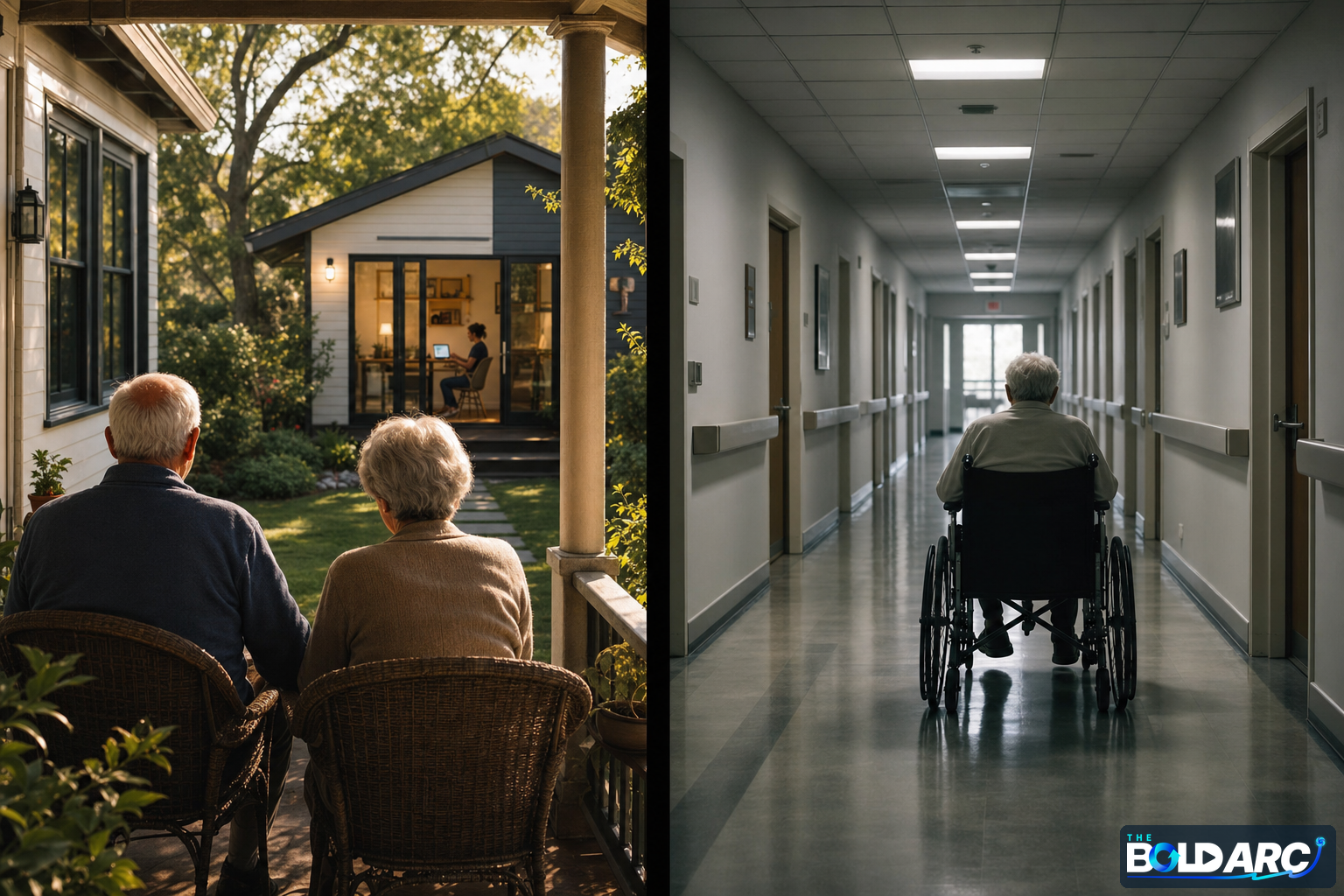
The arrangement was a genuine exchange. Aging parents owned the main house. Their adult children — young families starting out, unable yet to afford their own homes — lived in a small structure on the same property. The parents provided affordable housing. The children provided proximity, help with daily needs, companionship, and the presence that made aging in place possible rather than terrifying. Nobody called it a policy. Nobody needed a subsidy. The land supported two generations, and both generations took care of each other.
This is the quid pro quo of multi-generational living. It ran in both directions simultaneously: the ADU solved the young family's housing problem and the elderly parents' care problem in a single arrangement. The grandmother watched the grandchildren while their parents worked — free child care. The adult children watched their parents as they aged — free elder care. The land was used efficiently. The family was solvent. No one went broke.
Then postwar zoning law imposed single-family-only requirements on American neighborhoods. One lot, one house, nothing else. The small structure where the grandparents lived — or where the young family started — was reclassified as illegal. The proximity that made mutual care natural was severed by a zoning ordinance. Families dispersed across metro areas, across states. The aging parent ended up alone in a house too large to maintain. The adult children lived forty minutes away, managing guilt and logistics from a distance. And when the parent could no longer live independently, there was exactly one option left: the facility.
Certificate of Need: The Supply Suppression Law Nobody Talks About
 Get the book →
When the family arrangement was broken, a commercial elder care industry filled the gap. And government, characteristically, immediately moved to protect that industry from competition.
Certificate of Need (CON) laws require any entity wishing to open a new nursing home, add beds to an existing facility, or offer new long-term care services to first obtain government permission — a "certificate of need" — proving that the market requires the additional supply. These laws exist in approximately 35 states. They were originally encouraged by the federal government in 1974 as a cost-control mechanism. The federal mandate was repealed in 1987 when Congress recognized the laws were doing the opposite of controlling costs. Most states kept them anyway.
The process is not merely bureaucratic. In most CON states, existing providers — the nursing homes and assisted living facilities already operating — have the legal right to formally oppose new competition. They can challenge applications, demand hearings, and drag approval processes out for years. The Federal Trade Commission and the Department of Justice have both issued formal statements identifying CON laws as anticompetitive barriers that raise prices and reduce access. Neither agency has the power to repeal them. That power rests with state legislatures, many of which receive substantial campaign contributions from the existing long-term care industry.
As Atul Gawande documented in Being Mortal — the most clear-eyed account of what American elder care actually delivers versus what families need — the institutional model of aging is not primarily designed around the preferences of elderly people. It is designed around liability, regulation, and the operational requirements of running a licensed facility. What elderly people consistently say they want — autonomy, purpose, connection, proximity to family — is structurally incompatible with how most licensed facilities operate. CON laws ensure that alternatives with different models struggle to enter the market.
The Regulatory Pile-On: Mandates That Drive Cost Without Improving Care
For the facilities that do manage to open, the regulatory burden is substantial and growing. Nursing homes are among the most heavily regulated businesses in America — subject to federal requirements under the Nursing Home Reform Act, state licensing mandates, inspection regimes that can generate hundreds of citations annually, and staffing ratio requirements that, like those in child care, are calibrated for liability management rather than evidence about outcomes.
The Biden administration finalized a federal minimum staffing rule in 2024 requiring nursing homes to provide a minimum of 3.48 hours of total nursing care per resident per day, including 0.55 hours from a registered nurse. The stated goal: improve care quality. The practical effect: facilities in rural and low-income areas that cannot recruit sufficient nursing staff face the choice between closing, reducing admissions, or paying premium wages they cannot sustain. Industry analysts estimated the rule would require 80,000+ additional nursing staff nationally at a cost exceeding $6 billion annually — costs that flow directly into resident fees.
The Medicare Illusion and the Medicaid Trap
 Get the book →
Most Americans believe Medicare covers nursing home care. It does not — not in any meaningful long-term sense. Medicare covers skilled nursing care for up to 100 days following a qualifying hospital stay, and only the first 20 days are fully covered. After day 20, a significant daily co-pay applies. After day 100, Medicare coverage ends entirely. For the average nursing home stay of two-plus years, Medicare covers a fraction of the first year and nothing thereafter.
Medicaid does cover long-term care — but only after the patient has spent down nearly all of their assets. The threshold for an individual: approximately $2,000 in countable assets in most states. A lifetime of savings, a retirement account, the equity in a home — all of it must be exhausted before the government steps in. Medicaid planning around these rules has spawned an entire legal industry. Families spend thousands on attorneys to restructure asset ownership years in advance of a parent's potential care needs, specifically to qualify for a program designed for people with no money — even though the family has a lifetime of savings.
As Nancy Mace details in The 36-Hour Day — the definitive caregiver's guide — the families bearing the actual cost and labor of elder care receive almost no systemic support. The 53 million Americans providing unpaid family care spend an average of 24 hours per week on caregiving. The economic value of that informal care exceeds $600 billion annually — more than the entire Medicaid long-term care budget. Government policy taxes that labor implicitly by denying the housing forms that make it sustainable, while subsidizing the institutional alternative after families have been financially destroyed.
53 Million Unpaid Caregivers — and the Government Ignores Them
The most striking number in elder care is not the cost of facilities. It is the scale of what families already do, without compensation, without policy support, and without the basic housing arrangements that would make it sustainable.
Fifty-three million Americans are providing unpaid care to an aging parent, spouse, or family member. The economic value of this informal care — measured at what it would cost to hire a professional caregiver — exceeds $600 billion per year. This is not a marginal contribution to the elder care system. It is the system. Licensed facilities and paid caregivers supplement what families already provide. The unpaid family caregiver is the primary infrastructure of elder care in America, invisible in the national accounts and systematically unsupported by policy.
What these caregivers need more than anything else is proximity. Study after study confirms that the single greatest predictor of whether a family member will provide informal care is geographic distance. When the parent lives on the same property or within walking distance, care happens naturally and consistently. When the parent lives forty miles away, the caregiver must choose between their job, their own family, and their parent's needs — and usually everyone loses.
ADU reform is therefore not merely a housing policy. It is the most cost-effective elder care policy available to any state legislature. It requires no appropriation. It adds no government program. It simply allows the arrangement that families have always found to work — the multigenerational property — to exist legally again.
The Rest of the World Is Watching — and Doing It Differently
The American elder care crisis is not inevitable. It is not the universal consequence of an aging population. It is a specifically American outcome, shaped by specifically American policy choices. A comparison with peer nations reveals just how unusual — and how avoidable — the American predicament actually is.
🇩🇪 Germany: They Pay the Daughter
Germany's Pflegeversicherung — Long-Term Care Insurance — has been mandatory since 1995. Every German worker pays in; everyone receives benefits when needed. The system is not unusual in covering nursing home care. What is unusual is what it does for family caregivers.
In Germany, if a family member — a daughter, a son, a spouse — provides regular care to an elderly relative, the insurance fund pays them. Directly. As wages. The caregiver receives pension contributions, health insurance coverage, and accident insurance while providing care. The government is not asking families to sacrifice; it is compensating them for doing the work the system would otherwise pay a facility to do.
Germany also provides Pflegezeit — caregiver leave — allowing employees to take up to six months of unpaid leave (with job protection) to care for a family member, and Familienpflegezeit allowing reduced-hours work for up to two years. The result: average nursing home costs in Germany run approximately €4,000–5,000 per month (~$4,400–5,500 USD) — less than half the American median. And a far larger share of elderly Germans age at home, supported by a system designed to make that possible rather than impossible.
🇯🇵 Japan: The World's Most Aged Society — and What It Chose
Japan is the most aged nation on earth. Thirty percent of its population is already over 60. Its dependency ratio — elderly people relative to working-age adults — is the highest in the OECD. If any country should be overwhelmed by elder care costs, it is Japan.
Japan launched its Long-Term Care Insurance system in 2000. Like Germany's model, it is mandatory and universal. It covers 90 percent of assessed care costs, with a 10 percent copay. But its more important feature is its design philosophy: it is explicitly oriented toward keeping people at home and in their communities, not toward institutional placement. Home-based services — visiting nurses, home helpers, adult day programs — are covered at the same level as nursing home placement. The system does not financially reward institutionalization the way the American Medicaid structure does.
Average nursing home costs in Japan run approximately ¥300,000–400,000 per month (roughly $2,000–2,700 USD) — less than a quarter of the American median. Multi-generational living remains culturally embedded and policy-supported. Japan faces genuine stress on its elder care system — no country with its demographics avoids that — but it faces it with a structure designed around families, not against them.
🇸🇬 Singapore: The Government That Pays You to Live Near Your Parents
Singapore's approach is the most directly analogous to what ADU reform in America could achieve — and the most striking proof that government policy can actively support multi-generational proximity rather than destroying it.
Singapore's Housing Development Board, which manages public housing for approximately 80 percent of the population, operates a Proximity Housing Grant: up to S$30,000 (~$22,000 USD) for families that buy or rent a home within 4 kilometers of their elderly parents or adult children. The Multi-Generation Priority Scheme gives queue priority to families seeking to live near elderly parents in the same estate. Seniors who live with or near family receive additional healthcare subsidies.
The logic is explicit and unambiguous: family proximity reduces formal care costs, improves health outcomes for elderly residents, and produces social stability. The government has decided it is worth paying families to stay close. Average nursing home costs in Singapore run S$2,500–4,500 per month (~$1,800–3,300 USD) — roughly 25–30 percent of American costs. And Singapore's Maintenance of Parents Act (1995) goes further still: adult children can be legally required to provide financial support to elderly parents who cannot support themselves. Filial responsibility is not a cultural expectation in Singapore. It is the law.
🌏 Southeast and South Asia: Where the Crisis Hasn't Arrived
Across much of Southeast Asia, South Asia, and East Asia, the elder care cost crisis that defines American and Western European policy debate is largely absent — not because aging isn't happening, but because the institutional infrastructure that makes aging expensive in America was never built, because it was never needed. Multi-generational living is the default. The family home houses three generations as a matter of course. Grandparents are cared for by adult children who live with them, as they always have.
This is changing under economic pressure — urbanization, smaller apartments, dual-income necessity — and the coming decades will test these systems severely. But for now, the countries where multi-generational housing is the default are the countries where the elder care affordability crisis is least acute. The correlation is not coincidental.
🇬🇧 United Kingdom: The Mirror
Britain's experience is perhaps the most instructive for Americans because it is the most similar. The UK has no mandatory long-term care insurance. Its National Health Service covers acute medical care but not ongoing personal care. Social care — the help with daily living that most elderly people eventually need — is means-tested, requiring asset spend-down before government assistance begins. Average nursing home costs in the UK run £50,000–70,000 per year (~$63,000–88,000) — considerably less than the American median, but still devastating for middle-class families.
The UK has debated reform for decades, including the Dilnot Commission's 2011 recommendation for a lifetime cap on personal care costs (never fully implemented). The political dynamics are nearly identical to America's: the families bearing the costs lack the organized lobby power of the facilities collecting them. The result is the same: a system that transfers wealth from the middle class to institutional providers while unpaid family caregivers — 6.5 million of them in the UK — provide the bulk of actual care without compensation or systemic support.
The lesson from these comparisons is not that America needs a European-style government program. Germany and Japan's mandatory insurance systems are expensive and involve significant payroll contributions. The lesson is simpler: every country that has meaningfully contained elder care costs has done so by designing its housing and care policies to support families staying close together. Singapore does it with grants. Japan does it with culture and home-first insurance design. Germany does it by paying families directly. America did it naturally for centuries — until it outlawed the housing form that made it possible.
What Actually Works
Repeal Certificate of Need laws. The FTC, DOJ, and a growing body of research agree: CON laws raise prices, restrict supply, and protect incumbents at the expense of families. States that have repealed their nursing home CON requirements — including Ohio, Indiana, and others — have seen more facility entry, more competitive pricing, and more diverse care models emerge. Repeal does not lower quality. It lowers the barrier to entry for new providers willing to compete on quality.
Reform ADU laws statewide. The most powerful elder care intervention is letting families live close together. Every state that passes meaningful ADU reform — eliminating owner-occupancy requirements, capping setbacks, banning parking mandates — makes it possible for the family arrangement that costs nothing and provides everything to exist legally again. California data already shows: 18 percent of ADUs house family members rent-free. That number will grow as awareness grows. It is the most natural, highest-quality, lowest-cost elder care model in existence.
Rationalize staffing mandates with evidence. Federal and state staffing ratio requirements for nursing homes should be set based on evidence of outcome improvement, not political calculations about liability. Blanket hour requirements that cannot be staffed in rural markets do not improve care — they close facilities in the communities that can least afford to lose them.
Fix the Medicare coverage gap honestly. Families make financial decisions based on the belief that Medicare covers long-term care. It does not. Closing the awareness gap — through honest disclosure requirements at the point of Medicare enrollment — would allow families to plan realistically, purchase long-term care insurance earlier, and make housing decisions (including ADU construction) that reflect the actual financial exposure they face.
▸ Repeal Certificate of Need laws — let new providers compete
▸ Reform ADU laws statewide — restore the proximity that makes family care possible
▸ Rationalize staffing mandates to evidence-based standards
▸ Honest Medicare disclosure — families deserve to know the coverage gap before it's too late
▸ Tax incentives for ADU construction explicitly for elder care
The Arc
Every day until 2030, 10,000 Baby Boomers turn 65. Seventy percent of them will need long-term care. At current nursing home costs, the financial exposure facing the median American family is not a planning problem — it is a crisis that will arrive on schedule, with or without preparation.
Government did not cause aging. It caused the unaffordability of the response to aging. It outlawed the housing form that let families care for each other. It protected incumbent facilities from competition through CON laws. It created a Medicaid system that requires financial ruin before providing coverage. It imposed staffing mandates that close rural facilities and raise costs everywhere else. Every one of these was a policy choice. Every one of them can be reversed.
The 77 percent of adults over 50 who tell AARP they want to age in their own home are not expressing a preference for inconvenience. They are expressing a preference for the life they have built, the relationships they have sustained, and the dignity that comes from remaining part of a community rather than an institution. The family member in the backyard cottage — watching, helping, present — is how that preference becomes possible.
The arc of elder care is the same arc as everything else in this series. It bends up when families are allowed to organize themselves on land the way they always have. The government took that right away in the 1950s, built an institutional replacement it cannot fund, and is now asking families to pay $130,000 a year for the privilege.
The answer was always in the backyard.
| Nursing home private room — annual median (2025) | $129,575 |
| Assisted living — annual median (2025) | $74,400 |
| Medicare long-term care coverage after day 100 | $0 |
| Medicaid asset threshold (individual) | ~$2,000 |
| Americans providing unpaid family elder care | 53 million |
| Annual value of unpaid family care | $600 billion |
| Americans turning 65 daily until 2030 | 10,000 |
| Adults 50+ who want to age at home (AARP) | 77% |
| States with CON laws for nursing homes | ~35 |
| California ADUs housing family members rent-free | 18% |