
In 1440, Johannes Gutenberg built a printing press. It took decades before anyone called it an economic turning point. At the time, it looked like a faster way to copy manuscripts. What it actually was: the first time in human history that information could move faster than a person on horseback. Every university, every science revolution, every democracy that came after — they all ran on that infrastructure.
In 1769, James Watt improved the steam engine. Economists writing contemporaneously focused on coal yields and textile output. They missed the headline: for the first time, a species that had been limited to the power of muscle and wind could now harness thermodynamics. The entire industrial civilization that followed was the downstream consequence.
In 1995, Netscape went public at $28 a share and closed its first day at $58. Financial analysts debated the valuation. The actual story: the market had just decided the internet was real. Everything that came after — e-commerce, mobile, AI, the digital economy worth tens of trillions — was already latent in that moment.
On June 12, 2026, SpaceX lists on the NYSE under ticker SPCX, valued at $1.75 trillion in the largest IPO in recorded history. The Wall Street Journal will write about the valuation. The Financial Times will write about market risk. Bloomberg will run seventeen takes on whether it’s overpriced.
We’re going to write about what actually happened.
The Question the IPO Answers
For decades, space was a government project. NASA received its first substantial budget in 1958. Over the following fifty years, the United States spent well over a trillion dollars on space programs. The Soviet Union spent comparable amounts. The result was extraordinary — the Moon landing, the Hubble telescope, the International Space Station — but it was never economical. It was never scalable. It was never the kind of platform that the rest of civilization could build on.
The cost to put one kilogram into low Earth orbit in the year 2000 was approximately $54,000. At that price, space is a government luxury. It is research and prestige and geopolitical signaling. It is not infrastructure. It is not an economic layer of human civilization.
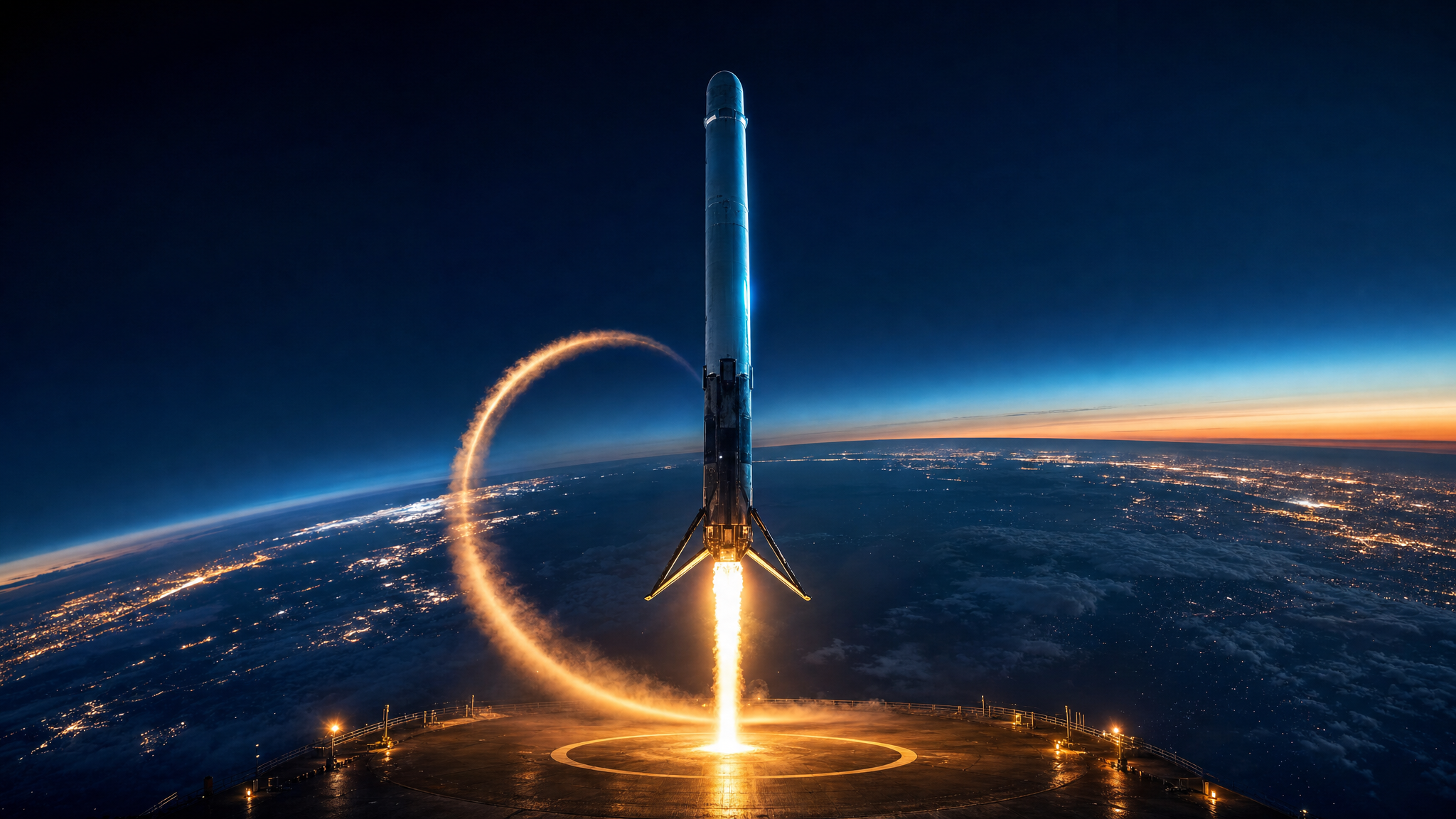
SpaceX was founded in 2002. In 2015, a Falcon 9 booster landed itself back at Cape Canaveral after delivering a payload to orbit. The engineers watching on the floor lost their composure. So did anyone who understood what they were watching: a rocket booster — a $40 million piece of hardware — had just flown itself home to be used again. The cost equation for space access had been broken open.
By 2026, the cost to put a kilogram into orbit on a Falcon 9 is below $2,700. That 95% reduction is not incremental improvement. It is a phase transition — the same kind of phase transition that happened when transistors went from $8 apiece in 1960 to fractions of a cent today, or when solar electricity fell 90% in a decade. When cost falls by 95%, you do not do the same things cheaper. You do entirely different things.
The $1.75 trillion valuation is not the story. It is the market’s answer to a twenty-year-old question: “Is space real now?” And the answer is yes.
The Transition That Everyone Misread
Here is a historical comparison that deserves more attention than it gets.
In 1492, Christopher Columbus sailed west under a royal commission from Queen Isabella of Castile. The Spanish crown funded the voyage. This was not unusual — for most of human history, exploration beyond known frontiers was a government enterprise. Too risky, too capital-intensive, too uncertain for private actors.
Two centuries later, something changed. The transcontinental railroad that stitched North America together was privately financed — built by the Union Pacific and Central Pacific under government land grants, but capitalized by private investors who believed in the return. The telegraph lines that followed. The transatlantic cables. The oil fields of Pennsylvania. The electrical grid that Edison built.
At some point in the arc of exploration and infrastructure, the calculus always flips. Government blazes the trail at public expense. Then costs fall, returns become visible, and private capital takes over — because private capital is better at scaling, more efficient at cost control, more ruthless about eliminating waste, and more motivated to serve customers rather than bureaucracies.
Space just made that transition. NASA had 50 years and hundreds of billions of dollars. They proved it was possible to reach orbit, to land on the Moon, to build permanent stations above the Earth. What they could not do — what government, by its structural nature, is ill-equipped to do — was make it economical. That required the profit motive. That required an entrepreneur willing to bet his entire fortune that he could build a reusable rocket when the aerospace establishment said it was impossible.
“Government proved space was reachable. Markets proved space was affordable. The IPO proves space is now an economic layer of human civilization — the same way the internet is.”
Five Ways Space Already Bends the Arc
The story of space as human progress is not a story about the future. It is happening now, in data, at scale. The metrics that matter most to the arc of human civilization — life expectancy, food security, poverty, knowledge, safety — each have a space component that is already measurable.
Food. Precision agriculture guided by GPS and satellite imagery now directs fertilizer, water, and pesticide application at centimeter-level accuracy across hundreds of millions of acres globally. The result is more food per acre, less chemical runoff, less water consumption. Satellite-based crop monitoring systems give commodity traders, governments, and aid organizations real-time visibility into yield forecasts — preventing the supply shocks that historically caused famines. The Green Revolution fed the world’s growing population in the twentieth century. The Space-Enabled Agricultural Revolution is quietly feeding it more efficiently in the twenty-first.
Connectivity and poverty. The most durable predictor of poverty is disconnection — from markets, information, education, and economic opportunity. Starlink, SpaceX’s satellite internet constellation, now serves over 100 countries with broadband speeds unavailable via ground infrastructure. Approximately 3.5 billion people on Earth still lack reliable internet access. They are disproportionately in sub-Saharan Africa, Southeast Asia, and rural Latin America. Starlink and competing constellations from Amazon’s Project Kuiper and others are building the infrastructure to connect them — not in decades, but now. Access to the internet’s economic layer is access to microfinance, remote work, digital markets, and global education. Space is delivering that access at planetary scale.
Safety and early warning. More people die each year from natural disasters than from war. Hurricanes, typhoons, tsunamis, wildfires, and volcanic eruptions exact their largest tolls not because they are unpredictable — they are increasingly predictable — but because warning systems and response infrastructure fail in the final miles to the people most at risk. The network of satellites monitoring Earth’s surface, atmosphere, and ocean temperatures has compressed warning windows from hours to days for the most severe weather events. NOAA estimates that every dollar invested in weather forecasting infrastructure saves $6 in disaster losses. Space is the backbone of that infrastructure.
Knowledge. The Hubble Space Telescope, launched in 1990 with optics corrected in 1993, produced more fundamental discoveries about the universe in its first decade than ground-based astronomy produced in the preceding century. The James Webb Space Telescope, operational since 2022, has extended that reach to the first galaxies formed after the Big Bang — looking back 13.5 billion years in a single observation session. Space-based observatories do not merely advance science. They expand the cognitive horizon of the species. Understanding the age of the universe, the distribution of dark matter, the prevalence of potentially habitable exoplanets — these are not abstract academic exercises. They are the inputs to a civilization deciding what to do next.
Medicine and life expectancy. NASA has documented over 2,000 technology spinoffs from space research that have entered civilian use — memory foam, scratch-resistant lenses, water filtration membranes, CAT scan enhancement algorithms, insulin pump miniaturization. Less visible but increasingly significant: microgravity manufacturing of pharmaceuticals and biological materials that cannot be produced cleanly in Earth’s gravitational field. Orbital platforms are beginning to manufacture protein crystals for drug development with a precision impossible on the ground. The long arc of space-derived medical technology is still early. But it is already bending the curve.
This Transition Has Happened Before
History offers a clean template for what happens when a new layer of human infrastructure becomes economical and transitions from government project to private platform.
| Era | Government Phase | Market Inflection | What Followed |
|---|---|---|---|
| Printing | Royal manuscripts, church scriptoria | Gutenberg press, ~1450 — print shops proliferate across Europe | Protestant Reformation, Scientific Revolution, the Enlightenment |
| Rail | Government surveys, land grants | Private railroad capital, 1830s–1870s — transcontinental lines complete | Industrialization of agriculture, national labor markets, urbanization |
| Electricity | Edison’s government-backed lab | General Electric IPO, 1892 — grid build-out begins in earnest | The 20th century economy — manufacturing, appliances, modern medicine |
| Internet | ARPANET (DARPA), 1969–1991 | Netscape IPO, August 1995 — market decides internet is real | $30 trillion digital economy; every sector transformed |
| Space | NASA / Soyuz, 1958–2015 | SpaceX IPO (SPCX), June 12, 2026 — market decides space is real | ? |
The final row ends in a question mark — not from uncertainty about the direction, but because the full downstream consequences of a new civilizational layer are never visible at the inflection point. Nobody who watched Netscape close its first trading day at $58 could describe TikTok, cloud computing, or AI as specific products that would follow. What they could see — what the data made clear — was that the infrastructure was now economical, the talent was flowing toward it, the capital was following, and the expansion was going to be faster than anyone’s conservative forecast.
The same logic applies to space in 2026. The specific products and platforms that will define the space economy in 2046 are not yet visible. What is visible: the cost of access has collapsed by 95%, the world’s most valuable company just listed on public markets as proof of concept, the talent pipeline is the deepest in the industry’s history, and the capital will follow.
The Argument That Markets Win
There is a philosophical point embedded in the SpaceX story that deserves to be stated plainly, because it gets obscured when the coverage focuses on Elon Musk’s personality or SpaceX’s valuation multiples.
Government institutions are good at things governments are structurally designed to do: establish safety, set standards, fund basic research, coordinate across jurisdictions, absorb losses that no private actor would tolerate. NASA proved it could reach the Moon when the nation’s full political will and budget were directed at it.
Government institutions are structurally bad at one specific thing: cost reduction through iteration. Government procurement optimizes for political survival and contractor relationships, not lean manufacturing and fast failure. The same $54,000 per kilogram cost that prevailed through most of NASA’s operational history was not a technology problem — it was an incentive problem. Nobody in the government space industrial complex had a financial stake in making launch cheaper.
SpaceX had an existential stake in making launch cheaper. If they failed to drive down cost, they failed as a business. They failed three consecutive times before Falcon 1 first reached orbit in 2008 — with Musk’s personal fortune nearly exhausted. That pressure — the consequence of failure — is what government programs cannot replicate and what markets cannot avoid.
The result of that pressure, applied over twenty years: a 95% cost reduction that fifty years of government programs never approached. The lesson is not that government is useless — NASA’s foundational work made SpaceX’s learning curve possible. The lesson is that government blazes the trail, and markets scale it. Both phases are necessary. But you cannot confuse one for the other.
This Is Not Elon Musk’s Story
The business press will cover the SpaceX IPO as Elon Musk’s story. His biography is genuinely extraordinary, and the drama of his various companies and controversies is genuinely compelling. That is a reasonable story to tell.
It is the wrong frame for what is happening.
Gutenberg did not democratize knowledge. The printing press did. Watt did not industrialize civilization. The steam engine did. The individual’s role in history is to be the vehicle through which an idea, a technology, or a structural force finds its moment. SpaceX’s IPO is the moment when space economics crossed the threshold from government program to market platform. Elon Musk is the vehicle. The arc is the destination.
What matters is the infrastructure: the reusable rockets that will fly hundreds of times, the satellite constellations that are connecting the unconnected, the orbital platforms that will manufacture materials impossible to make on the ground, the supply chain that is developing around launch services the way a supply chain developed around semiconductors after the transistor went commercial.
The question worth asking on June 12 is not “Is $1.75 trillion fair value?” The question is: “What does an economical, commercially scalable space infrastructure mean for life expectancy, for food security, for connectivity, for the knowledge base of the species over the next fifty years?”
History says the answer is: more than we can currently imagine.
The arc of human progress has a new layer. It just went public.