
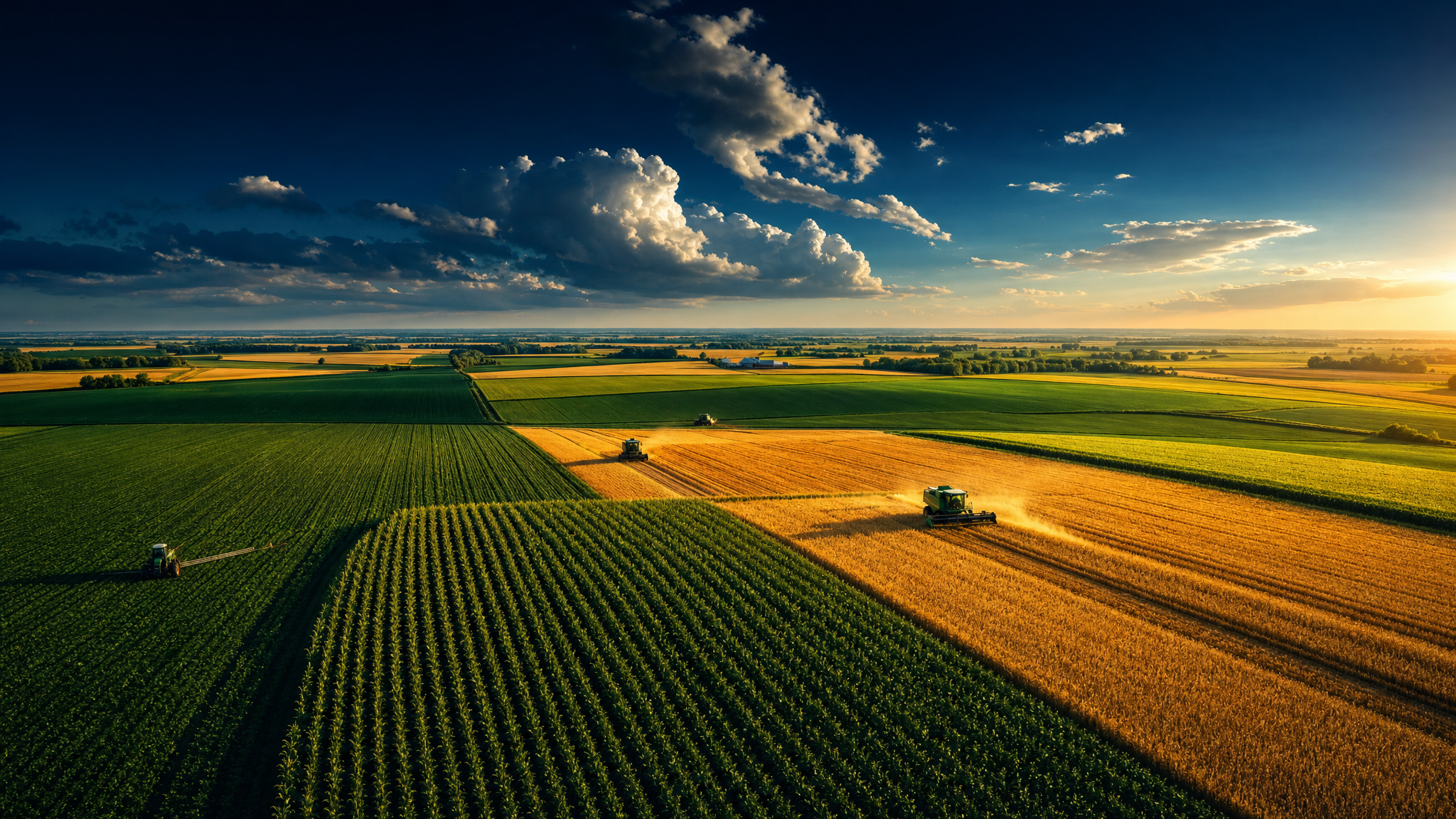
In 1961, the world’s farmers harvested roughly 1.4 metric tons of cereal grain per hectare of farmland. By 2022, that number had reached approximately 4.1 metric tons per hectare. The planet’s cultivated land area grew by less than 10% over that period. The world population grew by nearly 5 billion people.
The arithmetic of how we fed them has never been properly celebrated.
The pessimist narrative about industrial agriculture centers on depletion: that modern farming exhausts soil, requires ever-increasing chemical inputs, and cannot sustain the yields that have so far averted global hunger. What that narrative misses is the mechanism behind every yield improvement—competitive R&D markets constantly solving the next bottleneck. The data on where yields have come from, and where they are going, tells a different story than the depletion narrative.
The Yield Numbers
FAO data shows global cereal yields—covering wheat, rice, maize, barley, sorghum, and other grains that form the core of human nutrition—improved continuously from 1961 through 2022. The improvement was not linear. It accelerated during periods of intensive research investment and slowed when research funding stagnated.
The most dramatic gains came in three waves. The first wave, from the 1960s through the 1980s, was driven by the Green Revolution: semi-dwarf wheat and rice varieties developed by CIMMYT and IRRI that could absorb more fertilizer without lodging. Norman Borlaug’s wheat breeding work alone tripled yields in South Asia within a decade.
The second wave, from the 1980s through the 2000s, was driven by hybrid seed technology and improved fertilizer efficiency. Private seed companies—Monsanto, Pioneer Hi-Bred, Syngenta—competed intensively to develop hybrids with higher yield potential. The mechanism was straightforward market competition: the company that developed the highest-yielding seed captured the largest share of a multi-billion dollar seed market.
The third wave, still underway, combines precision agriculture, gene editing, and AI-guided crop management. GPS-guided planters optimize seed spacing to within centimeters. Satellite and drone imagery identifies stress patterns before they affect yield. CRISPR-based gene editing is producing drought-resistant varieties that maintain yields under climate stress. Each tool reduces inputs per unit of output.
The Land Efficiency Story
The tripling of yields on roughly the same land area is the most important environmental fact in modern agricultural history, and the least discussed.
If 2022 crop yields had remained at 1961 levels, feeding today’s population would have required converting approximately three times as much land to agriculture. That land—roughly an additional 3 billion hectares—does not exist in a form suitable for cultivation without destroying most of the world’s remaining forests, wetlands, and grasslands. The yield revolution did not just feed more people. It implicitly protected enormous tracts of natural habitat from agricultural conversion.
The economist Jesse Ausubel coined the term “peak farmland” to describe the moment—which he argues has already arrived in developed nations—when yield improvements allow total food production to grow while total agricultural land area stays flat or declines. His analysis of USDA and FAO data suggests that if developing nations achieve the crop yields already common in Europe and North America, total global cropland could shrink by 20–25% over the next 50 years, releasing land for natural recovery.
The Depletion Argument, Examined
The serious version of the soil depletion argument holds that modern agricultural practices deplete soil organic matter, create dependence on synthetic nitrogen, and undermine the microbial ecosystems that underlie soil fertility. These are real phenomena in some agricultural systems. They are not universal trends.
Soil organic matter has declined in some heavily cropped regions—parts of the U.S. Midwest, the North China Plain, portions of South Asia’s wheat belt. In other regions, cover cropping, reduced tillage, and precision nutrient management have maintained or improved soil organic matter over the same period. The pattern is not uniform degradation. It is heterogeneous, and the trend in well-managed systems is toward improvement.
More importantly, the same competitive R&D markets that drove yield improvements are now attacking the input-intensity problem. Precision agriculture tools reduce fertilizer and pesticide applications by targeting inputs to where they are most needed. Biologicals—microbial products that enhance nitrogen fixation and phosphorus availability—are replacing synthetic inputs in some production systems. Regenerative agriculture practices are being validated at scale in multiple geographies.
The pattern is not depletion followed by collapse. It is a continuously improving frontier, driven by the same economic logic that drives every cost curve downward.
The Yield Gap and Its Implications
One of the most underreported facts in global food security is the size of the yield gap: the difference between what farmers in a given region actually achieve and what is theoretically achievable with best available practices. In much of Sub-Saharan Africa and South Asia, actual yields are 30–60% below attainable yields. Closing that gap—through better access to improved seed, fertilizer, and crop management knowledge—would increase global food production by 40–70% without converting a single additional hectare to agriculture.
The yield gap is not primarily a technology problem. The technology exists. It is a market access and infrastructure problem: farmers in low-income countries lack affordable access to high-quality seed, credit, and agronomic knowledge. Each of those constraints is being addressed by a growing ecosystem of agricultural technology companies, mobile money platforms, and satellite-based advisory services. As markets have reached more of the world’s poor, access to agricultural inputs has improved alongside everything else.
The Next Yield Revolution
The yield improvements from the Green Revolution era are largely captured in the world’s most productive agricultural systems. The next wave of gains will come from a different set of tools: precision agriculture, AI-guided crop management, and gene editing.
Precision agriculture—using GPS, satellite imagery, and sensors to tailor inputs to spatial variability within fields—is already reducing fertilizer and water use by 15–30% in commercial applications while maintaining or improving yields. AI-based plant disease detection, applied via smartphone apps, is reaching smallholder farmers in Kenya, India, and Indonesia, providing agronomic advice that was previously available only to large commercial producers.
CRISPR-based gene editing is producing varieties with drought tolerance, heat tolerance, and disease resistance that conventional breeding programs could take decades to develop. Unlike transgenic GMOs, many CRISPR-edited varieties are not subject to the regulatory burden that delayed adoption of earlier biotechnology. Varieties are reaching commercial deployment in years rather than decades.
The next yield revolution is not speculative. It is already in the pipeline. Famine has already been driven to near-extinction. The same competitive mechanism that built the first three yield waves is building the fourth.
The Structural Argument
Every Malthusian prediction about food supply has treated agricultural productivity as a slowly-moving constraint that population growth would eventually outpace. Every prediction has been wrong for the same reason: it failed to model the velocity of competitive agricultural research.
The correct model is not a race between two linear trends. It is a dynamic system in which the pressure of growing food demand continually attracts investment into productivity improvement—seed companies, fertilizer companies, precision agriculture companies, biotech companies—all competing to solve the next bottleneck. That competition compounds. It does not exhaust itself.
The same land that fed 2.5 billion people in 1950 now feeds 8.1 billion. Crop yields tripled. The planet got greener, not browner. The arc has always bent toward more food from less land. There is no structural reason to believe that relationship reverses.
Further Reading
- The Omnivore’s Dilemma: A Natural History of Four Meals — Michael Pollan on modern food systems
- The Future of Farming: The Revolution Happening to Agriculture — deep dive on precision agriculture transformation
- Tomorrow’s Table: Organic Farming, Genetics, and the Future of Food — Pamela Ronald on integrating precision biology with sustainable farming
See also: Norman Borlaug and the Green Revolution | How global famine was nearly eliminated