
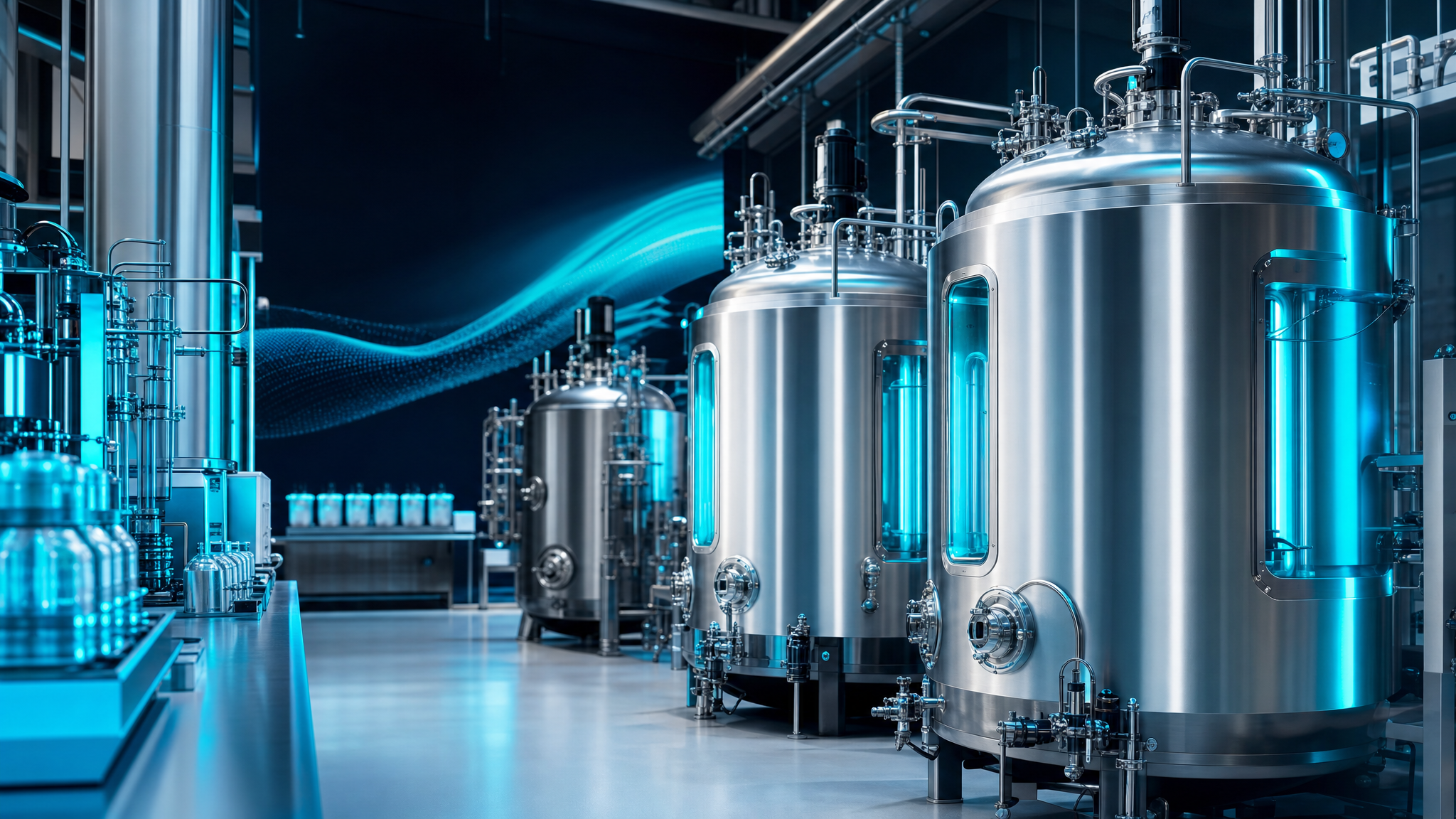
Inside an industrial building in the Netherlands, stainless steel bioreactors produce proteins that are chemically identical to those in cow’s milk. No cows. No pasture. No feed crops. No methane. The process uses microorganisms—yeast, fungi, bacteria—programmed via inserted genetic sequences to produce specific proteins on demand. It is called precision fermentation, and it is already operating at commercial scale.
The pessimist argument is that we cannot feed 10 billion people sustainably—that modern agriculture uses too much land, too much water, generates too much carbon, and is already at the edge of what the planet can absorb. The data on precision fermentation suggests a different conclusion: we are at the early stages of a food production revolution that will do to agriculture what solar did to electricity—drive costs down by an order of magnitude while dramatically reducing environmental footprint.
How Precision Fermentation Works
Conventional dairy requires a cow. The cow requires feed crops—typically soy and corn, which require land, water, pesticides, and fertilizer. The cow converts that feed into milk at roughly 25% efficiency. The land, water, and carbon costs of that inefficient conversion chain are enormous: dairy is one of the most resource-intensive food systems on the planet.
Precision fermentation eliminates most of that chain. Instead of a cow, the production system uses microorganisms in a bioreactor. A gene sequence encoding for a specific dairy protein—beta-lactoglobulin, casein, whey—is inserted into a yeast or fungal strain. The microorganism produces that protein as it ferments a sugar feedstock. The protein is then extracted, purified, and formulated into food products that are molecularly identical to conventional dairy proteins.
The resource math is stark. Research published in Frontiers in Sustainable Food Systems found that precision-fermented milk has a land footprint up to 96% lower than conventional cow’s milk. A separate analysis by RethinkX found that precision fermentation uses 87% less water than conventional cattle-derived protein production. Carbon emissions per unit of protein are estimated at 60–80% lower, depending on the energy source powering the bioreactors.
The Solar Parallel
Solar power cost $76 per watt in 1977. By 2024, the cost was below $0.20 per watt—a 99.7% reduction driven by Swanson’s Law: every doubling of cumulative production cuts costs by approximately 20%. The mechanism was not magic. It was the compounding effect of hundreds of companies competing to reduce manufacturing costs, improve efficiency, and scale production.
Precision fermentation is following an analogous trajectory. The core constraint is fermentation efficiency—how much protein a bioreactor can produce per liter per hour. That efficiency is improving rapidly through advances in strain engineering, fermentation optimization, and process scale-up. As efficiency improves and production scales, cost per kilogram falls.
The investment data confirms the trend. Over 700 companies focused on precision fermentation, cellular agriculture, and alternative proteins have received funding in the last decade, totaling over $15 billion in investment. The competition is global: the United States, Singapore, Israel, the Netherlands, and China are all running parallel development programs. Each company is racing to achieve cost parity with conventional animal proteins first—because that is when the market tips.
What’s Already on Shelves
This is not speculative technology. Precision fermentation has been producing ingredients in the food supply for decades. Rennet—used in cheese making—has been produced via fermentation since the 1990s and now accounts for over 80% of global rennet supply. Vitamin B12, used in supplements, is almost entirely fermentation-produced. The same process now produces whey protein, casein, egg white protein, and heme (the compound that gives meat its flavor).
Perfect Day, a California-based company, has been selling fermentation-produced whey protein to food manufacturers since 2020. Its proteins are used in ice cream, protein powders, and baked goods sold by major food brands. The products taste identical to conventional dairy—because the proteins are identical at the molecular level.
Remilk in Israel, New Culture in the U.S., and TurtleTree in Singapore are each scaling production of casein proteins—the proteins responsible for cheese’s stretch and melt. The cheese applications are the largest commercial prize: global cheese markets represent over $150 billion annually.
The 10 Billion Person Calculation
The skeptical argument against feeding 10 billion people sustainably is essentially a land and water argument. Conventional animal agriculture uses approximately 77% of all agricultural land globally while producing only 18% of global calories. That is an extraordinarily inefficient allocation. If precision fermentation achieves cost parity with conventional animal proteins—and current trajectories suggest that is a question of when, not if—the land freed by reducing conventional livestock operations would be enormous.
RethinkX’s food and agriculture analysis projects that by 2035, precision fermentation and cellular agriculture could displace 60–80% of conventional animal product demand in developed markets. The land released would dwarf the area of all current U.S. cropland. That land could be reforested, rewilded, or converted to more efficient plant-based food production.
The same analysis that concluded Malthus was wrong about the Green Revolution applies here. The constraint is not fixed. The protein of the future is already being brewed, not raised, and the economics are following the same cost curves that reshaped solar, computing, and genomics before it.
The Regulatory Runway
The primary constraint on precision fermentation today is not technology—it is regulatory approval. Novel food ingredients require extensive safety review in most jurisdictions. The U.S. FDA and USDA have approved several precision-fermented products, establishing regulatory precedent. Singapore became the first country to approve cultivated meat in 2020. The EU has an active novel foods dossier pipeline.
As more products receive approval and as safety records accumulate, the regulatory constraint will relax. That pattern is consistent with every previous food technology transition—margarine, pasteurization, preservatives, fortified foods—each of which moved from novel and regulated to standard and unremarkable.
The Arc Closes
The worry that modern food systems can’t scale to 10 billion people sustainably is a legitimate observation about the current system. It is not a permanent constraint. Global famine has already been driven to near-extinction by the compounding of agricultural innovation since the Green Revolution. Precision fermentation is the next wave of that same process.
The factory that makes milk without cows is already running. The cost curves are moving. The competitive pressure from hundreds of funded companies is relentless. The direction is set—the same direction every technology cost curve points once competition takes hold.
Further Reading
- Rethinking Food and Agriculture: New Ways Forward — Allison Lanier on the coming transformation in food systems
- The Future of Food: How Digital Technology Is Changing the Way We Eat — comprehensive look at food tech disruption
- Clean Meat: How Growing Meat Without Animals Will Revolutionize Dinner and the World — Paul Shapiro on the alternative protein revolution
See also: The aquaculture revolution that fed a billion more people | How 800 million people escaped extreme poverty