
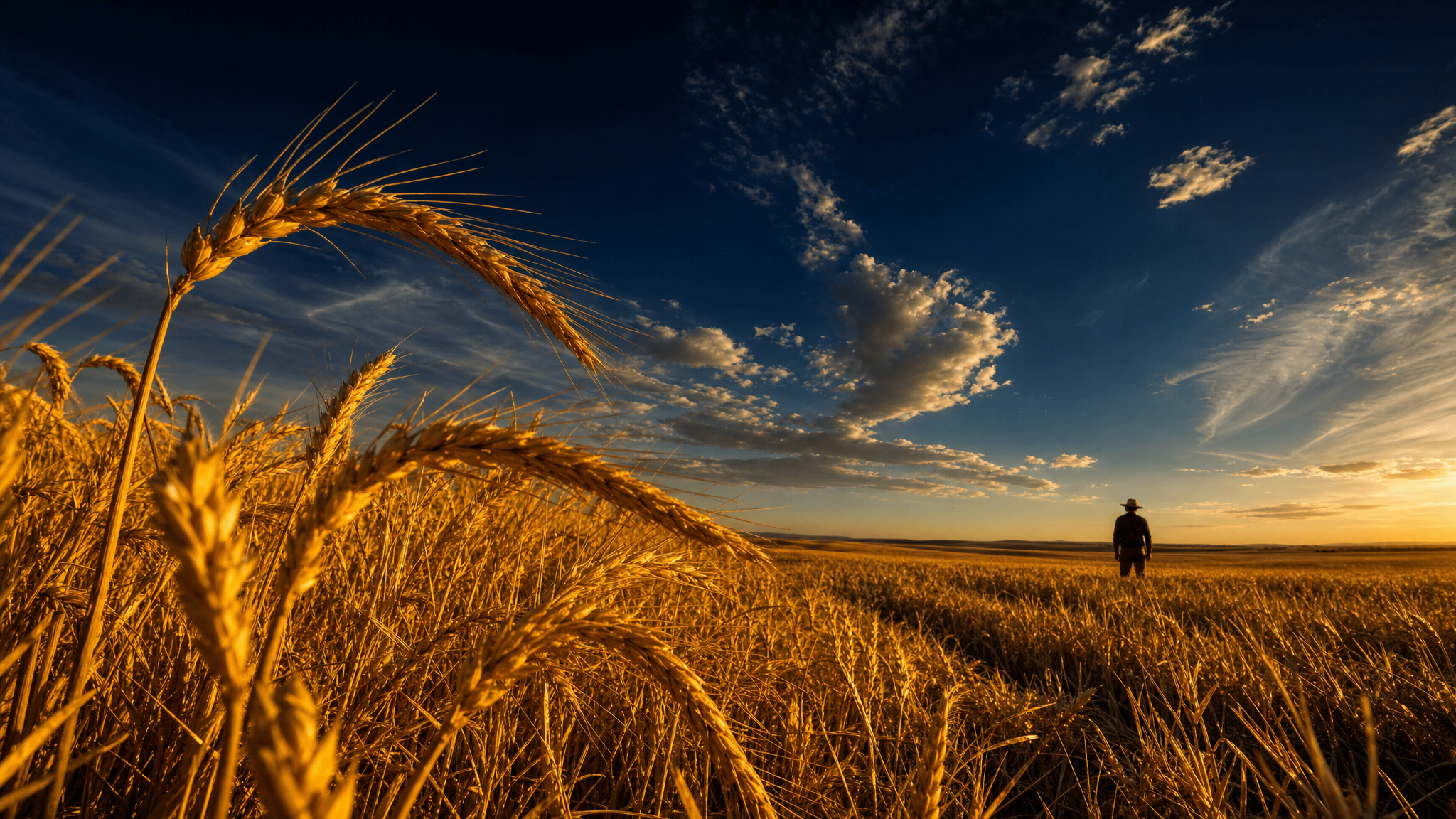
In 1944, a 30-year-old plant pathologist named Norman Borlaug arrived in Mexico with a simple assignment: help farmers grow more wheat. What he built over the next three decades didn’t just solve a food problem. It quietly rewrote the trajectory of human civilization.
Borlaug is credited with saving approximately one billion people from starvation. He received the Nobel Peace Prize in 1970. He was awarded the Presidential Medal of Freedom and the Congressional Gold Medal. He is one of only seven people to have received all three of America’s highest civilian honors.
Almost nobody outside agriculture knows his name.
The Problem Malthus Got Wrong
In 1798, the English economist Thomas Robert Malthus published his famous essay on population. His conclusion: population grows geometrically while food production grows arithmetically. Eventually, population will outrun food. Famine is not a catastrophe to be prevented—it is a mathematical correction, as inevitable as arithmetic itself.
For 150 years, Malthus was a serious intellectual position. Population did grow. Famines did occur. India experienced catastrophic famines in the 1870s, 1890s, and again in 1943, killing tens of millions. China’s Great Leap Forward famine of 1959–1961 killed an estimated 15 to 55 million people. As recently as 1967, respected demographers were predicting mass starvation in Asia within a decade.
Borlaug made those predictions look foolish.
What He Actually Built
The core problem with wheat in the 1940s was yield and disease. Traditional wheat varieties were tall—their long stalks lodged (fell over) when fertilized, wasting nutrients. They were vulnerable to rust fungus. And they produced modest yields that left little margin for error.
Borlaug’s solution came in two phases. First, he developed disease-resistant wheat varieties through systematic cross-breeding with Japanese semi-dwarf wheat strains. The shorter stalks could hold more grain without lodging. Second, he pioneered shuttle breeding—growing two crops per year in different locations in Mexico—doubling the pace of genetic selection. What would have taken decades happened in years.
The results were extraordinary. In Mexico, wheat yields more than tripled between 1950 and 1970. When Borlaug brought his seeds to South Asia in the mid-1960s, the transformation was even more dramatic. India’s wheat production grew from 12 million tons in 1965 to 17 million tons in 1968 to over 20 million tons by 1970. Pakistan achieved self-sufficiency in wheat within three years of adopting the new varieties. Countries that had been planning famine relief were instead exporting food.
The Competitive Engine Behind the Science
The standard telling of the Green Revolution focuses on Borlaug’s genius. The more important story is the institutional architecture that enabled it.
The Rockefeller Foundation launched its Mexican agricultural program in 1943 as a deliberate response to Cold War competition. The concern was not academic: hunger-driven political instability in the developing world was seen as fertile ground for Soviet influence. Private philanthropy, U.S. foreign policy interests, and scientific ambition converged in a single research institution.
CIMMYT—the International Maize and Wheat Improvement Center that grew from Borlaug’s work—was designed on competitive research principles. Scientists from multiple countries worked in parallel. Varieties were tested across dozens of growing environments. Success was measured in yield data, not academic publications. The result was a faster-moving, more results-oriented scientific machine than anything government bureaucracies could produce.
India: The Most Important Field Trial in History
By 1965, India was on the verge of catastrophe. Two consecutive monsoon failures had depleted grain reserves. The U.S. was airlifting 11 million tons of grain per year just to prevent mass starvation—a program so large it strained American agricultural capacity. Indian Prime Minister Lal Bahadur Shastri authorized a massive import of Borlaug’s semi-dwarf wheat seed, over the objections of officials who doubted a foreign variety would perform in Indian conditions.
The results silenced the doubters. By 1974, India was self-sufficient in all cereals. By the 1980s, India had accumulated grain reserves. A country that had depended on charity to feed its people became a food exporter within a single decade.
Pakistan’s transformation was equally rapid. The Philippines and Indonesia adopted Green Revolution rice varieties—developed by the International Rice Research Institute, modeled directly on Borlaug’s wheat program—with similar results. The demographic catastrophe that serious experts had considered inevitable simply did not arrive.
What Malthus Missed
Malthus treated agricultural productivity as a fixed constraint—something that grew slowly and linearly, unable to keep pace with exponential population growth. What he could not model was the capacity of competitive research institutions to continuously push the frontier outward.
Every yield improvement that followed Borlaug followed the same pattern: a specific constraint was identified, researchers competed to solve it, the winning solution was widely deployed, yields rose, and the constraint shifted to the next bottleneck. Rust resistance led to semi-dwarf varieties led to hybrid seeds led to precision irrigation led to GPS-guided planting.
The data tells the story. Global wheat yield per hectare averaged roughly 1.1 tons in 1960. By 2022, it had reached 3.5 tons. Cereal yields broadly—including maize and rice—tripled across the same period. The world fed 5 billion additional people on roughly the same amount of farmland.
That is not an accident. It is the compound result of thousands of researchers, seed companies, fertilizer manufacturers, and agricultural equipment makers competing to extract more food from every acre.
The Uncomfortable Footnote
Borlaug spent the last years of his life frustrated. He had won the battle for food production, but he worried the next battle was being lost before it started. Opposition to genetically modified crops—his natural successors to the semi-dwarf wheat program—was delaying technologies that could have fed hundreds of millions more people with even fewer inputs.
He said in a 2000 interview: “I now say that the world has the technology—either available or well advanced in the research pipeline—to feed on a sustainable basis a population of 10 billion people. The more pertinent question today is whether the farmers and ranchers of the world will be permitted to use this new technology.”
The pessimists had changed their argument. Instead of claiming technology couldn’t solve hunger, they argued the technology was too dangerous to use. Borlaug, who had watched millions nearly starve while waiting for ideological consensus, had little patience for that position.
The Arc Continues
Borlaug’s work is still compounding. Dwarf wheat varieties remain the foundation of global wheat production. Biofortified crops—varieties engineered to contain higher levels of zinc, iron, and vitamin A—are now being deployed in South Asia and Sub-Saharan Africa, addressing micronutrient deficiencies that affect over 2 billion people. Precision agriculture uses satellite imagery and AI-guided planting to push yields higher while reducing fertilizer and water use.
Each breakthrough follows the same curve Borlaug set in motion. The driver is always the same: scientists and farmers competing to produce more from less.
The famine pessimists have been wrong every decade since 1960. They have been wrong not because the problem wasn’t real—it was—but because they consistently underestimated the velocity of competitive research. Global famine deaths have fallen by over 99% since the early 20th century. The world that Malthus predicted never arrived. The world Borlaug built did.
His name deserves to be known.
Further Reading
- The Man Who Fed the World: Nobel Peace Prize Laureate Norman Borlaug and His Battle to End World Hunger — Leon Hesser’s definitive biography
- Enough: Why the World’s Poorest Starve in an Age of Plenty — Roger Thurow & Scott Kilman on the politics of hunger
- The Wizard and the Prophet: Two Remarkable Scientists and Their Dueling Visions to Shape Tomorrow’s World — Charles Mann on Borlaug vs. the pessimists
See also: How 800 million people escaped extreme poverty | The aquaculture revolution that fed a billion more people