
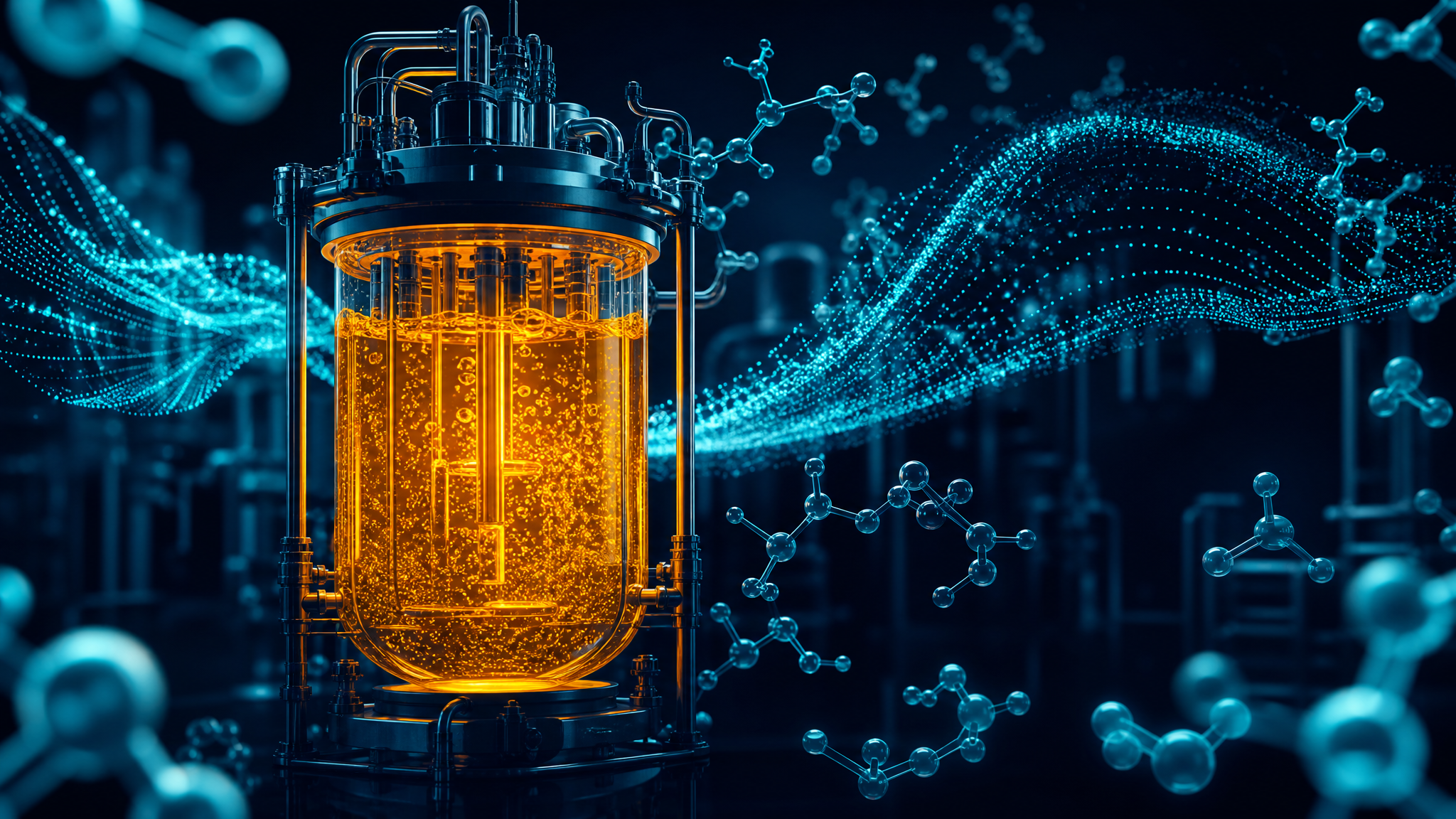
The factory is in Denmark. It looks like a brewery — because it essentially is one. Inside stainless steel fermentation tanks, microorganisms are producing proteins that are chemically identical to those found in cow’s milk. No cows required. No pasture. No methane. The product is already on American grocery shelves. This is precision fermentation, and it is moving from proof-of-concept to industrial infrastructure faster than almost anyone in conventional agriculture expected.
Remilk, an Israeli biotech company, opened a 65,000-square-foot precision fermentation facility in Kalundborg, Denmark in 2023 — the largest of its kind in the world at the time of its opening. The plant is designed to produce milk proteins at a scale that can compete with conventional dairy supply chains. The location is not accidental: Denmark has a century-old dairy infrastructure, trained fermentation engineers, and food-grade regulatory frameworks that are among the most efficient in the world.
The company is using a process that has existed in pharmaceutical manufacturing for decades. You engineer a microorganism — typically a yeast or fungus — to produce a specific protein by inserting the relevant gene sequence. The organism ferments in a sugar-rich broth, expresses the protein, and you extract it. The resulting molecule is structurally identical to its animal-derived counterpart, because it was produced by the same genetic instructions. The difference is the host.
Perfect Day and the Consumer Proof Point
While Remilk was building in Europe, Perfect Day — the California company that pioneered animal-free whey protein — was demonstrating that consumers would buy it. The company’s whey protein, produced via precision fermentation, has appeared in products sold by major US retailers under brands including Brave Robot ice cream. The company has raised over $750 million in capital and partnered with food companies including Archer-Daniels-Midland for manufacturing scale.
The consumer test result is significant: in blind taste tests, precision-fermented dairy proteins perform identically to conventional dairy, because chemically they are identical. The objection that plant-based alternatives typically face — that they taste or texture differently — does not apply here. You are not replacing dairy protein with something approximating it. You are producing the same protein through a different manufacturing pathway.
The Cost Curve That Changes Everything
The critical variable for precision fermentation is cost — and the cost has been falling for a decade. McKinsey’s analysis projects cost parity with conventional dairy proteins by 2030. The reduction since 2013 has been roughly 90 percent, following a learning curve that resembles solar panels or lithium-ion batteries more than it resembles traditional food manufacturing.
The analogy is not casual. Solar didn’t become the cheapest form of new electricity generation because of a single breakthrough. It became cheap because of compounding improvements in manufacturing efficiency, supply chains, and deployment scale. Precision fermentation appears to be following the same dynamic: each new facility is cheaper to build than the last, each fermentation run is more efficient, and each kilogram of protein produced carries a lower cost basis.
“We’re not competing with meat. We’re building an entirely new supply chain for protein — one that doesn’t have the land, water, and climate constraints of the old one.” — Ryan Pandya, CEO, Perfect Day
Why This Matters at a Planetary Scale
The framing of precision fermentation as an environmental story is accurate but incomplete. The deeper structural issue is protein supply security. Global protein demand is projected to increase by 70 percent by 2050, driven by the same population growth and income rises that have already lifted three billion people into the middle class, driven by population growth and rising incomes in South and Southeast Asia. Conventional agriculture cannot meet that demand on current land use without catastrophic consequences for biodiversity, water systems, and carbon emissions.
Precision fermentation doesn’t need land. It needs fermentation tanks, sugar feedstocks, and engineered microorganisms. The 65,000-square-foot Remilk facility in Denmark produces volumes of protein that would require thousands of acres of pasture to generate conventionally. As the technology scales, it decouples food security from agricultural geography — a shift with profound implications for countries that currently import large shares of their protein from a small number of exporting nations.
The Regulatory Frontier
Precision fermentation products require regulatory approval in most markets, and the process varies significantly by country and by the specific protein being produced. In the United States, the FDA has completed pre-market consultations for several precision fermentation proteins, including Perfect Day’s whey. The European Food Safety Authority has its own Novel Food process, which Remilk and others are navigating.
The regulatory pathway is slower than the technology, which creates a gap between what’s scientifically possible and what’s commercially available in any given market. But the frameworks are moving: Singapore approved precision fermentation chicken in 2020, and regulators in the UK, Australia, and Canada have all signaled they are developing updated guidelines. The direction of travel is clear even where the arrival date is uncertain.
The deeper significance of precision fermentation is not that it will replace conventional food systems entirely — at least not quickly. It is that it introduces a genuinely new manufacturing pathway for protein that is not bounded by the same constraints as agriculture. A factory producing dairy proteins in Denmark uses the same ingredients and the same basic process as one in Malaysia, India, or Chile. The technology is, in principle, geography-agnostic. That is a structural change in how humanity can feed itself — one that is already off the drawing board and onto the factory floor.
The How Well We Eat dimension of the Arc Index tracks not just calorie abundance but protein quality and access. Precision fermentation addresses both: it produces complete proteins identical to those found in animal products, through a process that is scalable to countries that currently cannot sustain conventional animal agriculture. It is the most significant structural shift in protein production since the Green Revolution — and unlike the Green Revolution, it doesn’t require more land.
-
Regenesis by George Monbiot
Monbiot’s controversial but rigorous argument that precision fermentation and food technology are the only path to feeding the world without destroying nature. Required reading for understanding the stakes. -
The End of Animal Farming by Jacy Reese Anthis
The evidence-based case for why animal agriculture will be replaced by technology within decades — and why precision fermentation is the leading candidate to do it.
📚 Recommended Reading

A recommended book that goes deeper on this topic.
View on Amazon →Bold Arc earns a small commission on purchases at no extra cost to you.