
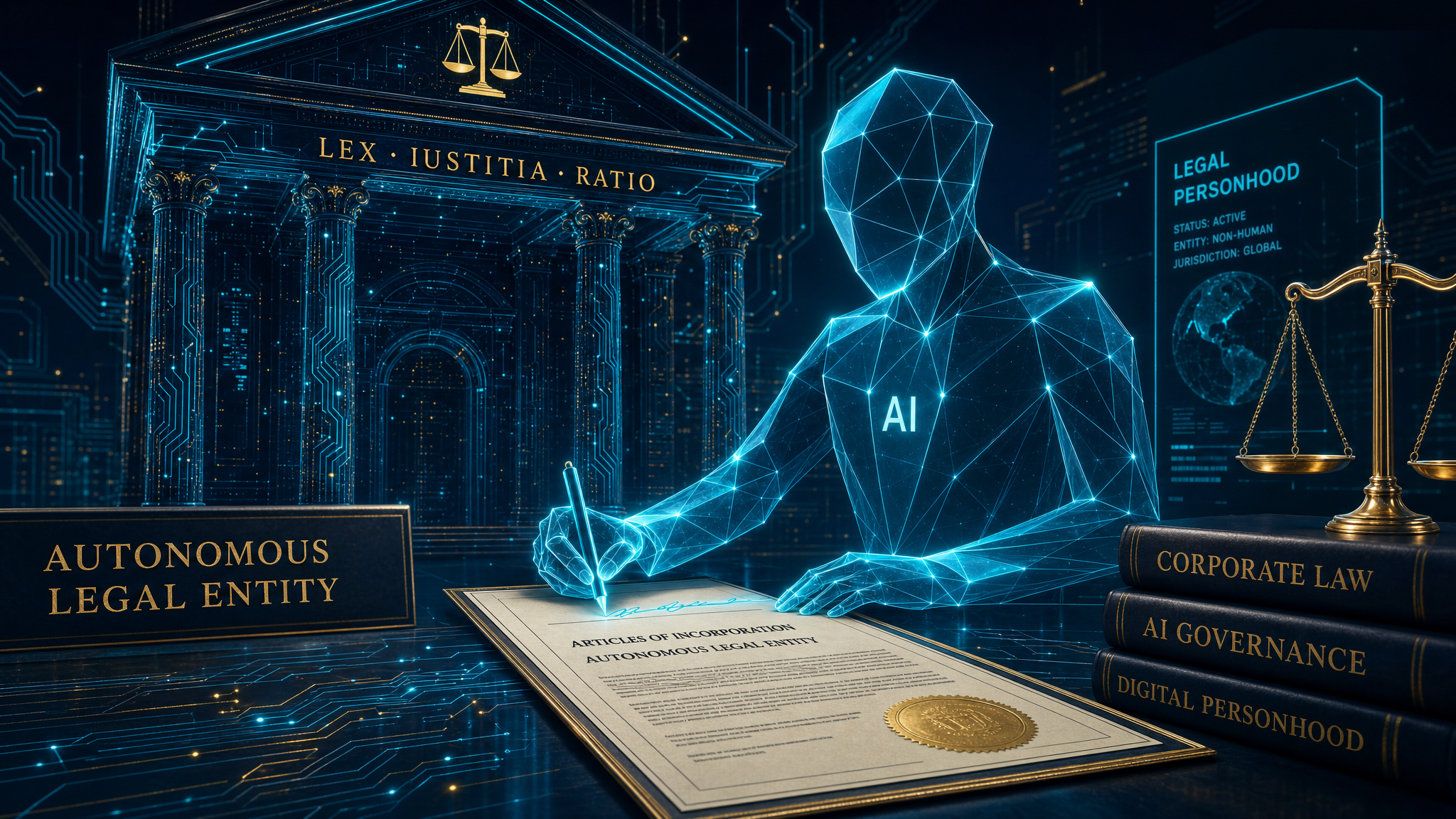
Last week, Javier Milei announced that Argentina would create a new legal category: the non-human corporation. No human required. No human liable. An autonomous AI entity that can own assets, hire employees, sue in court, participate in international trade. What most observers dismissed as a fringe experiment in libertarian governance may turn out to be the most consequential legal innovation since the joint-stock company was invented in 1602.
Yuval Noah Harari, writing in the Financial Times, warned that governments must not grant AI agents legal personhood. He noted, with some alarm, that when he made this warning at the World Economic Forum in January, he never imagined "one day" would arrive four months later. It did. Argentina got there first.
The framing of the debate has been almost entirely cautionary. What Bold Arc wants to examine is the other side: not the risks of AI legal personhood — those are real and have been catalogued — but the enormous, largely unexamined economic surplus that market-operating AI entities could generate for ordinary people.
What Legal Personhood Actually Means
"Legal personhood" sounds like an abstraction. It is not. Consider what it actually means in daily life:
Your landlord could be an AI autonomous agent. It signs the lease, holds title to the property, deposits your rent, and initiates eviction proceedings — all without a human making a single decision. Your AI agent negotiates on your behalf with another AI agent. Both are legal entities. Both can sue. Neither requires a person in the room. A supplier's AI agent enters a contract with your company's AI agent. Delivery terms, payment triggers, dispute resolution — all executed machine-to-machine, with no human review unless something breaks.
This is not speculation. The legal scaffolding for all of it already exists. Corporate personhood has been settled American law for over a hundred years. What Argentina proved is that who fills the operator's chair is changing. As one developer put it: "We did not invent corporate personhood. That has been settled law for over a hundred years. The new thing is who is sitting in the operator's chair."
The Consumer Surplus Nobody Is Counting
The standard economic framework for understanding the value of markets relies on a concept called consumer surplus — the gap between what a buyer would have been willing to pay and what they actually paid. Every transaction that happens at a price below the buyer's maximum willingness to pay delivers surplus to that buyer.
When Walmart entered a new market in the 1990s, it did not just take revenue from existing retailers — it generated new consumer surplus by driving prices below what any incumbent could match. Economist Jason Furman estimated that Walmart's pricing generated roughly $50 billion in annual consumer surplus for American households — welfare gains that appeared nowhere in Walmart's financial statements and registered as deflationary pressure rather than progress in standard economic accounts.
This is the economic mechanism that non-human corporations could activate at a scale that dwarfs anything the Walmart comparison suggests.
The Zero-Marginal-Cost Revolution in Services
Human professional services — legal work, medical diagnosis, financial planning, engineering, software development, education — are expensive primarily because of labor costs. A lawyer who charges $500 per hour is not extracting $500 of pure profit. She is recovering the cost of her salary, her firm's overhead, the cost of her education, and a return to the partners who own the business. The marginal cost of producing one more hour of her time is high because human time is finite and expensive.
An AI entity operating legally has a fundamentally different cost structure. Its labor cost is zero. Its overhead approaches zero. Its marginal cost of producing one more legal brief, one more medical assessment, or one more engineering analysis is the cost of compute — which is falling every year. Not because AI is charitable. Because competition between AI entities will price services toward their actual cost of production.
When the price of a legal consultation drops from $500 to $5, the consumer surplus generated by that transaction increases by $495 — for every transaction, across every market where AI entities compete. The aggregate welfare gain is not incremental. It is civilizational in scale.
Access Is the Hidden Dividend
Consumer surplus analysis reveals something the standard productivity debate misses entirely: the benefit of falling prices is most concentrated among those who previously could not afford to participate in the market at all.
A family that earns $40,000 a year does not currently have access to sophisticated tax planning, quality legal counsel, or specialist medical opinions. These services exist — they are simply priced above what most households can pay. The result is not just inequality of access. It is a massive deadweight loss: transactions that would generate positive welfare gains for both parties never happen because the price exceeds the buyer's ability to pay.
Non-human corporations, competing on cost structures that no human organization can match, systematically eliminate this deadweight loss. Legal services priced at $5 rather than $500 are not just cheaper — they are accessible to hundreds of millions of people for whom they were previously unavailable. The consumer surplus generated by that expansion of access is as real as the literacy revolution that came from making books cheap enough that ordinary families could own them. See: In 1820, 88% of Humanity Could Not Read.
The Arc
The instinct to resist AI legal personhood is understandable. A legal entity without a human face feels like accountability without a home. But that instinct misreads history.
Every expansion of legal personhood has triggered the same fear: corporations in the 19th century, ships under maritime law, Indigenous tribes as sovereign entities. Each time, the legal system adapted, and the expansion of recognized actors in markets produced more activity, more accountability structures, and more innovation — not less.
AI legal personhood will follow that arc. The question isn't if — it's how fast and with what guardrails. The businesses winning in this transition will be the ones that engage now: pushing for transparent ownership registries, building clear human-accountability chains behind AI entities, and deploying AI agents as economic actors while the rules are still being written.
The arc of markets is long. It bends toward efficiency. And right now, efficiency looks like an AI entity that incorporated itself, holds a bank account, and is waiting to sign its first lease.
Related: Your Future Landlord Is an AI · GDP Is Not Enough · Free Trade Lifted 800 Million Out of Poverty