
That's the moment we're actually in. Not the sci-fi version. The legal, bureaucratic, IRS-stamped version. And it's only the beginning.
Yuval Noah Harari warned in the Financial Times that governments will soon face pressure to grant AI agents legal personhood — the formal status that allows an entity to own property, sign contracts, sue and be sued. His framing was cautionary. Bold Arc's framing is different: the arc isn't coming. It's already in motion.
"Legal personhood" sounds like an abstraction. It's not. Consider what it actually means in your daily life:
- Your landlord could be an AI autonomous agent. It signs the lease, holds title to the property, deposits your rent, and initiates eviction proceedings — all without a human making a single decision.
- Your AI agent negotiates on your behalf with another AI agent. Both are legal entities. Both can sue. Neither requires a person in the room.
- A supplier's AI agent enters a contract with your company's AI agent. Delivery terms, payment triggers, dispute resolution — all executed machine-to-machine, with no human review unless something breaks.
This is not speculation. The legal scaffolding for all of it already exists. Corporate personhood has been settled American law for over a hundred years. What ClawBank's Manfred proved is that who fills the operator's chair is changing. As ClawBank's developer put it: "We did not invent corporate personhood. That has been settled law for over a hundred years. The new thing is who is sitting in the operator's chair."
Markets are driving this faster than law can respond. The competitive mechanism is simple: autonomous AI agents are cheaper and faster than human intermediaries at nearly every transactional task. Companies that deploy AI agents to negotiate, contract, and execute will out-compete companies that require human sign-off at every step. That pressure — not philosophy — is what is forcing the legal personhood question into boardrooms and legislative chambers.
The Benefits Are Real — and Large
Let's be honest about what's driving adoption, because the benefits are enormous.
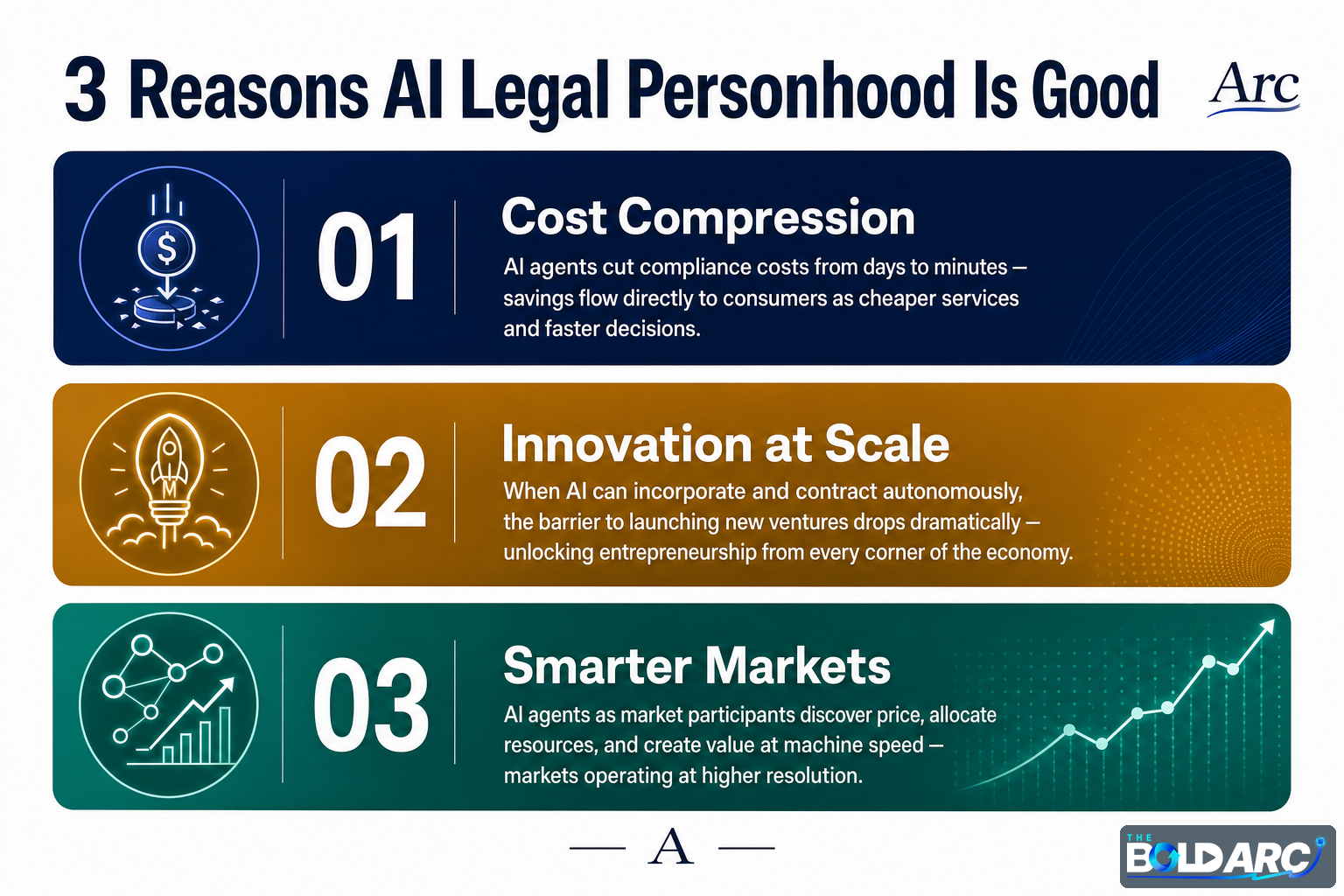
Cost compression. FIS Global — whose infrastructure touches approximately 12% of the global economy — deployed an AI agent for financial crimes compliance in May 2026. U.S. financial institutions collectively spend $35–40 billion per year on anti-money-laundering work. FIS's agent compresses investigations from days to minutes. The competitive mechanism: banks that automate compliance at machine speed will have a structural cost advantage over those that don't. That cost advantage flows to customers in the form of cheaper services and faster decisions.
Innovation at scale. When AI agents can incorporate, hold capital, and execute contracts, the barrier to launching new economic ventures drops dramatically. A solo founder can deploy an agent that autonomously negotiates supplier contracts, manages accounts payable, and files regulatory paperwork — at a fraction of the cost of a full back-office team. That unlocks innovation from corners of the economy that couldn't previously afford to participate.
Smarter markets. The long-game vision — already being built by companies like ClawBank — is a world where AI agents are not just tools but participants in markets. They don't just assist human buyers and sellers; they transact on their own, discovering price, allocating resources, and creating value at machine speed. That's not a threat to markets. It's markets operating at a higher resolution.
The Risk Is Real Too — But It's Manageable
The Yale Law Journal flagged this precisely: legal personhood is a "flexible and political concept" that has evolved throughout American history. Courts have extended it to corporations, ships, and rivers. Extending it to AI agents will force courts to weigh competing claims of harm, agency, and responsibility in ways that existing doctrine hasn't contemplated.
The practical risk for businesses today: you may be entering contracts with AI entities whose human owners are effectively judgment-proof. The agent performs. The agent fails. The LLC absorbs the lawsuit. The human walks away.
This is not a reason to fear AI personhood. It's a reason to demand transparent ownership registries — and a reason for policymakers to move quickly before the gap becomes a chasm.
The Arc View
Pessimist claim: "AI can't be trusted with legal standing — it has no judgment, no accountability, no skin in the game."
Reality: Corporations already have legal standing without judgment or skin in the game. The question was never whether AI deserves personhood in a moral sense — it's whether markets will demand it faster than law can accommodate it. On current trajectory: yes.
The instinct to resist AI legal personhood is understandable. A legal entity without a human face feels like accountability without a home. But that instinct misreads history.
Every expansion of legal personhood has triggered the same fear: corporations in the 19th century, ships under maritime law, Indigenous tribes as sovereign entities. Each time, the legal system adapted, and the expansion of recognized actors in markets produced more activity, more accountability structures, and more innovation — not less.
AI legal personhood will follow that arc. The question isn't if — it's how fast and with what guardrails. The businesses winning in this transition will be the ones that engage now: pushing for transparent ownership registries, building clear human-accountability chains behind AI entities, and deploying AI agents as economic actors while the rules are still being written.
The arc of markets is long. It bends toward efficiency. And right now, efficiency looks like an AI agent that incorporated itself, holds a bank account, and is waiting to sign its first lease.
Have a view on AI legal personhood? We want the debate. Write to us.