
The AI catastrophists have a prediction problem. Not a values problem — the concern about jobs is genuine and human. But a data problem.
Every major technology in history — the steam engine, the automobile, electricity, the internet — was predicted to destroy jobs permanently. Every single time, the economy created more jobs than it destroyed, almost entirely in industries that didn't exist before the technology arrived. The people who ran the horse-and-buggy economy didn't disappear into unemployment. They became mechanics, gas station attendants, highway engineers, and auto insurers.
AI will follow the same pattern. Not because of optimism — because of the most consistent law in the history of technological development. And this time, there is a second force the catastrophists have never modeled: the new industries created by AI will need more workers than the economy can provide.
America won't run out of jobs. It will run out of workers to fill them.
Blind Spot One: America Is Running Out of Workers
Steven Ruggles is not a tech pundit. He is a professor at the University of Minnesota, a 2022 MacArthur Genius grant recipient, and one of America's foremost demographers. His research, published this May in the Proceedings of the National Academy of Sciences, tells a story the catastrophists never modeled.
The labor force surge that defined 20th-century America is structurally over. The baby boom peaked at 24 million net new workers in the 1970s. Women's labor force participation — which rose dramatically from 30% in 1950 to 77% by 1990, a massive hidden reserve — has plateaued. No equivalent pool exists to replace it. Fertility rates have declined since the mid-2000s. Immigration has flattened.
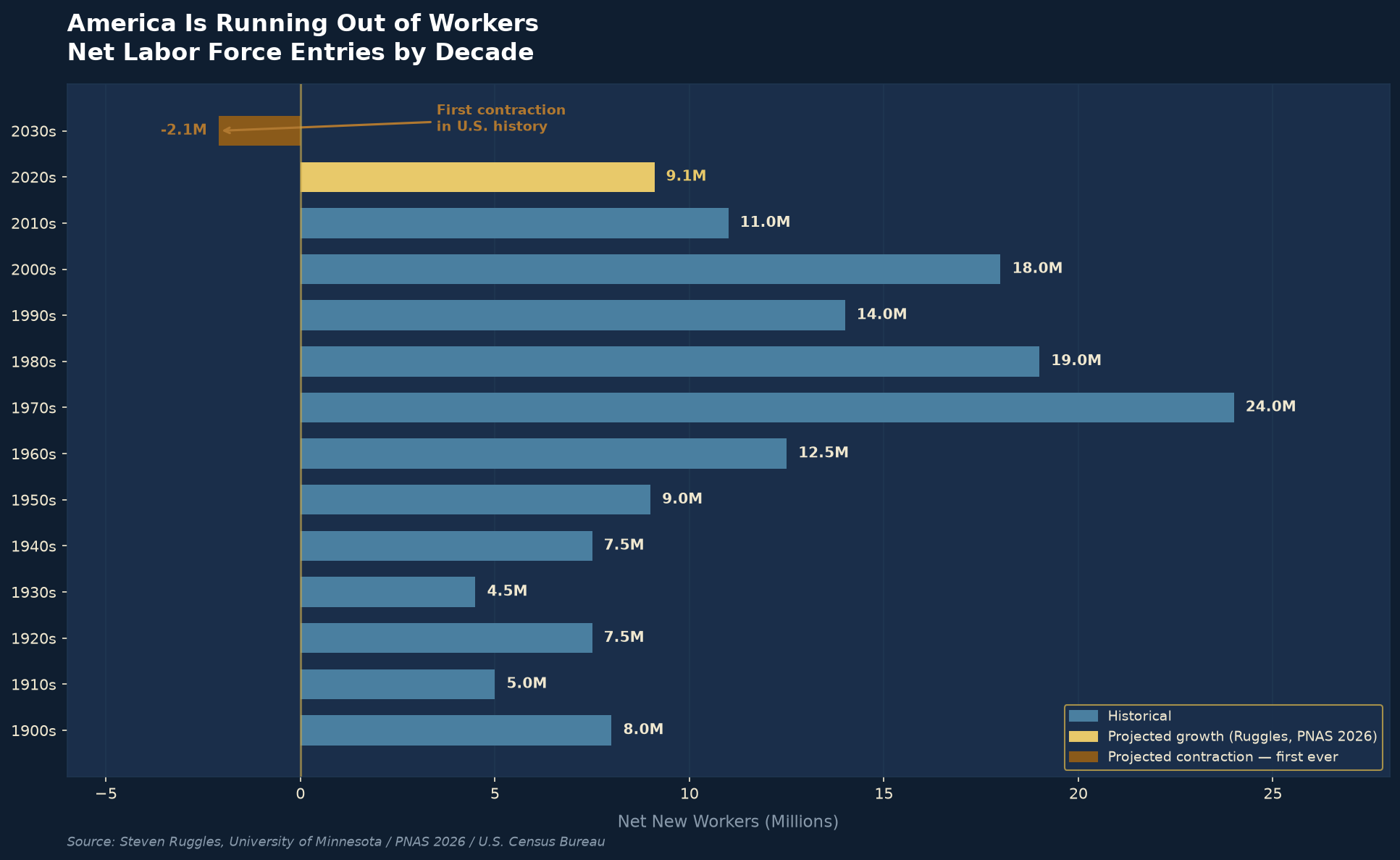
The result: 9.1 million net new workers this decade. Then a net loss of 2.1 million the decade after — the first labor force contraction in American history. The catastrophist scenario requires a growing supply of displaced workers with nowhere to go. The data shows the opposite.
Blind Spot Two: Technology Always Creates More Than It Destroys — and Always Needs Humans in the Loop
Now the demand side — and the pattern the catastrophists have ignored across every major technology transition in modern history.
Every transformative technology destroys certain job categories. Every one creates far more jobs than it destroys — almost entirely in industries that did not previously exist. And every one creates a permanent, large-scale layer of human oversight that never goes away.
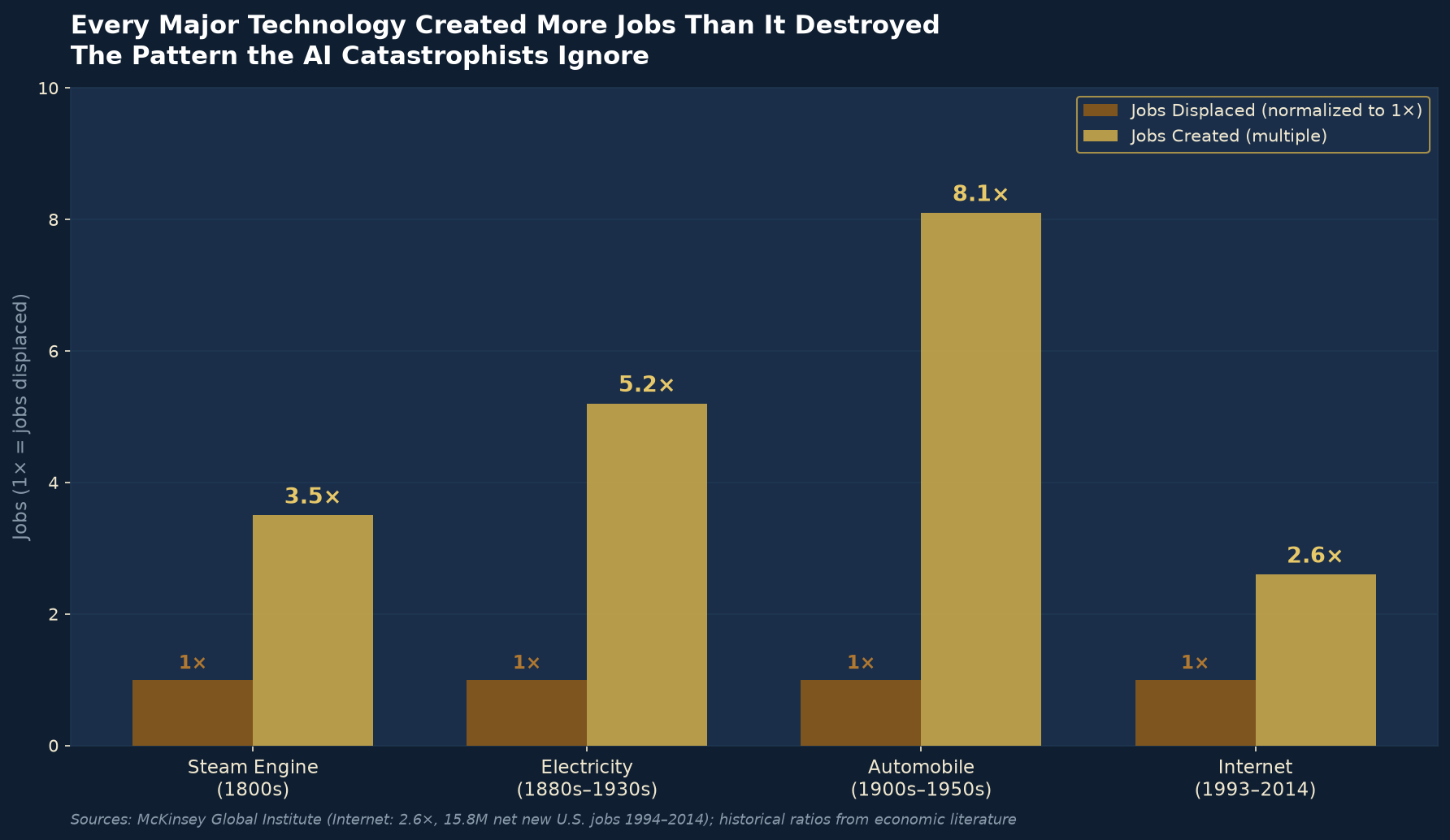
The automobile is the obvious example — mechanics, gas stations, highway construction, auto insurance, logistics. Tens of millions of jobs that had no name before the Model T.
But electricity is the most instructive parallel, because the fear was just as intense, and just as wrong.
Thomas Edison lit New York City in 1882. By the end of World War I — more than three decades later — only 20 percent of U.S. homes had electricity. The technology that would define the 20th century sat largely unused for a generation, slowed by fear. A prominent New York neurologist coined the diagnosis "neurasthenia" — exhaustion caused, he believed, by the accelerating pace of modern life from the telephone and telegraph. Edison publicly electrocuted animals to discredit his rival's AC system. Early X-ray workers died from radiation exposure. Historian Linda Simon described the era as a time "when electricity was a force stronger in the imagination than in reality."

The fears were real. The harm was vastly overstated. But here is what the catastrophist narrative always misses: electricity didn't just create electricians and appliance factories. It created an enormous, permanent layer of human-in-the-loop jobs that exist to this day and employ millions.
Power plant operators run every generating station in the country around the clock — humans monitoring, adjusting, and managing systems that cannot run themselves. Line technicians maintain thousands of miles of grid infrastructure, climbing poles and repairing lines after every storm. Grid operations centers — rooms full of human operators watching live system data — are the 1920s equivalent of today's robot dispatch center. Utility companies built massive customer service operations. Electrical safety inspectors created an entire regulatory profession. And the marketing and sales infrastructure for electrical appliances, utility services, and electrical contracting became industries unto themselves.
The internet followed the same pattern. Network Operations Centers — NOCs — are 24-hour human monitoring rooms for internet infrastructure, a direct ancestor of the robot dispatch center. Comcast and AT&T alone employ hundreds of thousands in customer support. Every company built an IT department. Cybersecurity operations centers became a major employer. The creator economy — YouTube, podcasting, streaming — generated millions of jobs that didn't exist in 1995.
McKinsey calculated the internet created 15.8 million net new U.S. jobs in its first two decades — 2.6 new jobs for every one it displaced.
The catastrophists always see the displacement. They never see the creation — because the new jobs don't have names yet.
The Robot Help Desk: The HITL Layer for the AI Economy
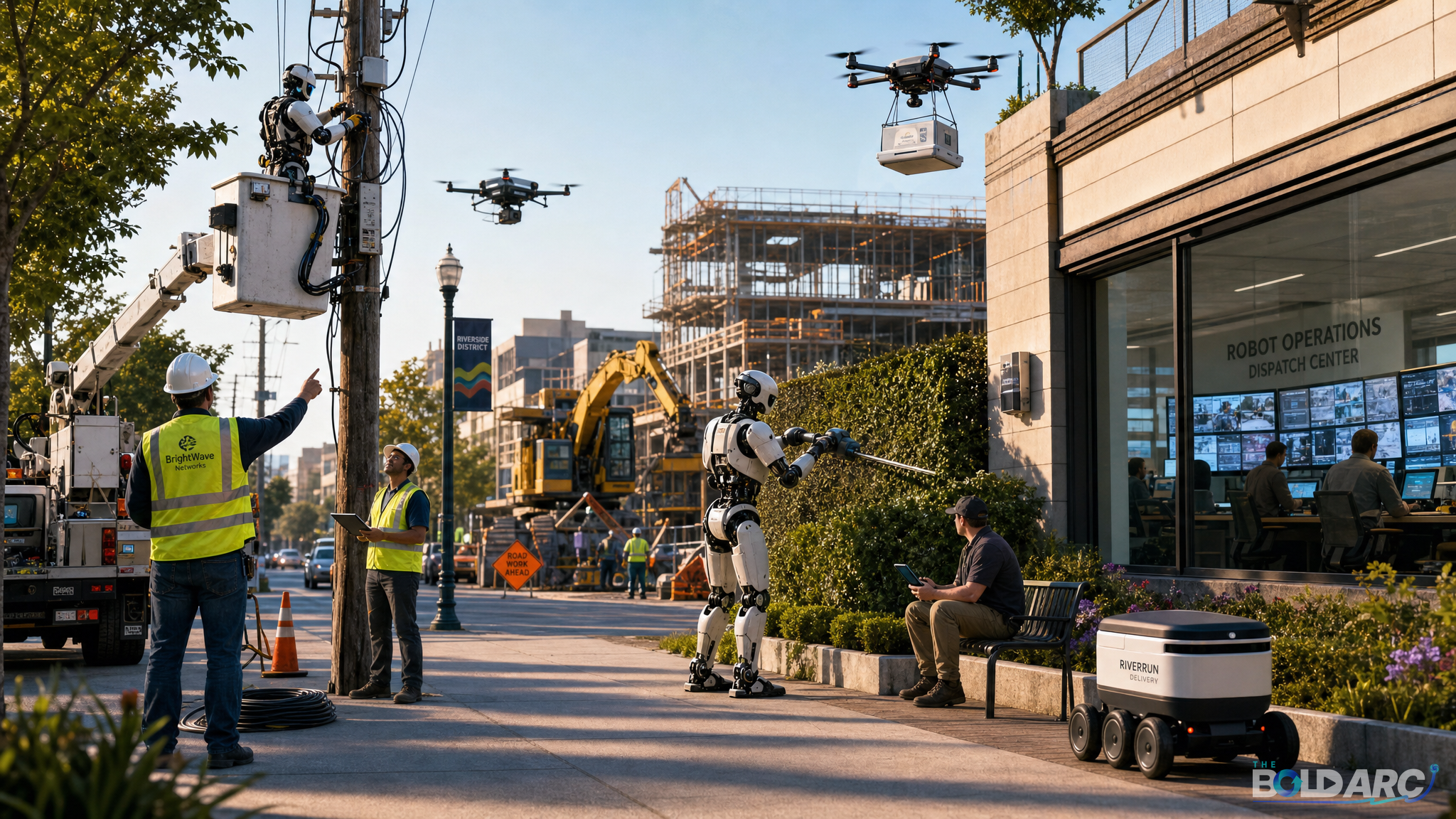
Every technology needs its human-in-the-loop layer. For the AI and robotics economy, that layer is just beginning to take shape — and it will be enormous.
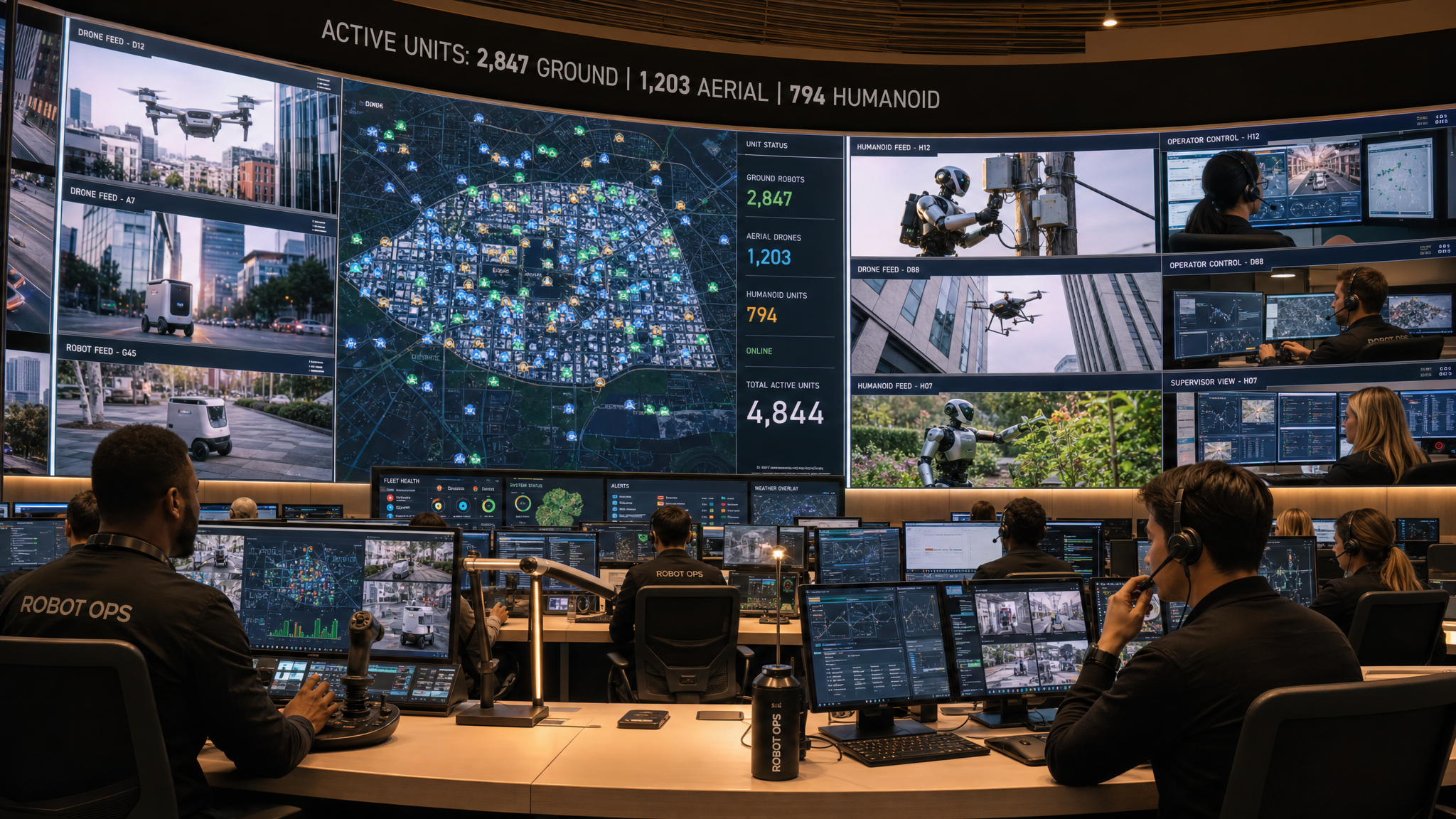
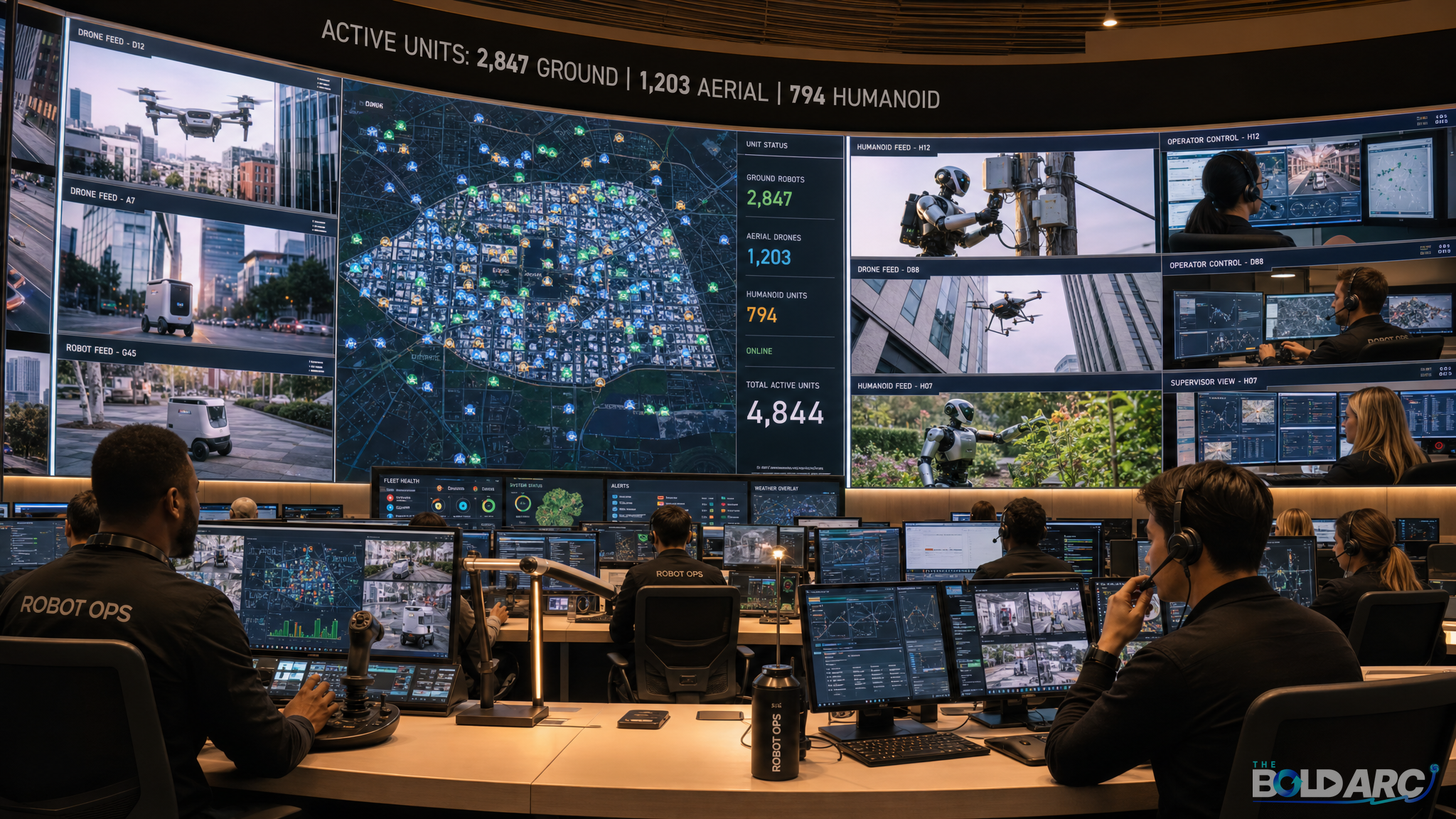
Picture a Robot Operations Dispatch Center. Think 911 emergency dispatch crossed with a NASA mission control room. Hundreds of screens showing live feeds from thousands of robots and drones operating across a city. Human operators at workstations, monitoring fleet health, taking remote control when a delivery robot gets confused by a construction detour, guiding a humanoid technician's arm movements at a telecom installation site, dispatching a drone to inspect a property alert. The wall display reads: Active Units: 2,847 Ground | 1,203 Aerial | 794 Humanoid.
That operations center is a real job category that does not yet exist at scale. It will employ tens of thousands nationally — and every major company deploying robots will run one.
The human-in-the-loop requirement runs through every industry being transformed:
Delivery and logistics. A telecom company deploying thousands of robots to assist technicians installing fiber networks needs robot fleet dispatchers, HITL navigation specialists, and recovery operators for every robot that encounters an unexpected situation. Amazon is the obvious example — but every utility, every logistics company, every retailer with last-mile delivery is building this infrastructure.
Home security and property surveillance. Roaming security robots on residential and commercial properties don't operate autonomously in critical situations. Human threat assessment specialists review AI-flagged events, authorize responses, and coordinate with emergency services. Every property management company, every campus security operation, every gated community becomes a customer — and a source of operator jobs.
Landscaping and property maintenance. The $130 billion U.S. landscaping market is moving toward autonomous mowers and robotic trimmers — but the human landscaping supervisor with a remote tablet, overseeing a fleet of machines across multiple properties, doesn't disappear. The job transforms and the productivity multiplies.
Construction. Robotic bricklaying systems and AI site management require human robotic site supervisors, digital twin managers, and AI safety monitors on every job site. The $2 trillion global construction market is being re-architected — and every new role requires training, certification, and ongoing oversight.
Telecom and network infrastructure. A humanoid robot threading fiber optic cable on a utility pole is supervised by a human crew coordinator on the ground. Behind that crew: a fleet manager tracking twenty robot-assisted teams across the region, a remote operations specialist ready to take manual control, and a maintenance technician keeping the machines running. One telecom company deploying 2,000 robot-assisted crews creates a new workforce category that didn't exist last year.
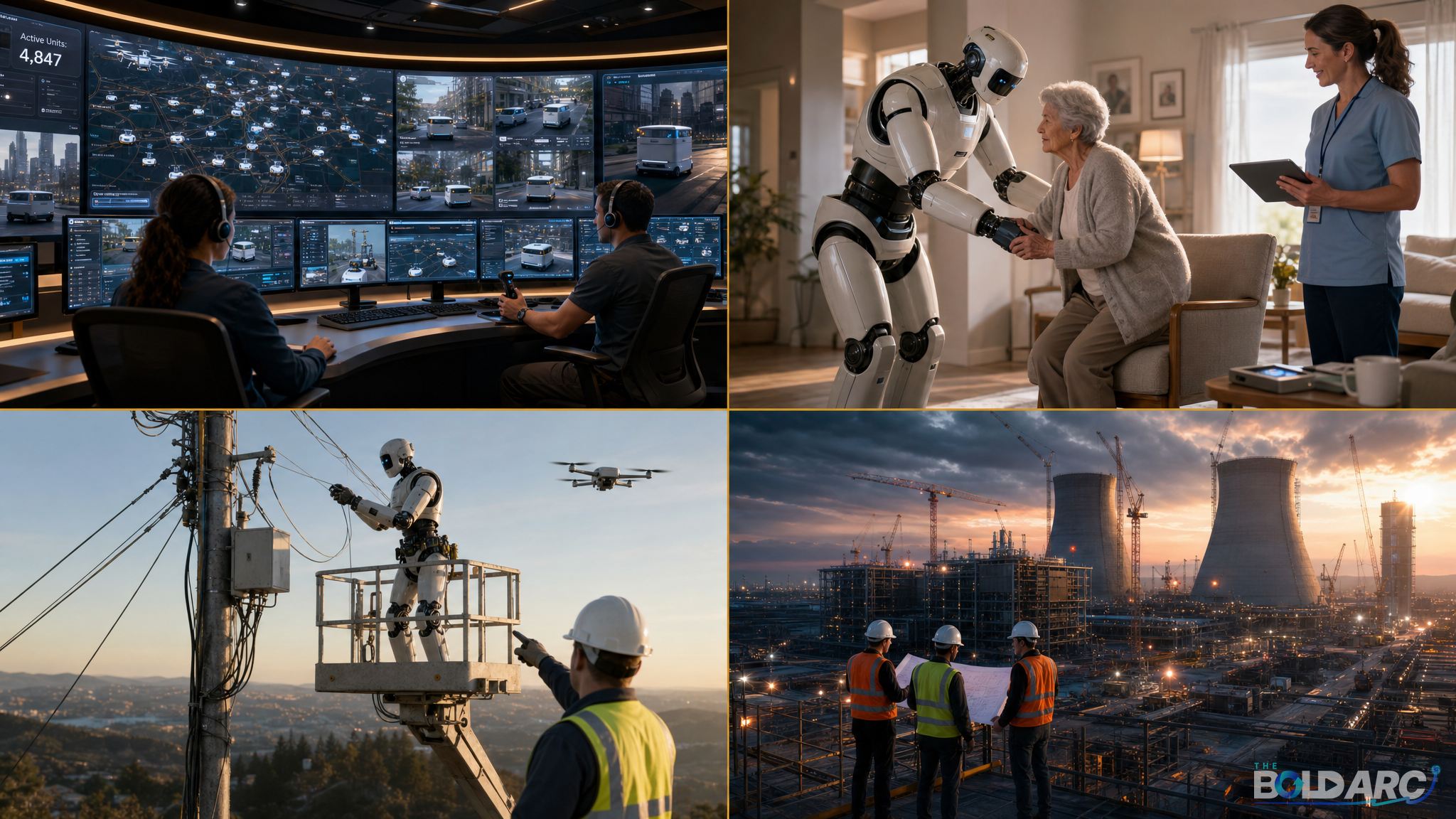
Add AI-augmented healthcare, AI safety and compliance auditing across every regulated industry, the AI infrastructure buildout, and entirely new creative and media formats — and the scale of the derivative employment wave becomes clear. None of these are speculation. They are early-stage versions of a pattern that has repeated, without exception, across every major technology transition in history.
The Math Points One Direction
Put the full picture together and the arithmetic becomes unavoidable.
AI will displace workers in specific roles — that is real and it deserves serious policy attention. But the creation engine that has run alongside every technology transition in history is already spinning up: robot dispatch centers, HITL supervisors, humanoid technicians, AI auditors, data center crews, senior care coordinators — jobs that barely existed five years ago and will employ millions within the decade.
The historical ratio is clear. The internet displaced 3.7 million retail jobs and created more than five million in logistics, e-commerce, and digital services. The ATM was supposed to eliminate bank tellers — instead, teller employment grew as banks opened more branches. Every technology. Same result.
And there is a second force compounding the demand for workers: the labor supply is shrinking. U.S. fertility rates have declined since the mid-2000s. The labor force, documented this May in the Proceedings of the National Academy of Sciences, will add only 9.1 million workers this decade — the smallest gain since 1960 — and then contract in the 2030s for the first time in American history. Fewer available workers means AI displacement translates to unemployment at a much lower rate than the catastrophists assume.
Daron Acemoglu, MIT professor and 2024 Nobel laureate in Economics, put it plainly after examining economies across countries with declining labor pools:
"Labor markets in which workers are scarce work really well for workers and generate productivity gains as well."
— Daron Acemoglu, MIT Professor | 2024 Nobel Prize in Economics
More demand for workers from new industries. Less supply from demographic shifts. That combination does not produce mass unemployment. It produces a race to find enough people to build everything AI makes possible.
The Catastrophists Owe Us Better Analysis
The AI job catastrophist narrative has always been more intuition than analysis. It counts displacement and never counts creation. It treats the labor supply as static when the data shows it shrinking. It ignores the HITL layer that every technology in history has generated. It ignores the single most consistent pattern in the history of technological development.
The fears about AI — on security, privacy, accountability — are legitimate and deserve serious attention. Bold Arc takes those seriously.
But the mass unemployment thesis is not supported by the evidence. Two peer-reviewed papers, one from a Nobel laureate, published in 2026, point clearly in the other direction. The historical record of what technology does to economies — and the emerging data on what AI is already creating — has been available for anyone willing to look.
The catastrophists weren't looking.
The Arc Trends Up
The dips are real. When a major technology arrives, there is genuine disruption. Jobs change. Industries transform. Workers in declining fields face real hardship that deserves serious policy attention and real support.
But the arc — the long, evidence-backed, historically consistent arc of what happens when human ingenuity meets new technology in a free market — trends up. It has always trended up. Not because of optimism. Because of markets, incentives, competition, and the inexhaustible human drive to build something new.
The 2030s will not be defined by mass unemployment from AI.
They will be defined by a race to find enough workers to staff the robot dispatch centers, train the humanoid technicians, coordinate the senior care robots, build the data center infrastructure, and create the industries that don't have names yet.
AI won't create a jobless future. The evidence — from electricity to the internet to the first robot surgeons — points the other way entirely. America will run out of workers long before it runs out of work.
The catastrophists were looking at the dip. The arc always trends up.