
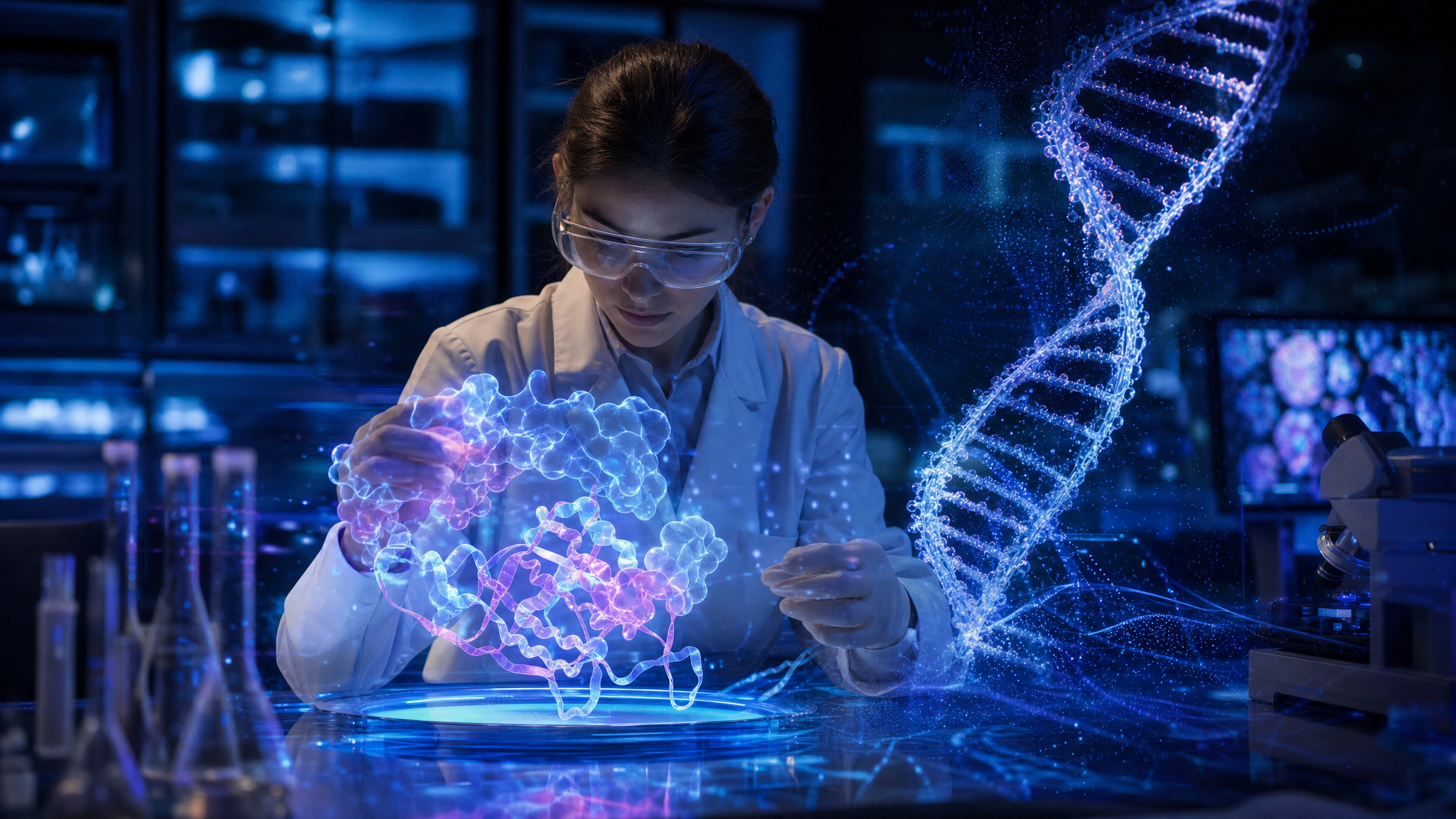
For fifty years, the protein folding problem sat at the center of biology like an unsolved theorem on a chalkboard. Proteins are the machinery of life — they regulate every cellular process, drive every disease, and control every drug interaction. Their function is determined by their three-dimensional shape. And their shape, which emerges from a sequence of amino acids folding into a specific structure, was almost impossible to predict.
Biochemists spent careers on single proteins. The entire field, over seventy years of work, had solved the structures of roughly 170,000 proteins. That was the state of the art in 2020.
Then DeepMind released AlphaFold2.
In a matter of months, AlphaFold predicted the structure of over 200 million proteins — essentially the entire known proteome of life on Earth. Researchers called it the most significant contribution to biology since the sequencing of the human genome. Nobel laureate Venki Ramakrishnan said it had “changed biology forever.”
It was also a proof of concept. Not just for protein science — for what AI does to every hard problem it encounters.
The 50-Year Problem
The protein folding problem was first articulated in the 1960s by biochemist Cyrus Levinthal. He observed something that became known as Levinthal’s Paradox: a protein of 100 amino acids has so many possible conformations that if it sampled each one for a nanosecond, it would take longer than the age of the universe to find the right fold. Yet proteins fold correctly in milliseconds. The mechanism was unknown.
Solving it mattered enormously. Every disease with a biological mechanism — cancer, Alzheimer’s, HIV, malaria — involves specific proteins. Every drug works by binding to a protein. Knowing the shape of a protein meant knowing where a drug could attach, how it would interact, what it might disrupt. Without that shape, drug discovery was largely guesswork informed by expensive, slow experimental methods.
Biochemists spent decades trying to predict protein structures computationally. The problem was intractable. Physics-based models were too slow. Statistical approaches couldn’t generalize. The best human researchers could manage was incremental improvement at the margins.
AlphaFold didn’t improve at the margins. It solved the problem.
Not an Outlier — A Pattern
AlphaFold was not a one-time event. It was the first visible instance of a pattern that has since repeated across scientific domains.
In 2023, DeepMind published GNoME — a system for discovering new stable materials. In one paper, it identified 2.2 million new stable crystal structures. The entire prior history of human materials science had catalogued roughly 20,000 experimentally verified stable inorganic materials. GNoME found 100 times more in a single computational run, including 380,000 materials predicted to be stable enough for real-world applications.
In 2024, Google DeepMind’s AlphaProof and AlphaGeometry systems solved problems at the level of the International Mathematical Olympiad — the most prestigious competition in mathematics for high school students, historically solved by only the most gifted human mathematicians. In weather forecasting, AI models including GraphCast and GenCast now outperform the best traditional physics-based models at a fraction of the computational cost.
The pattern is consistent: AI encounters a domain where the search space is vast, the rules are defined, and human intuition has hit a ceiling. It then exceeds that ceiling — not marginally, but by orders of magnitude.
What This Means for Medicine
Drug discovery is the domain where the acceleration has the most immediate human stakes. The traditional timeline from target identification to approved drug is 10 to 15 years and $2.6 billion. The failure rate is staggering — over 90% of drug candidates that enter clinical trials fail. Most failures happen late, after years of expensive development, because the biology wasn’t well enough understood to predict toxicity or mechanism.
AlphaFold changes the starting point. When you can see the shape of every protein a drug candidate might interact with, you can model binding, predict side effects, and filter out failures computationally — before a single clinical trial. Isomorphic Labs, the DeepMind spin-out now operating as a drug discovery company, closed partnerships with Eli Lilly and Novartis in 2024 worth up to $3 billion. The thesis: AI compresses the discovery timeline from over a decade to four to six years, and filters out the failures that currently waste most of the research budget.
“The 50-year-old protein folding problem wasn’t solved by a bigger research team or a larger grant. It was solved by a different kind of intelligence. That is what AI does to science.”
The Pessimist Case Was Wrong Again
The dominant concern about AI in science, articulated loudly since 2022, was that it would automate away scientific jobs and hollow out research institutions. The data so far points the other direction. NIH grant applications have increased. Research output has accelerated. New sub-disciplines — computational structural biology, AI-driven materials science, neural weather modeling — have created demand for researchers who did not exist before.
This is the pattern the pessimists always miss. They model the disruption and stop there. They do not model the response — the new fields, the new questions, the new problems that only become visible once the old ones are solved.
Before AlphaFold, researchers spent careers solving protein structures one at a time. Now the question is: what do you do with 200 million structures you didn’t have before? That is not a problem that puts scientists out of work. It is a problem that requires a generation of new scientists to answer.
The arc bends upward. The tool changes. The curiosity doesn’t.