
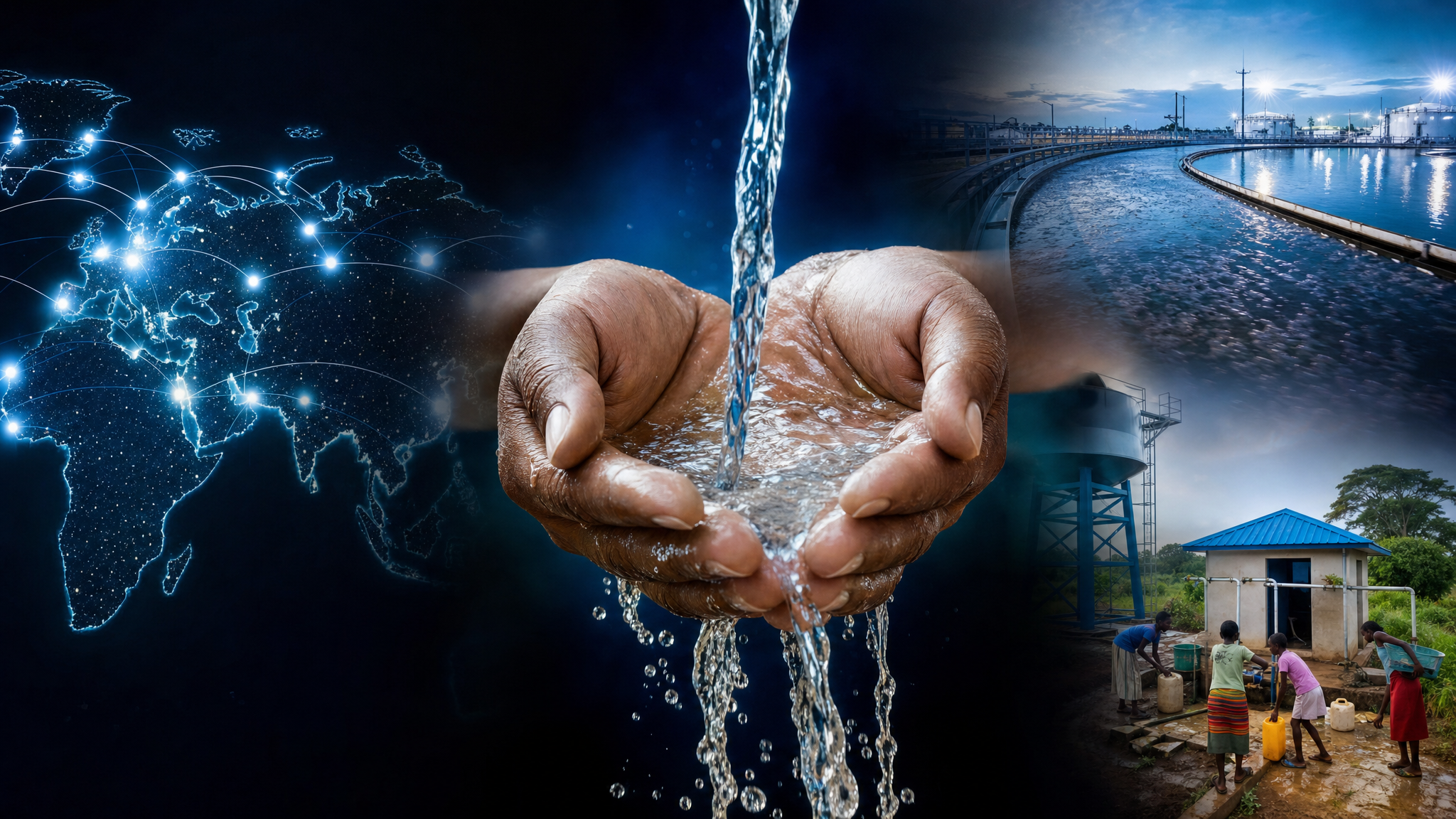
In 1990, approximately 2 billion people on Earth lacked access to safely managed drinking water. That is a statistic that should stop you. Two billion people — more than a third of the planet’s population at the time — lived without reliable access to the most basic requirement for human survival.
Over the next three decades, global population grew by 2.5 billion people. More people. More cities. More demand. And yet in 2022, the share of the global population with access to basic drinking water services had risen from 76% to 91%. The absolute number of people without access has declined dramatically even as billions more joined the rolls of people who needed to be served.
This is a headline-level achievement in global public health. It is almost entirely absent from the public conversation about progress.
What Changed — The Mechanism
The dominant narrative about global clean water access focuses on international aid, NGO interventions, and charity. These played a role in specific crises and specific communities. But the data tells a different story about the primary driver of the improvement.
The countries that made the fastest progress on water access were not the countries that received the most foreign aid. They were the countries with the fastest economic development.
China added more people to water and sanitation services than any country in history — not through international charity, but through the investment in urban infrastructure that followed economic growth. When a city’s GDP rises, it can afford to build water treatment plants, lay pipes, train operators, and maintain systems. Rural electrification enables pumping. Urbanization concentrates population in areas where infrastructure is economically viable to build.
India followed the same pattern. Bangladesh. Ethiopia. The mechanism was: economic growth → public revenue → infrastructure investment → water access. Aid organizations could serve populations that fell outside this mechanism — the remote, the conflict-affected, the extremely poor. But the bulk of the global improvement came from the engine of development, not charity.
Open Defecation: The Invisible Health Crisis
Water access and sanitation are inseparable. Pathogens travel through the same vectors — contaminated water, fecal contamination of food and water supplies. The decline in open defecation is one of the most important and least-discussed health improvements of the past three decades.
In 1990, approximately 1.3 billion people practiced open defecation — relieving themselves in fields, near water sources, on roadsides — because they had no access to any form of toilet or latrine. By 2022, that number had fallen to under 450 million — a reduction of more than 65%.
That reduction matters because it translates directly to child survival. The primary killer of children under five in low-income countries has historically been diarrheal disease — caused by contaminated water and food. As open defecation declined and clean water access increased, diarrheal deaths fell in parallel. The WHO and UNICEF estimate that diarrheal disease deaths dropped from roughly 2.5 million per year in 1990 to under 1.4 million in 2022 — a 44% reduction.
Most of those saved lives are children. Most of those children are in the world’s poorest countries. And the intervention that saved them was not a new drug or a medical breakthrough. It was infrastructure — toilets, pipes, clean water, systems that kept feces away from drinking water.
India’s Open Defecation Campaign
India was the country with the highest absolute number of open defecation practitioners in the world — roughly 600 million people as of 2014. Prime Minister Narendra Modi launched the Swachh Bharat Abhiyan (Clean India Mission) in 2014, targeting the construction of 100 million household toilets by 2019.
The campaign was controversial, imperfectly executed, and produced results that independent researchers debated. But the direction was clear: by 2020, India had declared itself open-defecation-free in rural areas, and measurements of child stunting and mortality in the areas with highest toilet construction showed measurable improvements. The ambitious political commitment to infrastructure investment — not charity, not aid — was the mechanism.
Bangladesh achieved even more striking results: open defecation fell from 33% of the population in 1990 to under 1% today, driven by community-level sanitation programs and economic development. Bangladesh is one of the most compelling stories in global development — a country that was written off as ungovernable and permanently poor in the 1970s, and has since reduced child mortality by 75%, improved life expectancy by 30 years, and nearly eliminated open defecation.