
WHO OWNS COMPASSION? — 4-PART SERIES
The problem: Government as the sole provider of safety net functions is neither efficient nor compassionate — and it crowds out the family, fraternal, and religious institutions that once made it work.
The opportunity: We can make progress for people by progressing and improving our safety net institutions with more pluralism and competition.
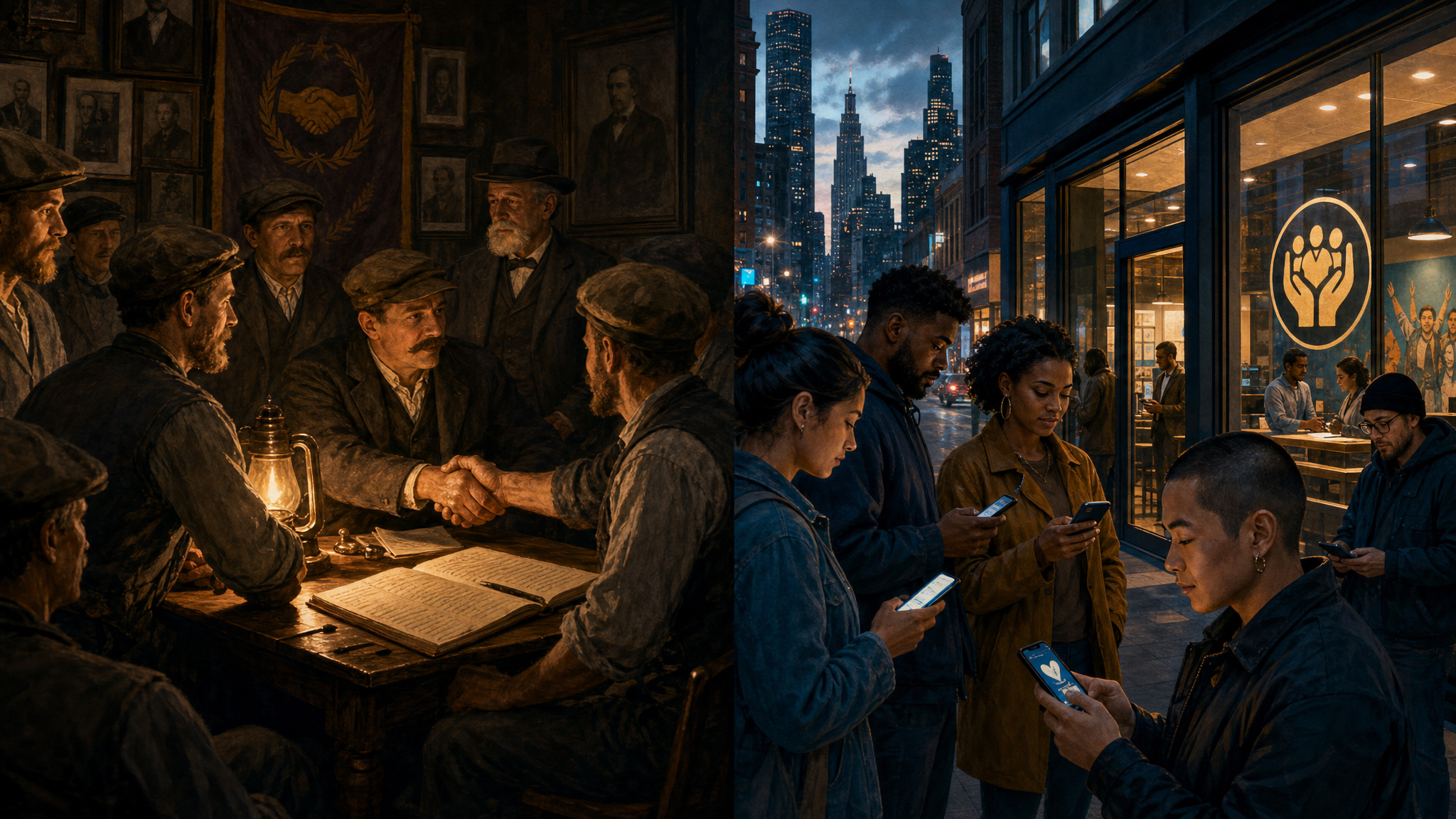
The American workforce is in the middle of the most significant structural transformation since industrialization. Not because AI is eliminating jobs — the data says otherwise. Bold Arc’s own reporting documents a long-term worker shortage, not a jobless future. What AI is accelerating is the end of the lifetime-employer model: more portfolio careers, more entrepreneurship, more rapid skill transitions. A safety net designed for one job, one employer, one pension, and one risk fails exactly the workers this transformation is creating. The answer is not a bigger government program. It is a more pluralist one.
The Safety Net Before the Safety Net: The Institutions America Forgot and the Principle That Needs a Comeback
Long before Washington became the nation’s insurer of last resort, Americans lived inside a dense ecology of family obligation, religious charity, mutual aid, employer benefits, private philanthropy, and local public relief. That world deserves recovery — but not mythology. Its lesson is not that government should vanish. It is that government should never be the only one in the room.
THE PLURALISM PRINCIPLE
No single institution — government, church, charity, or market — is capable of providing compassion at scale without becoming something worse: a bureaucracy, a monopoly, or a moralizing gatekeeper. Pluralism is not a compromise between these failures. It is the architecture that prevents any one of them from taking over.
On the eve of the Great Depression, an American who lost a wage earner did not face an empty landscape. He might turn to relatives, a congregation, an ethnic benevolent society, a union fund, a fraternal lodge, an employer, a commercial insurer, a city charity, or the local poor authority. The help could be intimate and generous. It could also be conditional, humiliating, discriminatory, or absent. What did not yet exist was a durable federal promise that followed the citizen across state lines and survived a local economic collapse.
We often compress this history into a morality play: private compassion came first; government later occupied the field. The sequence contains a truth, but it hides the more important story. Safety nets were never a single institution waiting to be nationalized. They were a portfolio of institutions with different ways of raising money, discovering need, disciplining abuse, and absorbing risk. The question was always less “Who cares?” than “Who must pay, who decides, and what happens when the system fails?” Pluralism is the answer. It has always been the answer. We forgot.
An Ancient Mixed Economy of Compassion
Religious giving was the moral center of premodern relief. Jewish tzedakah was understood not merely as optional kindness but as an obligation of justice. Christianity built traditions of almsgiving, monasteries, hospitals, and almshouses. Islam made zakat a pillar of faith and developed the waqf — the charitable endowment — to support mosques, schools, fountains, hospitals, and aid to the poor. In medieval England alone, historians count roughly 500 hospitals, usually small institutions supported by donated property and serving selected groups of the sick, old, and poor.
Yet public provision is ancient too. Roman rulers subsidized and eventually distributed grain in the capital. Chinese dynasties used granaries and famine relief; under the Qing, state-managed stocks supplemented storage by peasants, landowners, and merchants. These were not modern welfare states. Benefits were selective, political, and often designed as much for public order as for compassion. But they dispose of the claim that government entered the relief business only in the twentieth century. The real history is pluralist all the way down.
The decisive English precedent came after the crown dissolved monasteries, guilds, fraternities, hospitals, and other institutions that had carried much of the charitable burden. Parliament first encouraged voluntary parish collections in 1536. The acts of 1597–98 and 1601 then required each parish to levy a compulsory property tax — the poor rate — and charged local overseers with putting able-bodied adults to work, apprenticing poor children, and supporting people unable to maintain themselves. Notice what came first: the collapse of pluralism, then the government monopoly.
The First Welfare-State Failure Modes
The Poor Law also displayed pathologies that remain familiar. Under the allowance practices associated with Speenhamland after 1795, some parishes supplemented household income according to bread prices and family size. Labor-hiring farmers who dominated parish government could lay off workers in slow seasons or hold wages down while shifting part of the cost to other ratepayers.
Here, two modern criticisms appear before the modern welfare state: benefits can subsidize employers rather than workers, and administrators can be captured by the interests they regulate. Public spending is not automatically public-spirited.
The reaction was the Poor Law Amendment Act of 1834. Conditions were made deliberately harsh so that relief would be less attractive than the lowest-paid labor. Families could be separated, and dependence carried a public stigma. The lesson is not that public provision always fails. It is that every form of aid has a characteristic failure mode. And a monopoly — public or private — has no corrective. Only pluralism does.
Insurance Built From the Bottom Up
The most compelling voluntary alternative was not elite charity. It was mutual aid.
Britain’s friendly societies collected regular dues and paid benefits when a member was sick, unemployed, or dead. They supported widows, financed funerals, and created rituals that turned an insurance pool into a community. Estimates vary, but between 6.3 million and 9.5 million people belonged in 1910; perhaps 80 percent of male workers joined at some point. The Manchester Unity of Oddfellows alone exceeded one million members.
Their accountability was unusually direct because payer, governor, and potential recipient were often the same person. Members met, examined claims, watched the fund, and could move to another society. Reciprocity preserved dignity: a sick member was drawing on a compact he had helped finance, not pleading before a benefactor. This is what pluralism produces that monopoly cannot: accountability through exit, dignity through reciprocity, knowledge through proximity.
Competition was not only about price. Societies competed in trust, fellowship, benefits, and reputation. They converted social capital into risk capital. Government monopoly converts risk capital into political capital.
America’s Lost Institutional Ecology
Historian David Beito estimates that American fraternal societies reached roughly half of adult men at their height and, aside from churches, ranked among the leading welfare providers before the Depression. They sold affordable sickness and life protection, hired physicians, and built orphanages, hospitals, and homes for the elderly. Immigrants used lodges to pool risk in a hostile labor market. Black Americans, often excluded from white institutions and commercial opportunity, built parallel orders, banks, schools, hospitals, and burial societies.
These achievements reveal something a check-writing model of charity misses. The poor were not merely recipients. They were institution builders. That is the deepest loss when government becomes the sole provider: it does not just replace the institution. It replaces the civic muscle that built it.
Employer welfare added another layer. American Express established an early industrial pension in 1875; railroads and large manufacturers followed. Before Social Security, fewer than one worker in ten had a private pension — and a benefit tied to a job tended to disappear precisely when the employer failed.
What the Crash Exposed — and What It Didn’t
The Depression did not prove that voluntary compassion was fraudulent. It exposed a problem of correlated risk. A neighborhood lodge can insure one member’s illness because most members remain healthy and employed. It cannot easily insure the collapse of the neighborhood’s employers, property values, and donations at once.
Historical estimates put American private giving at $832 million in 1928 and $479 million in 1933 — a 42 percent drop in five years. Grants by 100 large foundations and community trusts fell from $83 million in 1928 to $34 million in 1934. Private institutions continued to help, often heroically. Their scale moved in the wrong direction at the moment demand exploded.
This argues for a public floor for catastrophic, nationally correlated risk — not for a public monopoly on all social provision. The New Deal built a necessary floor. What it did not need to do — and what its successors did anyway — was crowd out the entire ecology of institutions that had stood alongside it. That crowding out is the problem pluralism is designed to fix.
The Principle That Needs a Comeback
The institution America forgot is not charity. It is pluralism: the deliberate maintenance of family, mutual association, religious community, competitive providers, philanthropy, local government, and national insurance as a portfolio — each carrying the risks it handles best, none holding a monopoly on compassion.
There was no golden age to restore. Fraternal lodges excluded women and often minorities. Charity was sometimes humiliating. Employer benefits were sometimes controlling. Local relief was sometimes captured by elites. The point is not to return to 1890. It is to recover the pluralist principle that made the ecology resilient — and to rebuild it with the inclusivity those institutions lacked.
Today, the labor market transformation driven by AI makes this more urgent, not less. AI is not eliminating jobs — it is restructuring them, accelerating the end of the lifetime-employer model, and creating a workforce that moves across industries, builds portfolio careers, and changes skill sets in ways a rigid, single-provider safety net cannot track. The pluralist architecture — portable benefits, recipient choice, competing providers, civic voice — is not nostalgia. It is engineering for a dynamic economy.
Further Reading
On Liberalism: In Defense of Freedom — Cass R. Sunstein (MIT Press, 2023, ISBN 9780262049771)
A timely defense of liberalism’s core commitments — including pluralism — against critics on both right and left. Sunstein’s central argument: free societies require diverse institutions, competing values, and distributed power. No single architecture of the good — government or market — can substitute for that plurality.
From Mutual Aid to the Welfare State — David Beito (University of North Carolina Press, 2000)
The definitive history of American fraternal societies and mutual aid 1890–1967. Beito documents how working-class Americans — including Black Americans excluded from mainstream institutions — built sophisticated self-help networks, and how that ecosystem contracted when government took over.
Free Market Fairness — John Tomasi (Princeton University Press, 2012, ISBN 9780691158143)
A philosophical foundation for combining strong economic liberty with genuine concern for the material condition of the poor — the intellectual case for pluralist market democracy.
Next in the series: Part II — The Year Relief Became a Right: How the New Deal Rewired American Compassion →