

The plant sits on a lava field in southwest Iceland, powered by geothermal electricity, drawing air through its intake fans twenty-four hours a day. Inside, a chemical sorbent binds to carbon dioxide molecules, releases them under heat, and sends the captured gas down a pipeline for permanent storage in basalt rock two kilometers underground, where it will mineralize within two years. Climeworks opened Stratos in May 2024. It is the largest direct air capture facility ever built. It is also a data point in a cost curve that, if it follows its current trajectory, could make carbon removal a viable tool at civilizational scale by the 2030s.
Stratos is designed to capture 36,000 tonnes of carbon dioxide per year — the equivalent of removing roughly 7,000 gasoline-powered cars from the road permanently. At that scale, it is a proof-of-concept, not a climate solution. Total global CO2 emissions run at roughly 37 billion tonnes annually. But the significance of Stratos is not what it removes today. It is what it demonstrates about the technology’s readiness for industrial scaling — and what it reveals about where the cost is headed.
Climeworks’ first commercial DAC plant, Orca, opened in 2021 with a 4,000-tonne annual capacity. Stratos is nine times larger, built on lessons from Orca’s operation. The next facility in the pipeline is expected to be larger still. Each generation of deployment is driving down the cost per tonne of CO2 captured — and the cost curve is the number that determines whether this technology matters.
From $1,000 to $400 — and the Race to $100
In 2017, direct air capture cost approximately $1,000 per tonne of CO2 — an academic curiosity, not an economic reality. By 2024, Climeworks was reporting costs in the range of $400 per tonne for Stratos-scale operations. The US Department of Energy’s stated target is $100 per tonne by 2030 — the threshold at which DAC becomes cost-competitive with many natural carbon removal methods and begins to be economically viable for large-scale deployment.
The $100 target is not arbitrary. At that price, carbon removal starts to become relevant in discussions about Scope 3 emissions offsetting, regulatory compliance markets, and government procurement programs. Below $100, the addressable market for DAC expands significantly. Below $50 — a point that analysts believe is achievable in the 2030s if deployment scales rapidly — it becomes a mainstream tool in the climate response toolkit.
The Corporate Pre-Purchase Market
One of the more significant developments in DAC has been the emergence of a corporate pre-purchase market for future carbon removal. Microsoft, Stripe, Shopify, and Alphabet have collectively pre-purchased hundreds of thousands of tonnes of future removal credits from Climeworks, Heirloom Carbon, and other DAC developers. These deals are structured as advance purchases: the companies pay now, at current prices, for carbon removal to be delivered over the next decade.
“We can’t get to net zero without removing carbon that’s already in the atmosphere. The question isn’t whether to build this industry — it’s how fast.” — Brad Smith, President, Microsoft
The economic logic of the pre-purchase market is important: it provides the capital certainty that allows DAC companies to build larger facilities, which drives the cost reduction, which makes the next round of purchases cheaper. It functions as demand-side infrastructure for a supply side that is still learning to scale. The Frontier coalition — backed by Stripe, Alphabet, McKinsey, Shopify, and Meta — has committed over $1 billion to early-stage carbon removal purchasing through 2030.
The Government Bet
The Biden administration committed $3.5 billion to fund four regional DAC hub projects across the United States, funded through the Bipartisan Infrastructure Law. The hubs — in Texas, Louisiana, California, and the Great Plains — are designed to be at gigaton scale: facilities large enough to collectively remove millions of tonnes of CO2 annually. They are the US government’s bet that DAC will be necessary to meet long-term climate targets, regardless of how fast emissions reductions proceed.
The IPCC’s analysis is unambiguous on this point: virtually every scenario that limits warming to 1.5°C or 2°C includes significant carbon dioxide removal — not as a substitute for emissions reduction, but as a complement to it. Historical emissions have already pushed atmospheric CO2 to levels that will persist for centuries without active removal. Even if humanity stopped all emissions tomorrow, the legacy CO2 already in the atmosphere would continue to warm the planet. Removal is not optional in the math; it is the only way to address that legacy.
The Gap Between Now and Gigaton Scale
The honest accounting of where DAC sits relative to where it needs to be is sobering. The IPCC calls for roughly 10 billion tonnes of annual CO2 removal by 2050. Current engineered DAC capacity globally is in the low hundreds of thousands of tonnes. The gap is roughly five orders of magnitude. That gap cannot be closed by cost reductions alone — it requires deployment at a pace that has no precedent in energy infrastructure history.
But the critical shift is that the conversation has moved from feasibility to scale. Three years ago, the primary debate in climate policy circles was whether direct air capture would ever be technically or economically viable. That debate is over. The Stratos facility produces real data on real operating costs in a real environment. The debate now is about the pace of scale-up, the mix of public and private capital required, and which geographies are suited to large-scale deployment given energy and geology requirements.
Iceland, with its abundant geothermal power and basalt geology ideal for CO2 mineralization, is a natural laboratory. But the technology is not Iceland-specific. Heirloom Carbon, a US startup backed by Microsoft and Breakthrough Energy Ventures, uses a limestone-based process that works in diverse geographies. Carbon Engineering, acquired by Occidental Petroleum in 2023, is building a facility in Texas. The geography of DAC is expanding as the engineering matures.
The question of whether direct air capture will matter at civilizational scale is no longer open. The question is whether it scales fast enough, and at low enough cost, to matter in the window that the climate math requires. That is a different kind of uncertainty — the kind that progress can close.
The How Safe We Are dimension of the Arc Index measures the degree to which people live free from preventable threats — including environmental ones. Climate change is the largest slow-moving safety threat humanity has ever confronted. Direct air capture does not solve it alone. But it represents something significant: the first engineered tool for reversing atmospheric CO2 accumulation that works at demonstrated scale, with a credible cost curve toward affordability. Safety, in this dimension, is about having options. DAC is now an option.
-
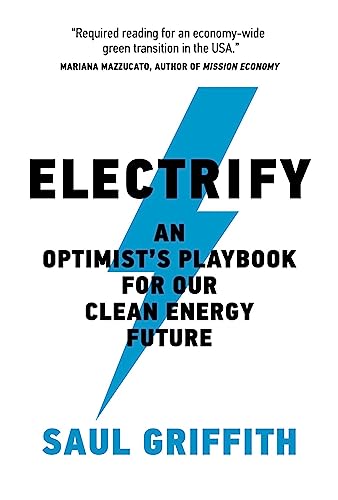
Electrify by Saul Griffith
The engineer’s blueprint for decarbonizing the US economy by electrifying everything. Essential context for understanding where direct air capture fits in the broader climate response. -
Speed and Scale by John Doerr
The venture capitalist’s action plan for avoiding climate catastrophe, including a quantitative case for carbon removal at scale. A useful framework for evaluating DAC’s role.
📚 Recommended Reading
A recommended book that goes deeper on this topic.
View on Amazon →Bold Arc earns a small commission on purchases at no extra cost to you.