
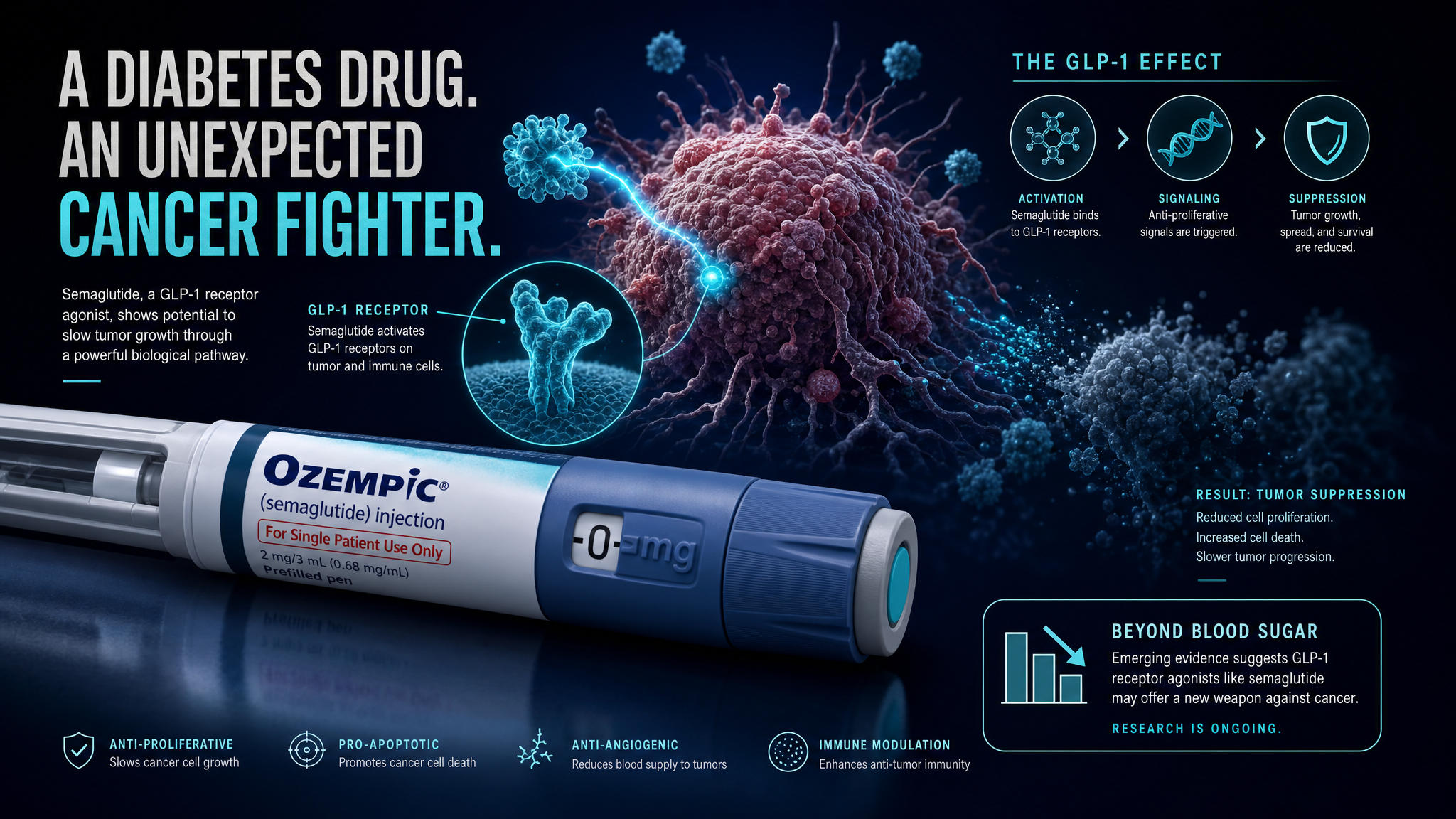
The pattern with GLP-1 drugs has become almost predictable: researchers study them for one thing, discover they do something else, publish the results, and the scientific community realizes the molecule is operating at a deeper level than anyone originally mapped.
It started with blood sugar. Semaglutide — the active molecule in Ozempic and Wegovy — was approved by the FDA in 2017 for type 2 diabetes. Effective, clean mechanism, good safety profile. Unremarkable by drug development standards.
Then the weight loss data came in. Not the modest 5–8% reductions typical of earlier obesity drugs — 15 to 22% of body weight, sustained, in randomized trials. The kind of results that get cardiologists, endocrinologists, and public health researchers paying attention at the same time. By 2024, semaglutide was the fastest-growing prescription drug in history by revenue.
That was Act Two. Act Three — presented at the American Society of Clinical Oncology Annual Meeting in Chicago in June 2026 — involves cancer. And the story is considerably more complicated, and considerably more interesting, than the headlines suggest.
Understanding the Study — Why the Comparison Matters
The study design matters for understanding what it actually found. Researchers didn’t compare GLP-1 users to people taking no diabetes medication. They compared GLP-1 users to people taking gliptins — another class of diabetes drug (DPP-4 inhibitors) that also lowers blood sugar effectively.
This is a critical distinction. Both groups are diabetic. Both groups have their blood sugar managed. The difference is not “treated vs. untreated” — it is “treated with GLP-1 vs. treated with a different drug that does not have GLP-1’s additional anti-inflammatory and immune-modulating properties.”
The implication: if GLP-1 users progress to Stage IV cancer at lower rates than gliptin users, the explanation cannot simply be “better blood sugar control.” Something specific to how GLP-1 receptor agonists work — beyond glucose management — appears to be involved.
“GLP-1 receptor agonists have never been just glucose-lowering drugs. Their anti-inflammatory and immune-modulatory properties have long suggested broader effects. What’s new here is the consistency across tumor types.”
— Marcin Chwistek, MD, Chief of Supportive Oncology and Palliative Care, Fox Chase Cancer Center (ASCO 2026)Two Layers — What We Know and What We’re Still Learning
The GLP-1 and cancer story has two distinct layers. Separating them matters because they carry different levels of scientific confidence and different implications for patients, researchers, and the healthcare system.
Layer 1 explains part of what the study found. Layer 2 is why the scientific community is paying close attention. If GLP-1 drugs are exerting effects directly on cancer cell behavior — not just on the metabolic context in which tumors grow — the implications for oncology extend far beyond any weight-related mechanism.
The Four Cancer Types Where the Signal Is Strongest
What This Is Not
The ASCO 2026 data is observational — it draws on real-world health records, not a randomized controlled trial. The comparison group design (GLP-1 vs. gliptin, not GLP-1 vs. placebo) controls for several confounders, but observational data cannot establish causation with the same confidence as a prospective RCT.
The ASCO expert quoted at the conference was explicit: “What’s new here is the consistency across tumor types… data this large and this consistent warrant a prospective randomized trial.” That trial has not been done yet. It needs to be.
What this is not: a finding that semaglutide is a cancer treatment. No oncologist should be prescribing GLP-1 drugs for cancer on the basis of this data. No patient should be self-medicating. The signal is real and warrants serious follow-up. The clinical application is years away and dependent on trials that haven’t started.
What this is: observational evidence, from a large and well-designed study, that is consistent enough across cancer types and mechanisms to move the scientific community from curiosity to active investigation. That transition — from “interesting observation” to “priority research agenda” — is what happened at ASCO this month.
The Pattern — What GLP-1 Keeps Teaching Us About Drug Discovery
The GLP-1 story is a lesson in what happens when a molecule that works on fundamental metabolic pathways — pathways that connect virtually every chronic disease — gets studied at enormous scale.
In 2020, 3.5 million Americans had prescriptions for GLP-1 receptor agonists. By 2025, that number exceeded 30 million. The scale of use created a real-world dataset that no clinical trial could match — and the data started revealing effects that no trial had been designed to find. Reduced cardiovascular events. Slower kidney disease progression. Cognitive improvement signals in Alzheimer’s patients. And now, cancer.
This is not magic. This is what happens when a drug that reduces chronic inflammation, modulates immune response, improves metabolic function, and interacts with receptors expressed across multiple organ systems gets taken by tens of millions of people long enough for the data to show what the mechanism actually does. The drug is doing biology. Biology is complicated. We are reading the results in real time.
“The drug is doing biology. Biology is complicated. We are reading the results in real time — and the results keep coming back more interesting than the original design.”
The competitive market for GLP-1 drugs — dozens of pharmaceutical companies racing to develop, improve, and gain market share with GLP-1 and GLP-1/GIP combination drugs — is what produced the scale. The scale is what produced the data. The data is what produced the cancer signal. This is, in miniature, exactly how human progress works: competition drives adoption, adoption drives scale, scale reveals what the science actually does.
What It Means for You — Right Now
The Arc of human progress runs through moments exactly like this one: a molecule designed for one thing turns out to interact with biology at a level we didn’t fully map. The data accumulates. The pattern emerges. The science community responds. And the drug that surprised us once surprises us again — this time, with evidence that one of the most common and deadly categories of human disease may be more treatable than we thought.
We are not at the end of the GLP-1 story. We may not be at the halfway point.