
This article contains affiliate links. Bold Arc may earn a commission at no cost to you. | Part of the Bold Arc Transcendence & Purpose series. Read Part 1 first →
In 1968, the Beatles flew to Rishikesh to study with Maharishi Mahesh Yogi. The press treated it as celebrity mysticism — a pop culture detour into Eastern exotica. The scientists who followed over the next half century found something considerably harder to dismiss.
More than 400 peer-reviewed studies have now been published on Transcendental Meditation. The National Institutes of Health has invested over $26 million in TM research grants. The American Heart Association issued a formal scientific statement — the gold standard of medical endorsement — identifying TM as the only meditation technique with sufficient evidence to recommend for blood pressure reduction. The data has been accumulating for five decades in the world's most rigorous journals.
And yet the deeper question — what is actually happening? — remains genuinely, fascinatingly open. The EEG can measure what the brain does during TM. It cannot yet tell us what the brain is during TM. That gap — between the measurement and the experience — is where the most interesting science of the 21st century is now being conducted.
What TM Actually Is — and What It Isn't
Most people conflate all meditation into a single category. The neuroscience does not support this. Different forms of meditation produce measurably different brain states — and the differences matter.
Mindfulness meditation — the dominant form in Western clinical practice — is an active technique. The practitioner directs attention to a specific object (the breath, body sensations, external sounds) and repeatedly returns focus when the mind wanders. It trains concentration and metacognitive awareness. Its effects are real and well-documented.
Transcendental Meditation is categorically different. It is an effortless technique — the practitioner does not try to concentrate, focus, or control the mind. Instead, using a specific mantra given by a certified teacher, the mind is allowed to settle naturally inward, like a body of water returning to stillness. The instruction is not to meditate on something but to let the thinking process settle toward its source. Twenty minutes, twice daily, eyes closed.
That distinction — effortless versus effortful — produces measurably different results in the brain. And the most striking difference is something researchers did not expect to find.
Alpha Coherence: The Brain Signature Nobody Had Seen Before
 Get the book →
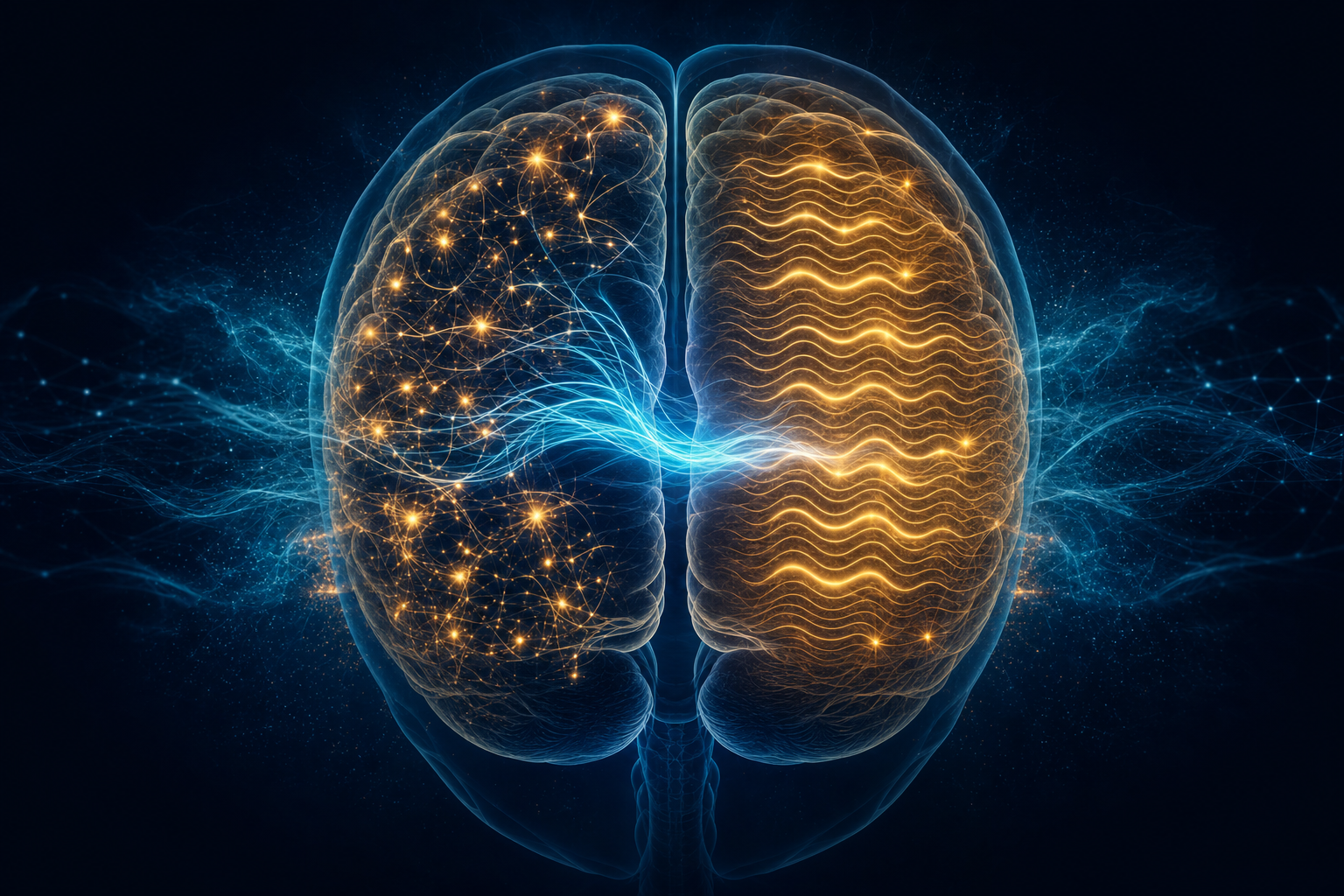
When researchers first put meditators in EEG machines during TM practice, they saw something they had no category for. During normal waking consciousness, the brain's two hemispheres operate largely independently — each processing information, generating its own electrical patterns, communicating across the corpus callosum but not synchronized. The left hemisphere handles language and sequential logic; the right handles spatial reasoning and pattern recognition. They are complementary but not usually coordinated.
During TM, the hemispheres synchronize. Alpha waves — the 8–12 Hz frequencies associated with calm, wakeful awareness — begin firing in coherence across the frontal cortex and between hemispheres. The pattern is distinctive enough that researchers can identify an experienced TM practitioner from their EEG alone. Dr. Fred Travis at Maharishi University of Management — who has published extensively on TM's neurological effects — describes it as the brain operating as a unified system rather than a collection of competing regions.
What this means functionally is that the fragmented, compartmentalized processing of ordinary waking consciousness is temporarily replaced by something more integrated. The left hemisphere and right hemisphere are speaking the same language at the same moment. Whatever that state is — and this is where the Hard Problem of consciousness makes its entrance — it produces measurable downstream effects throughout the body.
Cortisol, Stress, and the 30–40% Effect
Cortisol is the body's primary stress hormone. Released by the adrenal glands in response to perceived threat, it is useful in acute doses — it sharpens focus, mobilizes energy, suppresses inflammation temporarily. Chronically elevated, it damages cardiovascular tissue, impairs immune function, disrupts sleep architecture, promotes visceral fat accumulation, and accelerates brain aging. Modern life produces chronic cortisol. The body was not designed for it.
Multiple studies across independent research groups have found that regular TM practice reduces resting cortisol levels by 30 to 40 percent. This is not a small effect. Most pharmacological interventions targeting the stress response do not achieve this magnitude of cortisol reduction. The reduction appears to compound over time — practitioners with years of regular TM practice show lower baseline cortisol than matched controls — and it is specific to TM rather than a generic effect of sitting quietly.
The Default Mode Network: When the Ego Goes Quiet
One of the most significant neuroscience discoveries of the past two decades is the Default Mode Network — a set of interconnected brain regions that activate when we are not focused on external tasks. The DMN is sometimes called the "self-referential network" or colloquially the "monkey mind." It is active when we ruminate, plan, regret, fantasize, compare ourselves to others, and replay past conversations. It is the circuitry of self-consciousness in the social and anxiety-producing sense.
The DMN is not the enemy — it is essential to planning, creativity, and social cognition. But in modern humans it is chronically overactive, and its overactivity is strongly associated with anxiety disorders, depression, and the pervasive sense that the mind cannot rest. Most people have experienced the DMN's grip: lying in bed, unable to stop thinking; the intrusive loop of worry that returns despite conscious efforts to stop it.
During TM, the DMN suppresses. The self-referential machinery goes quiet. This is not the same as sleep — the brain remains alert and coherent, with the frontal alpha coherence signature described above. It is a state of restful awareness: awake but not engaged in the constant narration of selfhood that defines ordinary consciousness. Meditators consistently describe it in terms that map directly onto what the fMRI shows: a quieting of the internal commentator, a settling into silence, a sense of the mind returning to its own ground.
The Heart: What the American Heart Association Said
 Get the book →
In 2013, the American Heart Association published a scientific statement reviewing all available evidence on meditation and blood pressure. It evaluated every major form of meditation and relaxation intervention with peer-reviewed data. Its conclusion was specific and unambiguous: Transcendental Meditation was the only technique with sufficient evidence to warrant a formal recommendation for blood pressure reduction. Other techniques, including mindfulness, showed insufficient or inconsistent evidence.
A systematic review and meta-analysis of 107 published studies on stress reduction and hypertension confirmed the finding: TM practice is associated with statistically significant reductions in both systolic and diastolic blood pressure. A separate five-year utilization study comparing 2,000 Blue Cross Blue Shield members who practiced TM against a normative dataset of 600,000 members found the TM group had 50 percent fewer hospitalization days for adults under 40 and 69 percent fewer for those over 40.
As Bob Roth — CEO of the David Lynch Foundation, which has brought TM to over a million students, veterans, and trauma survivors — documents in Strength in Stillness, the technique has been deployed in some of the most stress-intensive environments in America: combat veterans with PTSD, inner-city schools with chronic trauma exposure, maximum security prisons. The outcomes are consistent across populations. The mechanism is the same: the nervous system using the technique to discharge accumulated stress load that no other intervention reliably addresses.
The Maharishi Framework: Beyond the EEG
Maharishi Mahesh Yogi — the Indian physicist-turned-monk who brought TM to the West in the 1950s and 1960s — was never content with the clinical research, though he encouraged it. He was making a larger claim: that consciousness is not produced by the brain but is a fundamental field of nature, and that TM is a technology for contacting that field directly.
His framework posits seven states of consciousness. The three are familiar: waking, dreaming, deep sleep. The fourth — Transcendental Consciousness — is the state accessed during TM: pure awareness without an object, the settled ground of mind before thought arises. The higher states — Cosmic Consciousness, God Consciousness, and Unity Consciousness — describe progressive integration of the transcendent experience into daily life, culminating in a state where the practitioner perceives the unified field of consciousness as the underlying reality of all experience.
This is where the neuroscience and the tradition diverge — or perhaps converge on the same territory from different directions. The EEG can document the fourth state: the alpha coherence signature, the DMN suppression, the distinct restful alertness that is neither sleep nor waking. It cannot document what the meditator experiences in that state. And it has no framework yet for the higher states — which longtime practitioners describe with specificity and consistency across cultures and centuries but which have never been subjected to rigorous longitudinal neurological study.
Norman Rosenthal — the psychiatrist at Georgetown University who identified Seasonal Affective Disorder and spent years studying TM — documents this tension thoughtfully in Transcendence. The science is solid, he argues. The experience reported by practitioners is consistent and compelling. The gap between what can be measured and what is experienced is not a reason to dismiss the practice — it is the reason to continue the research.
1. Waking — ordinary conscious awareness
2. Dreaming — REM consciousness
3. Deep Sleep — unconscious restoration
4. Transcendental Consciousness — pure awareness, the TM state; measurable by EEG
5. Cosmic Consciousness — 4th state integrated into daily life; witness awareness
6. God Consciousness — heightened refinement of perception
7. Unity Consciousness — the unified field experienced as the ground of all reality
States 1–4 have measurable neurological correlates. States 5–7 are documented experientially but await longitudinal neuroscience study.
The Question Science Cannot Yet Answer
Here is what the data establishes beyond reasonable scientific dispute: Transcendental Meditation produces a distinct fourth state of consciousness with a specific and reproducible EEG signature. It reduces cortisol by 30 to 40 percent. It suppresses the Default Mode Network. It reduces blood pressure more reliably than any other meditation technique. It produces downstream effects on medical utilization that are large enough to be visible in insurance claims data at scale. And it has done all of this consistently, across independent research groups, for fifty years.
What it has not yet established is why. Not at the level that matters. The mechanism of alpha coherence is described, not explained. The experience of transcendence — the settling of the mind into its own ground, the silence that practitioners describe as more vivid than thought — is documented by report but not yet accounted for by any theory of consciousness. That gap is not a weakness of the practice. It is, as Maharishi always argued, a frontier.
The Hard Problem of consciousness — the question of why physical processes produce subjective experience at all — has no answer yet in neuroscience or philosophy. TM does not solve the Hard Problem. But it may be the most reliable tool humans have yet found for accessing the territory the Hard Problem is trying to map. The brain scan shows what happens. The meditator knows what it is. The scientific challenge of the next fifty years is to close the gap between those two descriptions.
The arc of consciousness research, like every other arc on this site, is pointing up. The tools for studying inner experience — high-resolution fMRI, longitudinal EEG, global research networks — have never been more powerful. The traditions providing the experimental subjects — millions of TM practitioners with decades of regular practice — have never been more accessible to research. Something unprecedented is coming. The data already tells us it will be worth waiting for.
| Peer-reviewed TM studies published | 400+ |
| NIH research investment in TM | $26M+ |
| Cortisol reduction from regular TM | 30–40% |
| Blood pressure improvement (stress-treated) | 48–66% |
| Fewer hospitalization days (TM practitioners 40+) | 69% vs. norm |
| Distinct EEG signature produced by TM | Frontal alpha1 coherence |
| AHA recommendation (meditation techniques) | TM only |
| Maharishi's states of consciousness | 7 (3 familiar + 4 higher) |