A 52-year-old executive walks into a longevity clinic in San Diego. His calendar says he’s 52. His body, according to a panel of five biomarkers his cardiologist never orders, says he’s 44. Eight years younger than his birth certificate. He’s not taking anything experimental. He hasn’t had gene therapy. He changed three things in his daily routine 18 months ago — and a peer-reviewed test confirmed the result.
This is not a wellness trend story. It is a measurement story. And the measurement has changed everything.
The Clock You Didn’t Know You Were Running
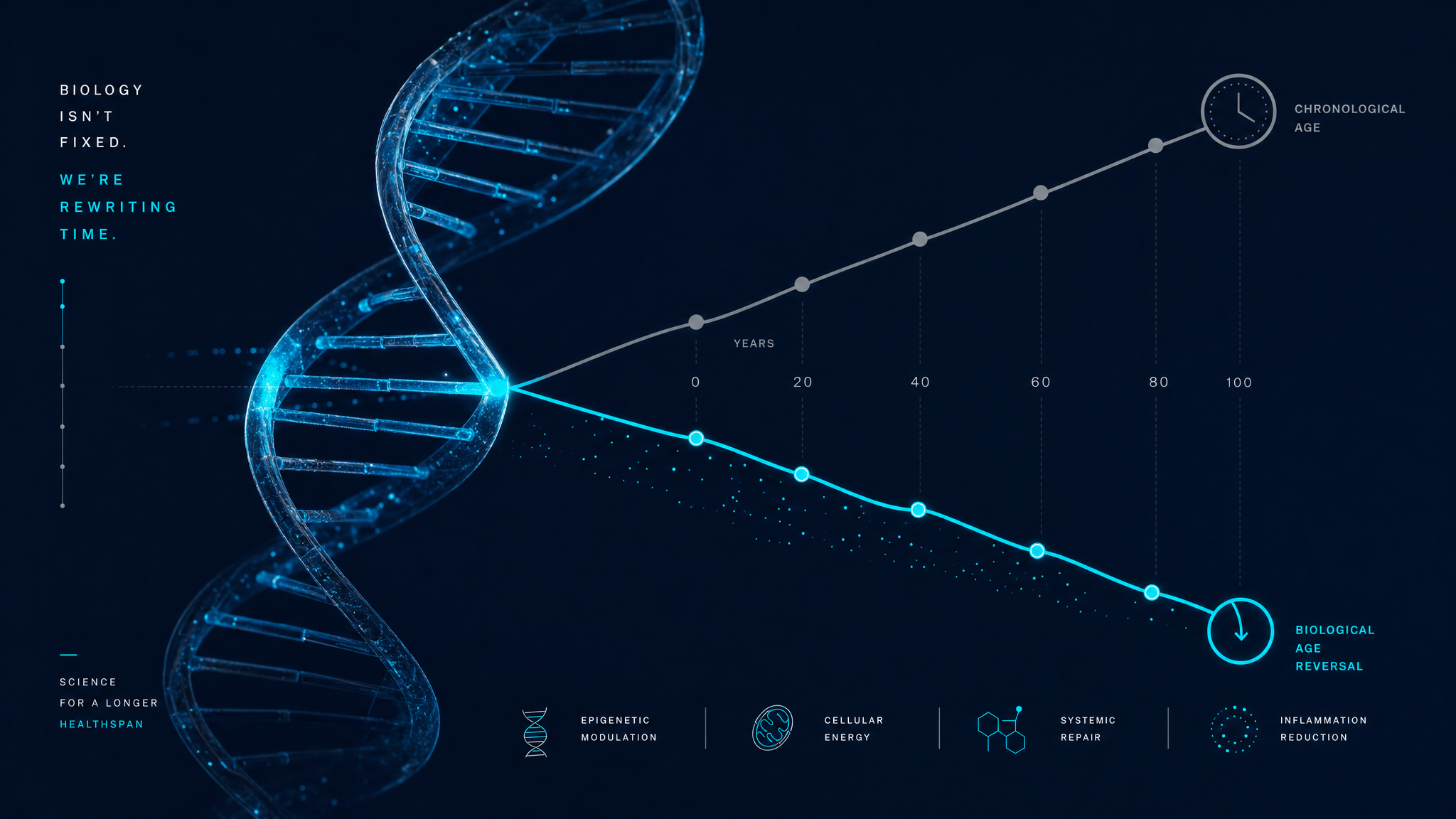
For most of medical history, “how old you are” meant one thing: how many years since your birth. But biology has never worked that way. Two people born in the same year can have cardiovascular systems a decade apart. Two cells in the same body age at different rates. The calendar has always been a bad proxy for biology — we just didn’t have a better one.
Now we do.
The field of biological age measurement — sometimes called “epigenetic clocking” — has produced a series of tools that measure how fast your cells are actually aging, independent of your birth year. The most validated of these, GrimAge and DunedinPACE, were developed by researchers at UCLA and Duke/Columbia respectively, and they work by reading changes to the chemical marks (methyl groups) attached to your DNA — marks that accumulate and shift in predictable patterns as cells age.
The result is a number: your pace of aging. DunedinPACE, for instance, outputs a figure around 1.0 for someone aging at the expected rate. A score of 0.8 means you’re aging at 80% of the biological clock. A score of 1.2 means you’re aging 20% faster than expected — and the data suggests you’ll feel, function, and likely die accordingly.
This is not theoretical. The GrimAge clock has been shown to predict all-cause mortality, cardiovascular disease, and cognitive decline more accurately than chronological age in studies of tens of thousands of people published in Aging (Albany NY) and Nature Communications.
“Biological age and chronological age diverge. The gap is measurable. And it moves.”
The Five Biomarkers Longevity Physicians Now Track
The epigenetic clocks require specialized testing — a handful of companies now offer direct-to-consumer versions; TruDiagnostic and Elysium Health are among the most validated. But they sit at the top of a biomarker stack that serious longevity physicians have largely standardized around five measures:
Epigenetic Age (GrimAge or DunedinPACE)
The anchor metric. Tests run $300–$500 and require a blood or saliva sample. Retested every 6–12 months. The single most predictive number of biological aging status available today.
VO2 Max
Your maximum oxygen uptake during exercise. It is the single strongest predictor of long-term mortality in the medical literature. A 1 MET increase in VO2 max is associated with a 13% reduction in all-cause mortality, per a landmark study in Circulation.
HOMA-IR (Fasting Insulin and Glucose)
A measure of insulin resistance so early that most people with pre-diabetes score “normal” on standard glucose panels. Insulin resistance is now linked to Alzheimer’s, cancer, cardiovascular disease, and accelerated epigenetic aging — yet the average primary care physician still doesn’t order it.
High-Sensitivity C-Reactive Protein (hsCRP)
The high-sensitivity version of the standard inflammation marker catches chronic low-grade inflammation that standard CRP misses. Chronic inflammation accelerates virtually every disease of aging. The test costs under $20.
GlycanAge
A newer entrant measuring IgG glycan profiles — the sugar molecules attached to your antibodies — which shift in measurable patterns with biological aging. Research out of the Genos Bioscience Institute has validated it against 10,000+ samples across multiple countries. Think of it as an immune system age score.
These five markers, taken together, give a clinician a multi-dimensional picture of how a body is actually aging. The results are often surprising — and frequently actionable.
The Trial That Proved You Can Turn the Clock Back
The most important study in this field is not widely known outside longevity medicine circles. In 2019, a small clinical trial funded in part by the National Institutes of Health and published in Aging Cell — the TRIIM trial, led by Dr. Gregory Fahy — treated nine men aged 51–65 with a combination of recombinant human growth hormone, metformin, and DHEA for one year.
The results were striking: on average, participants reversed their epigenetic age by 1.5 to 2.5 years, as measured by the Horvath clock. It was the first peer-reviewed human trial to demonstrate measurable epigenetic age reversal.
Since then, the evidence base has grown. The CALERIE-2 trial — the most rigorous caloric restriction study ever conducted in humans, published in Nature Aging in 2023 — showed that 25% caloric restriction for two years produced a measurable 2.4-year reduction in epigenetic age, as measured by DunedinPACE, in the intervention group versus controls.
The mechanisms include reduction in inflammation, improvement in insulin sensitivity, autophagy upregulation, and mTOR pathway modulation. The good news: none of these require a research protocol. They respond to lifestyle interventions that are already well-understood.
What the Data Says You Can Move
The longevity physicians who have been running these protocols for five to eight years — teams at Human Longevity Inc., Fountain Life, and a growing number of independent clinics — have accumulated enough patient data to identify what actually shifts the biomarkers.
The interventions with the strongest evidence base, ranked roughly by effect size:
- Cardiorespiratory fitness training (Zone 2 cardio + VO2 max intervals): consistent 3–4x weekly training has shown epigenetic age reductions equivalent to 3–7 years in observational data
- Protein-adequate, lower-glycemic nutrition: sufficient protein (0.7–1.0g per pound of lean body mass) combined with reduced ultra-processed food intake reliably improves HOMA-IR and hsCRP within 60–90 days
- Sleep optimization: 7–9 hours with consistent circadian timing reduces hsCRP and improves metabolic markers — sleep deprivation, by contrast, accelerates the DunedinPACE clock measurably within weeks
- Strength training: preserves lean mass, which correlates with metabolic age and is one of the strongest predictors of all-cause mortality past age 65
None of these are new. What’s new is that you can now test whether they’re working — precisely, repeatably, and at a biological level.
What This Means for You
The business leader who finishes this article and wants to act has a clear path: get tested, establish a baseline, and optimize against the numbers.
The two highest-ROI starting points are a VO2 max test (your doctor can order it, or any major longevity clinic offers it) and a HOMA-IR panel (ask your physician to add fasting insulin to your standard glucose draw). Together, these two tests cost under $100 and take 48 hours. The results will tell you more about how fast you’re aging than your birth certificate ever could.
The epigenetic tests — GrimAge, DunedinPACE — are the deeper signal, worth running annually once you have a baseline and a protocol in place.
The science is now precise enough to know: biological age and chronological age diverge. The gap is measurable. And it moves.